


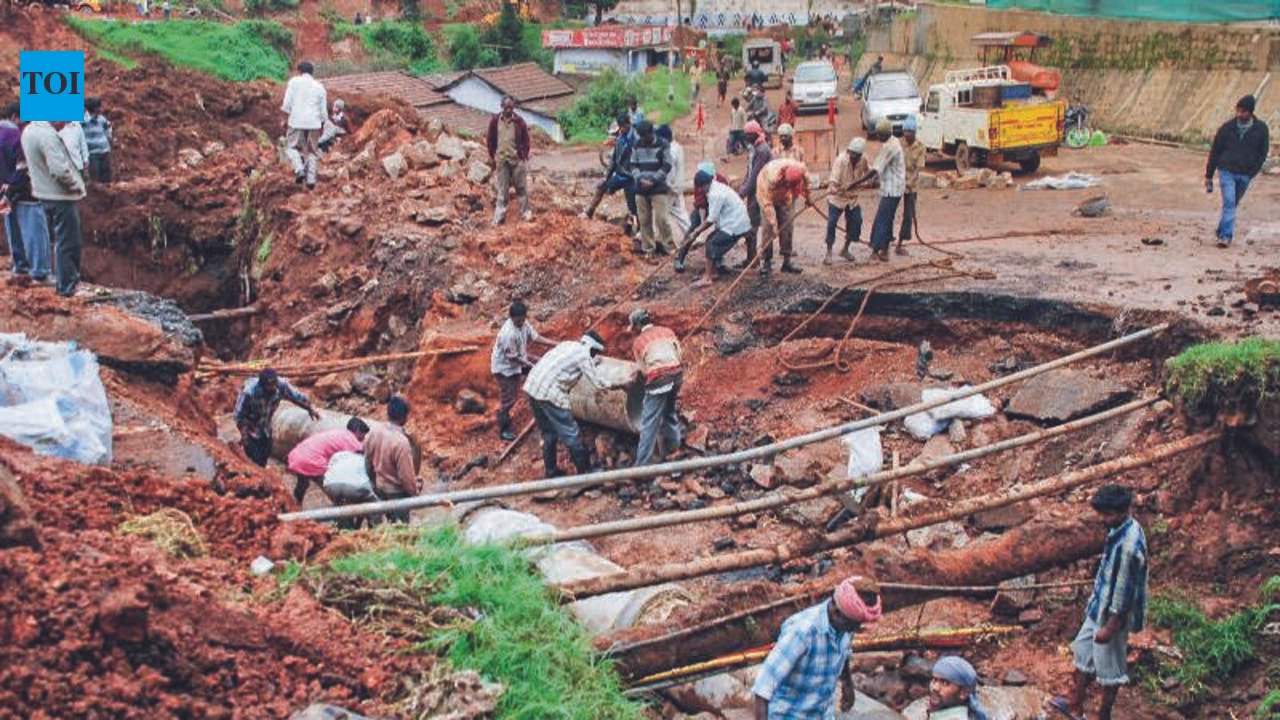
Has the Nilgiris become safer from landslides, or are officials misreading data? Nilgiris collector Lakshmi Bhavya Tanneeru recently said that a scientific reassessment by the Geological Survey of India (GSI) has reduced the number of vulnerable locations from 283 to 156, almost half. Environmentalists and officials from GSI are disputing the assessment saying the two figures measure two different things.“GSI completed its Nationwide Landslide Susceptibility Mapping-2025 (NLSM), covering 4.3 lakh sqkm across 19 states and Union Territories, providing high, moderate, and low-risk zones for disaster management and planning. We classified 156 locations as ‘highly susceptible. That does not mean the rest of the sites are no longer vulnerable. The district’s overall landslide risk has not reduced,” says a GSI official on condition of anonymity. “Our study assessed susceptibility across various zones throughout India, not just in the Nilgiris. NLSM is the only documented evidence provided by GSI.”Lakshmi counters that the earlier figure of 283 was not based on a “scientific” study. “It was established between 2017 and 2021, when lists of vulnerable locations were collected from local bodies and tahsildars. We later requested GSI for help to evaluate the existing vulnerable locations and provide a more accurate assessment. They have since narrowed it down to 156 locations.”The official adds that there has been “no reduction in the number of locations deemed vulnerable in the Nilgiris”.Lakshmi says that the reduction is partly because retaining walls (supporting structures against the landslipped areas) have been constructed in many areas. “The original 283 locations also included some road stretches, and certain protection structures have since been built. Ultimately, it has been refined to 156.”The Nilgiri Documentation Centre (NDC) has written to the Tamil Nadu revenue minister, about the misinterpretation of landslide data, which is “potentially dangerous”. NDC also disputes the collector’s statement that the earlier assessment by the revenue department was unscientific.“Data has been misinterpreted,” says Dharmalingam Venugopal, environmentalist and director of NDC. “GSI only identified 156 ‘highly’ vulnerable locations from the list of vulnerable spots. This only means that the disaster preparedness should be more at these locations. It does not state that the number of vulnerable locations has reduced.”The NDC has warned that understating the number of vulnerable locations could weaken disaster preparedness. “If the number of officially recognised vulnerable locations is reduced without scientific basis, some areas could receive less monitoring and lower priority for emergency response. It will also result in more unchecked real estate development in the Nilgiris. The district administration must make the GSI report of 2025 public.”Dharmalingam adds that in Jan 2025, the Nilgiris collector informed the National Green Tribunal that a nine-member technical expert committee had identified 283 landslide-prone locations in the district based on heavy rainfall during the southwest and northeast monsoons. “She had said that the committee was constituted specifically to conduct this study in the Nilgiris,” says Dharmalingam. “The study was conducted by the Nilgiris District Disaster Management Agency and the Revenue and Disaster Management Department in 2024. Why would these agencies have been entrusted with the study if they were not competent?”
