





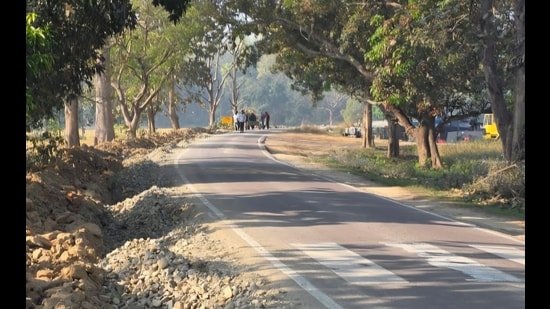
The ban on vehicular movement on the 25-km long Dudhwa-Gauriphanta road from dusk to dawn since Friday evening has evoked an objection by a Lucknow-based law practitioner.


High court advocate SM Haider Rizvi raised certain objections to the order on grounds that the apex court order had been misinterpreted as the Dudhwa-Gaurifanta road passed through the buffer zone, and not in core or critical tiger zone.
Rizvi in this connection submitted a representation to deputy director, DTR in which he urged him to stay or suspend the implementation of the said order or to withdraw it, besides requesting to commission a scientific study to assess the risk factors affecting wildlife due to vehicular traffic at night, and to find ways to regulate traffic through speed control, headlight control, convoy management if required.
When contacted, field director Dr H Rajamohan defended the order and said the vital Dudhwa-Gaurifanta road passed through sections of core/critical tiger zones and the buffer zone, adding a larger part fell within the core/critical zone.
He said in view of this and following the Supreme Court order, directives regarding vehicular traffic restriction during night hours were issued.
Deputy director Jagdish R, while talking to Hindustan Times over the phone, defended the order, saying that the order conformed to the Supreme Court directives.
He told Hindustan Times that “it was a misconception that Dudhwa-Gaurifanta road passes through the buffer zone of the Dudhwa tiger reserve.
“As per records, about 90% of the Dudhwa-Gaurifanta road passes through the core zone and a mere three to four km stretch fell within the buffer zone.”
He added that “after the Supreme Court order, hectic discussions and deliberations were carried out before issuing the Friday order.”
Deputy director, Dudhwa Tiger Reserve (DTR) Jagdish R issued an office order on Friday, citing the Supreme Court judgment and subsequent instructions from the UP principal secretary, environment, forest and climate change, through which he restricted all vehicular traffic on Dudhwa-Gaurifanta road except ambulances and emergency vehicles from 6:00 pm to 6:00 am everyday with immediate effect.
He also mentioned in his order that as an alternative, the Dudhwa-Chandanchowki road would remain functional round the clock.
Village heads fear inconveniences
The decision is likely to affect the people of over a dozen Tharu villages, which are located on the western side of the road.
Ram Naresh, village head of a tribal gram panchayat Chhediya Purab told Hindustan Times that “on Saturday I came to know of the order regarding vehicular ban at night.”
He said “among the 42 tribal villages in the area, residents of over a dozen villages including Banigawan, Singahiya (Serha Berha), Bankati, Masan Khambh, Suda, Sariyapara, Chhediya Purab, Chhediya Paschim, Balera were likely to be affected by the ban.
Ram Naresh added that “being located on the western side of Dudhwa-Gaurifanta road, they will now have to travel excess of minimum 13 to maximum 20 km to reach Chandan Chowki during their night journey while earlier, they directly reached Gaurifanta road to reach their destination.”
However, expressing satisfaction over the normal traffic on Dudhwa-Chandan Chowki road round the clock, Ram Naresh said this would ease their problems to some extent.
Another village head Chhail Bihari of Pipraula gram panchayat, agreed that some inconvenience due to the ban is natural.
According to him, “despite some distance, Dudhwa-Chandan Chowki road was much more convenient to travel as it was wider and smooth in comparison to Dudhwa-Gaurifanta road, which was a narrow single road.”
However, a Pallia-based trader who runs business in Gaurifanta area, was apprehensive over the restriction.
According to him, now they would have to close their shop to accommodate the travel restrictions and return home in time.


