



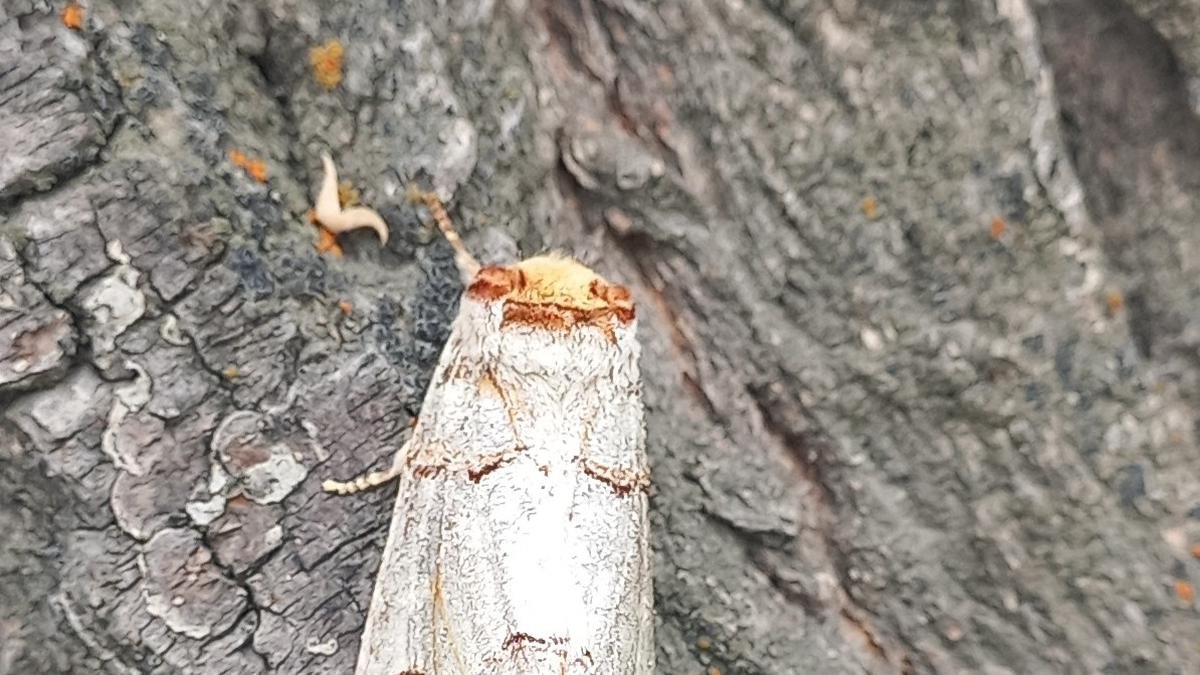
Ladakh, one of India’s most fragile landscapes, has a new set of invaders—a camouflaging moth that threatens the local farm-based economy.
A quartet of scientists has recorded the Phalera cf. bucephala, a moth native to parts of Africa, East Asia, and Europe, in the Suru Valley of Ladakh’s Kargil district. The ‘cf.’ is often used in a zoological name when experts suspect a new record or a similar, but not identical, species.
The scientist’s findings have stirred curiosity and concern because the larvae of this insect, commonly called the buff-tip moth, are voracious feeders and can strip an entire tree bare in a few weeks.
They are Mohd. Hussain of Government Degree College Zanskar; Nassreen Fatima Kacho of Krishi Vigyan Kendra Kargil-I, Khurbathang; Basharat Ali, Department of Zoology, Kargil Campus, Khumbathang; and Mohd. Ali of Aligarh Muslim University. Their study was published in the latest issue of the Journal of Threatened Taxa.
The study, conducted from June 2021 to August 2023, documents how the buff-tip moth may have established itself in the Trans-Himalayan region. The moth’s bark-like appearance helps it blend into the willow trees, which fuels India’s cricket bat industry.
The researchers found that the larvae of the seemingly unassuming invasive species can cause “complete defoliation of the host plant” within 30 days, highlighting the scale of the threat to the local vegetation.
According to the study, the moth appears to have developed a firm foothold in the Suru Valley, particularly on Salix alba, or white willow, a tree of immense local importance. Branches of this willow, locally known as Kralboo, are widely used as roofing material in Ladakhi houses, while the leaves and twigs serve as livestock fodder during harsh seasons.
More plants under attack
Willow is not the only plant that can end up as buff-tip moth-eaten. The study notes that the genus Phalera causes various degrees of infestation to other trees and shrubs, including poplar, sessile oak, apple, mountain ash, and walnut.
A factor behind the defoliation is the moth’s life cycle.
Adults emerge in mid-June, mate quickly, and lay clusters of up to 150 eggs. By July, the larvae hatch and begin feeding in groups, initially scraping the underside of the leaves before devouring them. By late summer, the caterpillars burrow underground to pupate, lying dormant through winter before emerging the following year.
The scientists note that this one-generation-per-year cycle may seem manageable, but the insect’s polyphagous nature (ability to feed on a wide range of plants) makes it particularly threatening. Sometimes, they crawl en masse on the ground in search of pupation sites, creating what locals describe as a nuisance during harvesting seasons.
Climate change link
What makes the study significant is its link to climate change.
Traditionally a cold desert, Ladakh has been experiencing gradual warming over the past two decades. Scientists suggest that these changing conditions are creating a more hospitable environment for invasive species in the region.
The study notes that insect pest outbreaks have increased in the region in recent years, with at least six other invasive species recorded earlier. The arrival of the buff-tip moth is, thus, seen as part of a broader ecological trend rather than an isolated event.
“During the survey, it was observed that the insect covers the entire valley from Minjee to Parkachik. Therefore, it may be declared an invasive pest and timely control measures should be implemented… without timely control measures, it may spread to other areas, including fruit-growing regions like Kargil City, Shilikchey, Hardas, and other adjoining areas of the Kargil district,” the study warns.
Published – May 08, 2026 01:17 pm IST


