






The field of molecular biology began when scientists attempted to answer a simple question: what molecule makes up the genetic material of an organism?
In the early 1900s, when the field was still in its infancy, there were two plausible candidates: nucleic acids (DNA and RNA) and proteins. At the time, proteins were the preferred candidates thanks to their diverse building blocks. All proteins (on the earth) are made up of some combination of 20 amino acids. Nucleic acids on the other hand were made up of just four nucleotides, leading to fewer molecular combinations than scientists believed were necessary for the carriers of heredity.
In 1944, three scientists, named Oswald Avery, Colin MacLeod, and Maclyn McCarty, showed that when you destroy the proteins and the RNA in certain pathogenic bacteria, something still remains — and mixing that mysterious something with non-pathogenic bacteria could ‘turn’ them into pathogenic ones.
But when you specifically destroy the DNA, the transformation does not happen.
The central dogma
The final nail in the coffin for proteins came in 1952 when Alfred Hershey and Martha Chase used bacteriophages — viruses that infect bacteria — and showed that when you radioactively label the phage DNA with phosphorus and its proteins with sulphur, you could find phosphorus inside the bacteria that the phage infected, but never the sulphur. The phosphorus was even present in subsequent generations of the phage produced by the infected bacteria, showing that DNA was the genetic material.
Soon afterwards, James Watson and Francis Crick proposed the double helical structure for DNA, and their model also explained how one strand helical strand can be used as a template to synthesise the other.
However, finding the answer to molecular biology’s foundational question opened a Pandora’s box of new questions. One of those questions was how the chemical information present in DNA was used to make proteins. At the time, scientists knew that proteins were the ultimate workhorses of the cell and performed all the cellular tasks. However, they did not know how the cell made proteins based on the instructions in the DNA.
In 1958, Francis Crick, with remarkable foresight, proposed what he called the “central dogma” of molecular biology. In a paper in the journal Symposia of the Society for Experimental Biology, Crick wrote that “once ‘information’ has passed into protein, it cannot get out again”. He further elaborated that the core principle behind the central dogma was that the “transfer of information from nucleic acid to nucleic acid, or from nucleic acid to protein, may be possible, but transfer from protein to protein or from protein to nucleic acid is impossible.”
Crick used the general term for DNA and RNA collectively, i.e. nucleic acid, rather than DNA alone, because by that time scientists knew that some viruses used RNA as the genetic material. In all other forms of life, RNA serves a different purpose.
An unbeaten rule
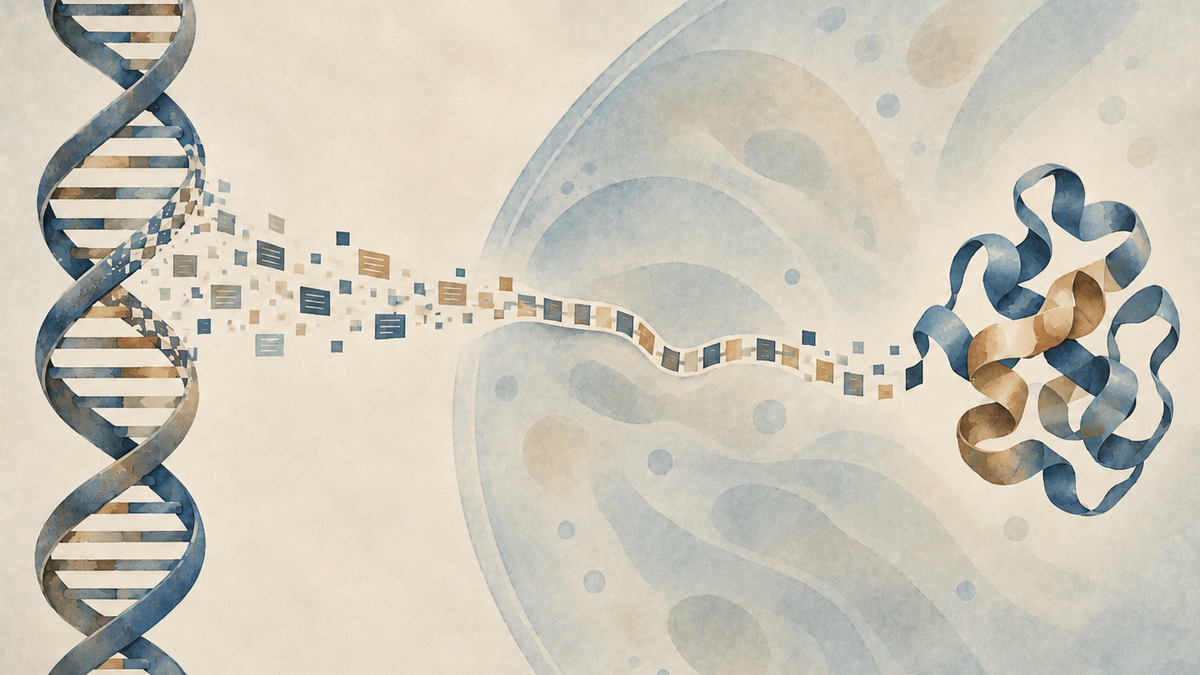
Today, we know that cells use the information in the DNA to make a messenger molecule, called mRNA, which then serves as the instruction manual for the cell to make proteins. The mRNA is a transient intermediate: a cell can stop making it if required and can degrade it if it needs to stop protein production. This way, the cell preserves the instructions in the DNA, makes a copy of the DNA into RNA, and makes protein from RNA.
But when Crick suggested the central dogma, scientists did not fully understand the role of mRNA. The DNA to RNA to protein flow sequence was only elucidated in 1961, and that sequence itself came to be known as the central dogma of molecular biology.
But one wrinkle turned up in 1970. U.S. biologists Howard Temin and David Baltimore reported the discovery of retroviruses — a new family of viruses that used RNA as the genetic material, but then made a DNA copy of it using an enzyme called reverse transcriptase, then mixed this DNA with the DNA of the host. The viruses then continued the ‘DNA to RNA to protein’ sequence. However, the starting point was RNA, and technically, information was flowing backwards along the sequence before it flowed in the conventional way, supposedly violating the central dogma.
The discovery stirred significant debate in the scientific community, and researchers published several articles along the theme of how the central dogma had been violated. Weeks later, Crick himself wrote another paper explaining in greater detail how his guidelines for the central dogma still held, and how, even in his original 1958 paper, he had not ruled out the transfer of information within nucleic acids. He emphasised that in order to violate the central dogma, one had to find information flowing from proteins to proteins or from proteins back to either one of the nucleic acids, i.e. DNA or RNA. It was a credible argument.
Thus, for 69 years, Crick’s central dogma has been unchallenged. There have been some interesting deviations but none completely broke the rule.
A novel mechanism
Now, however, two new papers in the journals Cell and Science have reported finding a new family of bacterial reverse transcriptases. These enzymes direct cells to synthesise a DNA molecule without a template. Usually, reverse transcriptases use an RNA molecule as a template and make a DNA copy of it. But the new studies said these specific bacterial reverse transcriptases could synthesise DNA without any template at all. Instead, the enzyme itself provided the information needed to determine the sequence of the DNA it generates.
These enzymes belong to a class called defence-associated reverse transcriptases (DRTs). These enzymes help bacteria fight off bacteriophages by producing unusual DNA molecules that trigger defence mechanisms, stopping the invading phage from successfully reproducing. There are several ways in which the DNA produced by DRTs stop a phage infection. Some interfere with essential phage proteins. Some activate other bacterial defence systems. Others cause the infected cell to shut itself down before the phage can multiply and spread.
The new family, called DRT3, described in these two papers, follows a novel mechanism to achieve the last outcome. According to the papers, DRT3 contains two enzymes — DRT3a and DRT3b — that work together to produce the two strands of a DNA molecule.
When this DNA accumulates inside the bacterial cell, it causes the cell to shut down and enter a dormant state, preventing the phage from completing its replication. In normal circumstances, the bacterium keeps this system under control by using a separate set of enzymes that acts as a brake. But when a phage infects the cell, it makes proteins that inhibit these brakes, causing the DNA made by DRT3 to build up, disrupting the bacterial cell and stopping the phage from spreading.
For seven decades, the central dogma postulated by Francis Crick (1916-2004) has remained unchallenged.
| Photo Credit:
Marc Lieberman (CC BY)
Unprecedented in molecular biology
But the most intriguing aspect of the papers was how the DRT3 system made the two DNA strands. DRT3a makes the first strand of the DNA using a bacterial RNA molecule as a template, as reverse transcriptases normally do. But the second enzyme, DRT3b, makes the second strand without using any template at all. Instead, the protein itself dictates the order of the nucleotides that determines the DNA sequence.
Interestingly, enzymes that can make DNA without a template are not new in molecular biology. One example is terminal deoxynucleotidyl transferase, which adds nucleotides to the ends of DNA without using a template. But the transferase does not add nucleotides in any specific order: if you mixed it with all the four nucleotides that make DNA in a tube, the transferase will produce a new sequence each time.
DRT3b is different primarily in this regard. Although it also makes DNA without a nucleic-acid template, it does not produce a random sequence. The protein itself dictates which nucleotide is added next, producing an ordered sequence of two alternating nucleotides cytosine (C) and adenine (A), i.e. CACACACA… Despite the enzyme’s product being a simple two base pair repeat, the idea of a protein that can produce a defined DNA sequence without a nucleic acid template is unprecedented in molecular biology.
The discovery of a protein that can, by itself, dictate the sequence of nucleic acid has once again caused a stir in the scientific community. Commentaries accompanying the work have highlighted the unusual nature of the finding and its implications for one of the foundational ideas of molecular biology. Some have gone so far as to suggest that the discovery challenges the central dogma because it appears to demonstrate information flowing from a protein back into a nucleic acid — which is just what Francis Crick had said was impossible.
However, it is important to note that while the study represents an important conceptual advance, in no way does it overturn the central dogma. The core principle of the central dogma deals with the information lost when it is passed from nucleic acid to protein. That is, once a cell has made a protein, the protein’s amino-acid sequence will not contain enough information for the cell to rebuild the DNA sequence from which it originated. This is because there are many different DNA sequences that can encode the same protein sequence.
DRT3b also does not violate this fundamental principle governing information loss. At most, it puts a toe over the line; it does not cross it. But it does illustrate one point very beautifully: that nature is far more creative than the rules we use to describe it.
Arun Panchapakesan is an assistant professor at the Y.R. Gaitonde Centre for AIDS Research and Education, Chennai.


