






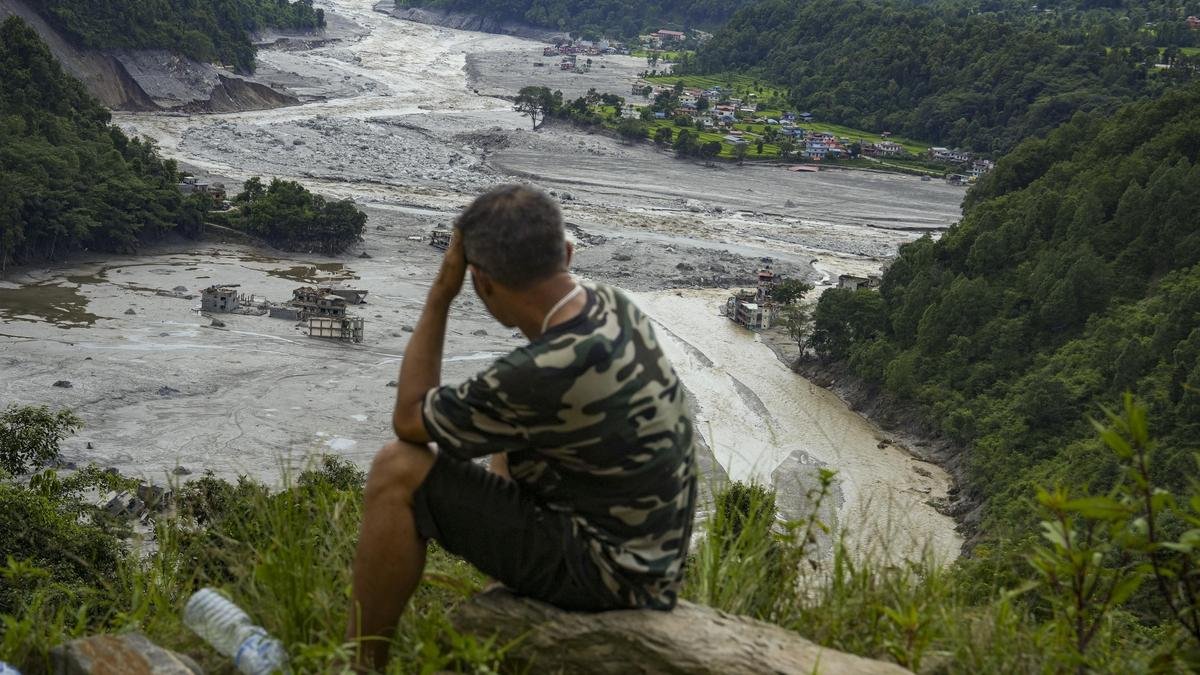
The wake of the August 26 flash floods in Nepal, which devastated several towns and villages, killed more than a thousand people, and left several more unaccounted for, follows a familiar pattern that emerged after the Chamoli floods, the South Lhonak Lake disaster, and the Thame floods: a call to rethink development in the region in light of risks exacerbated by climate change.
At the centre of this narrative sits hydroelectric power, whose infrastructure has received the region’s most attention and investment.
Estimates have revealed that the latest catastrophe extensively damaged at least 13 hydroelectric power projects along the Bhotekoshi and Trishuli river corridors and one solar power plant. According to the United Nations Development Programme, about 15 power projects with a planned capacity of 470 MW that were under construction were also damaged.
Sediment problem
While the flood caught everyone by surprise, that there was a flood risk was not new information, with the surging waters only serving a reminder on the challenges of development in the Hindu Kush Himalaya. Between 2014 and 2024, the latest year for which data is available with the International Centre for Integrated Mountain Development (ICIMOD), the region reported more than 2,500 landslides, 258 earthquakes, and several glacial lake outburst floods.
As countries in this part of the Himalaya tap into hydropower, anomalous weather now demands more resilience.
“Hydropower plants don’t have an issue dealing with all the water coming. You can always release water that you cannot use,” Jakob Steiner, a geoscientist at the University of Graz in Austria who is currently based in Bangladesh. “There are other things it cannot so easily deal with … and one thing is more sediment.”
“Himalayan rivers in the monsoon carry exceptionally high sediment loads. But we tend to measure water flow and volume, not sediment load in our rivers,” Kathmandu-based water and climate analyst Ajaya Dixit said. “Sediment load is only sporadically monitored, and its threat is downplayed to the extent that the threat of sediment has not been adequately considered in the design of river infrastructure, especially in the case of projects involving reservoirs.”
In a 2023 report, ICIMOD noted that the suspended sediment load from the Hindu Kush Himalaya’s headwaters has increased by around 80% in the last six decades thanks to heavier rainfall, accelerating glacier melt, and thawing permafrost.
The increasing sediment levels in turn affects reservoirs’ room to hold water and thus the amount of power the attached turbines can produce. Per a report published by the International Hydropower Association on the Jhimruk hydroelectric power project, most of the sediment is hard minerals like quartz and feldspar, which can wear uncoated turbines and other parts of the power infrastructure away.
This renders maintenance and repair work more frequent, further increasing costs.
Expecting change
As facilities fail, the risk goes beyond lost investments to endangering the lives of the people working at the plant.
“The tragedy of these plants is also, again, a climate justice one. In Chamoli, many of the workers who were working in Tapovan were from somewhere else completely, they were relatively poor, who had no agency, and they were exposed to something that they could not calculate,” Dr. Steiner said. “And to some degree, you have the same here” in Nepal.
According to media reports, at least 900 workers were estimated trapped in Nepal’s hydropower plants. After the 2021 Chamoli disaster, around 140 of the 200 killed or missing were reportedly workers at the Tapovan facility.
Following the latest disaster, two ethnic communities in Sikkim have called on the Centre to halt all new and proposed projects in the Himalayan State.
”In a way,” Dr. Steiner added, “I’m certain that things are going to change now, but then I also thought that things were going to change after Chamoli. I would rather say they haven’t changed as much as we would have hoped.”
Outliers no more
But whether or not the Centre responds, Nepal’s options are more limited: over 90% of its power needs are currently met by hydroelectricity. The mountain country is estimated to have around 83,000 MW of technical hydroelectric potential, with an installed capacity of 3,435 MW by 2025. Some 4,063 MW and 16,029 MW of its hydropower plants were also under construction and planned for construction, respectively. Electricity exports to India and Bangladesh through these plants also brought in about $200 million as revenue in FY2025-26, which the flash floods are likely to have disrupted.
Its energy ministry spokesperson has also said the country will buy electricity from India to cover shortages in the coming months.
“There are now other renewable alternatives and hybrid decentralised systems available,” per Mr. Dixit. “We need to rethink our broader energy system, and within that context, the role of hydroelectric power. At the very least, we need a risk-informed approach to designing and operating these energy systems so that the risks they face are not externalised onto the economy, society, and people.”
While the August 26 floods were exceptional, he added, such events must now be considered a real possibility rather than outliers — and that areas across the Hindu Kush Himalaya region need significant support in developing the skills and institutional capacity for effective early warning systems.
“This disaster demonstrates that our highest-elevation regions are undergoing profound changes that we do not yet fully comprehend and will require us to change how we live in and live with these mountains,” Mr. Dixit said. “These nations must come together and seriously begin to discuss ways of designing infrastructure that resonate with the emerging reality of a changing climate and environment.”
With inputs from Gandla Sneha, intern with The Hindu data team.
sambavi.p@thehindu.co.in
Published – September 10, 2026 08:30 am IST


