



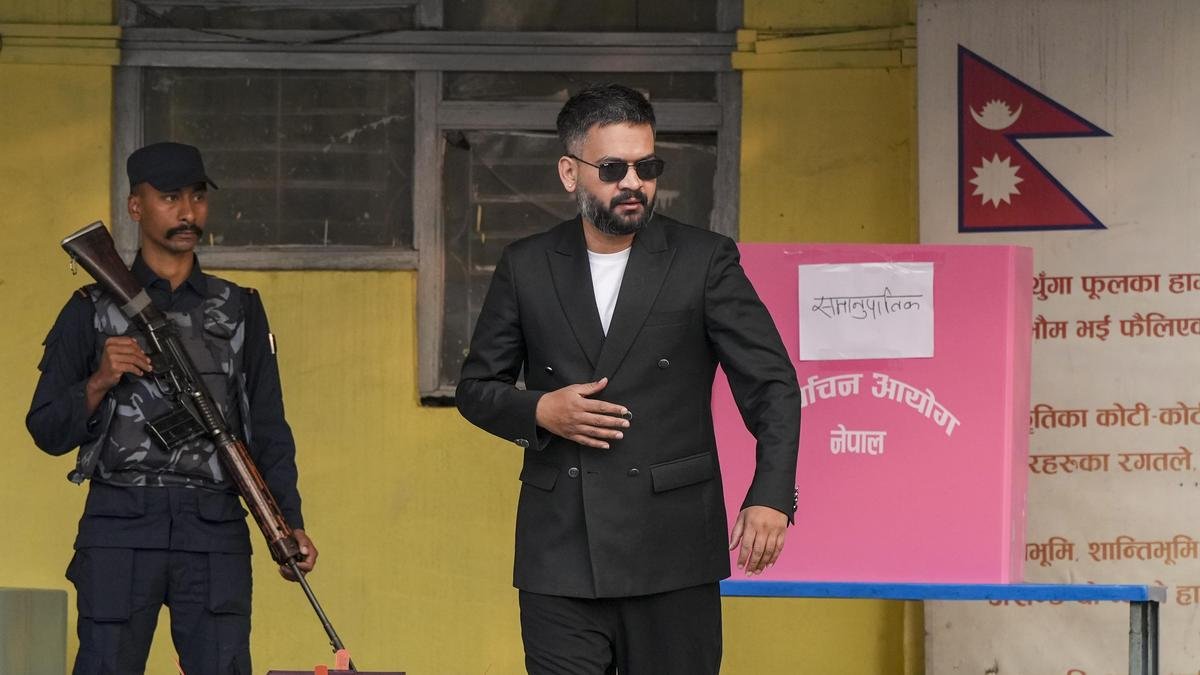
Rastriya Swatantra Party’s (RSP) prime ministerial candidate and former Kathmandu Mayor Balendra Shah while casting his vote in the Nepal general elections on March 5, 2026.
| Photo Credit: PTI
While vote counting continues in Nepal on Friday (March 6, 2026), the Rastriya Swatantra Party (RSP) stretched its lead to 101 constituencies under the first-past-the-post (FPTP) system.
The RSP’s prime ministerial candidate Balendra Shah widened his lead to 11,945 votes, leaving former Prime Minister K.P. Sharma Oli behind at 2,692. Jhapa-5, Mr. Oli’s home turf, has 163,379 registered voters.
Meanwhile, the Nepali Congress and Mr. Oli’s party, the CPN-UML, are trailing in 11 and 12 constituencies, respectively.
The RSP is also making gains under the proportional representation (PR) system, securing 11,562 votes. Of the 19,728 PR votes counted, the RSP’s share stands at 58%.
The Nepali Congress has 3,664 votes (18%), followed by the Rastriya Prajatantra Party with 1,752 votes (8.88%).
RSP’s Ranju Neupane and Biraj Bhakta Shrestha have already been declared winners in Kathmandu-1 and Kathmandu-8, respectively.
Also Read: Balendra Shah | Enigmatic mayor
People of Nepal cast their ballots on March 5 for a new House of Representatives, which was dissolved after the September Gen-Z protests.
Nepal elects 275 members to the House of Representatives — 165 under the FPTP system and 110 under the PR system.
PR seats are allocated based on the nationwide vote shares of parties, using the Sainte-Lague method.
Published – March 06, 2026 08:19 am IST


