



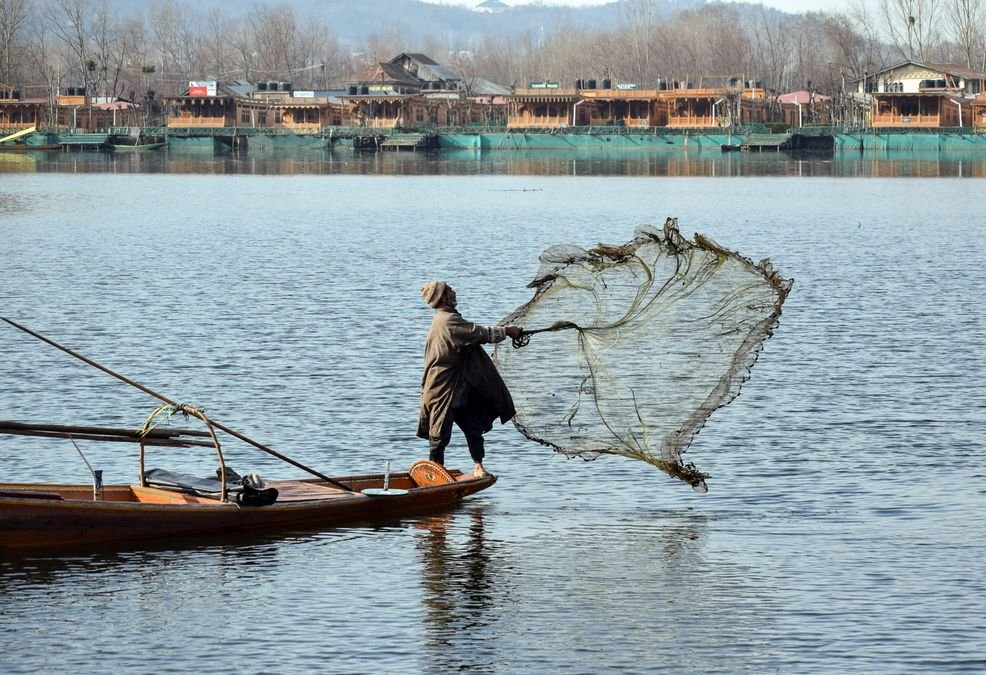
Srinagar, Oct 05: The fish community of Dal Lake appears to be tilting increasingly towards exotic species, with the common carp emerging as the overwhelming presence while native fish account for a much smaller share of the catch, according to a new study.
The study, “Diversity and Relative Abundance of Native and Exotic Fishes of Dal Lake, Srinagar, Kashmir”, found that the exotic common carp (Cyprinus carpio) constituted 59 per cent of the total fish catch, raising concerns over the changing ecological balance of one of Kashmir’s most important urban water bodies.
Conducted between March and May 2026, the study surveyed three locations—Hazratbal, Telbal Nallah and Char Chinari—and recorded 305 fish specimens belonging to five species. The study was conducted by Khunsa Fayaz, an undergraduate student at Government College for Women, Nawakadal, under the guidance of Prof Mohd Shafi Bhat, Assistant Professor, Department of Zoology, GCW Nawakadal.
“Three of the species were native to the region: Schizothorax esocinus, Schizothorax curvifrons and Crossocheilus diplochilus. The two non-native species recorded were common carp (Cyprinus carpio) and Carassius Carassius,” the study reads. “The distribution of the catch revealed a pronounced imbalance. Common carp accounted for 59 per cent, followed by native S. esocinus at 19 per cent, native S. curvifrons at 13 per cent, exotic C. carassius at 6 per cent and native C. diplochilus at only 3 per cent.”
Taken together, the three native species represented just 35 per cent of the recorded catch, compared with 65 per cent for the two exotic species.
The study found that the dominance of common carp was not static during the survey period. Its relative abundance increased from 56 per cent in March to 63 per cent in May.
“The highest abundance of common carp was recorded at Telbal Nallah, while Hazratbal showed comparatively greater diversity and a more balanced fish assemblage,” according to the study.
Researchers assessed the fish community using several ecological indicators. The Shannon-Wiener Diversity Index ranged from 1.0 to 1.3, indicating moderate diversity, while the Simpson’s Dominance Index ranged between 0.4 and 0.5, pointing to the dominance of a relatively small number of species.
The Margalef Species Richness Index remained at 0.9 during the study period. The researchers said the relatively lower abundance of native Schizothorax species may reflect the cumulative impact of several pressures affecting Dal Lake. “These include pollution, eutrophication, sedimentation, habitat degradation and increasing anthropogenic pressure, alongside competition from exotic fish,” the researchers said.
The findings do not establish a direct cause-and-effect relationship between exotic carp and the decline in native fish abundance, the researchers noted, but the strong dominance of common carp highlights the need for closer monitoring of the lake’s fish community. Native fish conservation needs closer monitoring, the researchers advocated.
The study recommends continuous monitoring of fish populations, pollution control, habitat restoration, conservation of native species and sustainable fisheries management to protect the lake’s aquatic biodiversity.
The researchers stressed the importance of maintaining a healthier balance between native and exotic fish populations as part of wider efforts to protect Dal Lake.
The findings also point to the need for longer-term studies covering more sampling locations and different seasons to establish whether the pattern observed during the three-month survey represents a broader, sustained change in the lake’s fish community.
For now, however, the numbers offer a stark snapshot: nearly six out of every 10 fish recorded in the survey were common carp, while three native species together accounted for little more than a third of the catch.
