


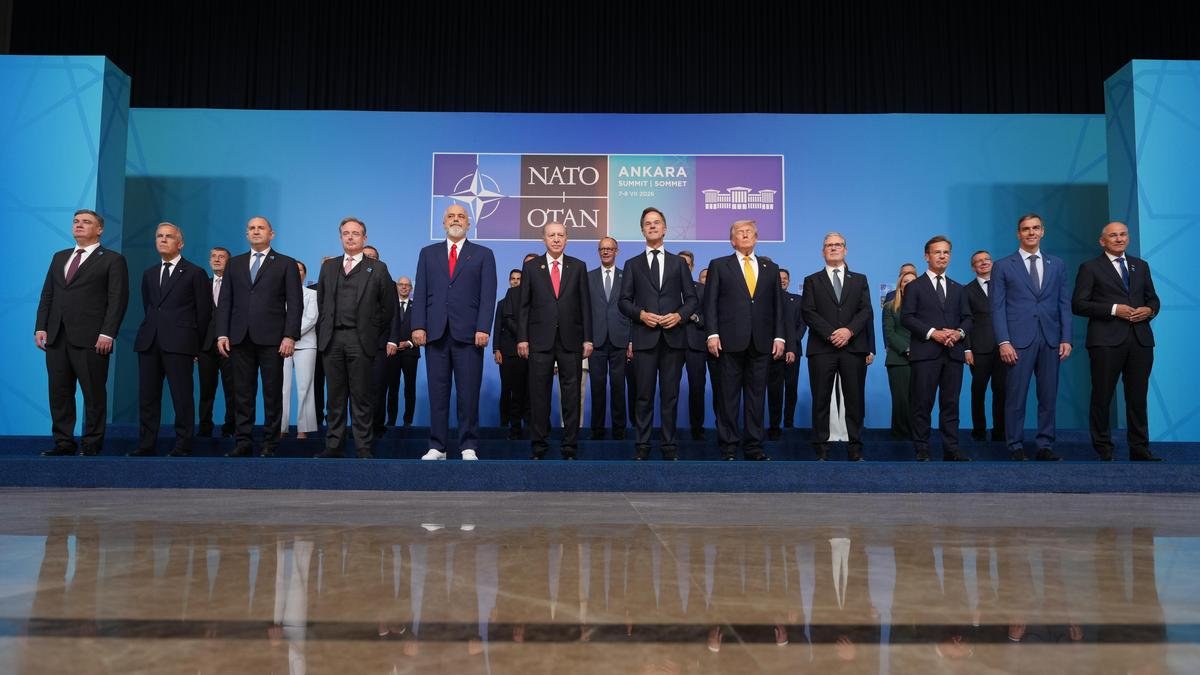
For more than seven decades, the North Atlantic Treaty Organisation (NATO) has been the cornerstone of Western security architecture. Founded in 1949 as a bulwark against Soviet expansion into capitalist Europe, the 32-member military alliance outlived its original purpose by morphing into a vehicle for American power projection not just in Europe but across the globe.
In the post-Cold War era, challenges to NATO have come from within and without. The most obvious external threat has been Russia, which sought to check its continued eastward expansion by invading Ukraine. Today, the Russia-Ukraine war, in its fifth year, remains NATO’s foremost priority in the context of its foundational mandate of European security. The threat from within, however, has been more insidious. It can be summed up in three words: the Trump Presidency.
Both in his first and current term, President Donald Trump has questioned NATO’s utility for the U.S., and even threatened to exit the alliance. He believes that while NATO’s capabilities, funds, leadership and infrastructure were overwhelmingly American, the U.S. gets out of the alliance far less than it puts into it, in contrast to its European allies, who got to reap its benefits while paying a fraction of the costs. In his deal-centric thinking, NATO seemed like a bad deal for the US.
Mr. Trump’s simmering resentment appeared to reach a boiling point in April, when his NATO allies ignored his call to join the U.S. in its war of choice against Iran. Notably, Spain and the U.K. (initially) refused access to their military bases for U.S. warplanes, while France refused over-flight rights. Mr. Trump lashed out, calling NATO a “paper tiger” without the U.S. He saw it as NATO’s betrayal of the U.S., stating: “We’ve been there automatically, including Ukraine. Ukraine wasn’t our problem. It was a test, and we were there for them, and we would always have been there for them. They weren’t there for us.”
U.S. Secretary of State Marco Rubio went further: “If NATO is just about us defending Europe if they’re attacked but then denying us basing rights when we need them, that’s not a very good arrangement. That’s a hard one to stay engaged in and say this is good for the United States. So all of that is going to have to be re-examined.”
U.S. drawdown
This was followed, in June, by a New York Times story based on a leaked communication, which laid out plans for a significant drawdown of U.S. commitments in NATO’s Europe operations. According to the report, the Trump administration planned to “pull a third of the fighter jets it provides NATO for Europe”, along with “reallocating a missile-launching submarine and an aircraft carrier, along with several warships”. These developments set alarm bells ringing in Europe’s strategic corridors, as they seemed to erode the lynchpin of their collective security — the pledge of mutual defence under Article 5. Could they still rely on the U.S. to rescue them in the face of an attack?
The U.S. has also scaled down its assistance to the Ukraine war effort, making European allies the principal financier. At the same time, Mr. Trump has been pushing NATO’s European members to spend 5% of their GDP on defence (3.5% on core military requirements plus 1.5% on critical infrastructure). But only five of NATO’s 32 members are on track to meet this target in 2026.
Other sources of intra-NATO tensions include Mr. Trump’s obsession with annexing Greenland, a sovereign territory of fellow NATO member Denmark. Mr. Trump also feels frustrated that European security considerations are coming in the way of his developing a more congenial relationship with Russian President Vladimir Putin. Tensions on this front came to the fore in early 2025 when he tried to broker an end to the Ukraine war by directly speaking to Mr. Putin.
For their part, NATO’s European members have tried to play a balancing act. There is now a clear-eyed recognition that the U.S. can no longer be expected to continue as the sole pillar of NATO. The constitutive principle of NATO is the unconditional security guarantee. But Mr. Trump’s repeated attempts to make it conditional — linking it to members “paying up”, or to their ‘loyalty’ — has cast a pall of uncertainty on that guarantee, prompting European nations to consider autonomy and self-reliance. But those are expensive propositions that need time, and vast investments, to fructify. In the interim, the European allies cannot do without continued U.S. engagement in NATO operations which, to their mind, calls for a strategy of placating Mr. Trump selectively and flattering him indiscriminately.
Interim strategy
This strategy, which was on full display at the NATO summit that unfolded in Ankara, Turkiye, on July 7-8, appears to have worked rather well. European leaders, led by NATO Secretary-General Mark Rutte, a canny Dutch politician, showcased their plans to ramp up spending on military hardware and investments in expanding their defence industrial base. While sticking to their decision not to get their hands dirty in the Strait of Hormuz, they ensured that the summit declaration reiterated Mr. Trump’s stated goals in the Iran war: Iran must never acquire nuclear weapons, and freedom of navigation must be restored in the Strait of Hormuz.
For good measure, they also pledged $50 billion in new defence procurements — a bonanza for America’s military-industrial complex — and €70 billion worth of military assistance to Ukraine. In return, they got Mr. Trump to undersign an “ironclad commitment” to Article 5. Notwithstanding his usual litany of complaints, which he revived again in Ankara, Mr. Trump, by the end of the summit, was pleased by the “tremendous love” he received from his European allies.
But the tensions, though papered over in Ankara, haven’t gone away. The European allies’ reluctance to join U.S. military operations against Iran points to a fundamental divergence in how the two see NATO. While Europeans view NATO as a “defensive” force that is region-specific (trans-Atlantic), Mr. Trump sees it more broadly as an extension of U.S. military capabilities that should be deployable globally. Hence his expectation of unconditional “loyalty” from his European allies in exchange for the unconditional security guarantee the U.S. provides them through NATO.
To be fair, NATO has never been a one-way street as Mr. Trump seems to believe. For nearly eight decades, the U.S. has enjoyed unfettered access to air bases, military networks, infrastructure and logistical support across Europe, without which its various campaigns in West Asia and elsewhere over this period would have been impossible. It has also enjoyed the support of its European allies on most foreign policy issues, including when they have been controversial, and the military leadership of most nations in the continent. But with the U.S. increasingly prioritising the Pacific theatre, a greater European role in NATO was inevitable.
For the medium-term, in the words of the Ankara declaration, “a stronger Europe within a stronger NATO”, is the stated objective, wherein European allies and Canada would be “assuming greater responsibility for the Alliance’s defence”. But over the long-run, Europe would want to develop its military capabilities to a level where, firstly, it provides credible deterrence against Russia even in a scenario of strategic ambiguity on the matter of American intervention in the face of a credible threat, and second, secures the autonomy necessary to safeguard its own political interests when they come up against American coercion.
Published – July 12, 2026 02:00 am IST
