


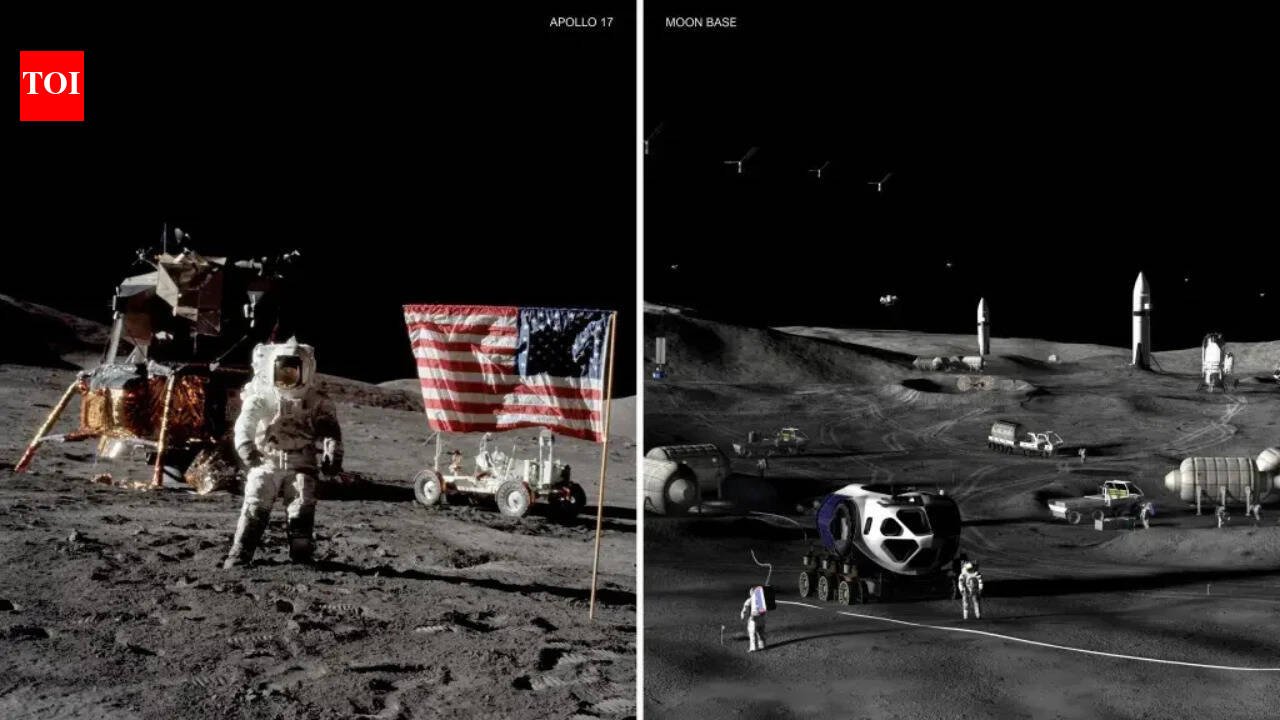
For millennia, humans have looked up at the Moon and wondered what it would be like to live there. It has tugged at the human imagination — fueling myths, inspiring poems and some of our boldest scientific dreams.Yet despite landing astronauts on its surface more than half a century ago, the Moon has remained a place we visit, not a place where we can live.NASA now wants to change all that.On July 20, 1969, astronaut Neil Armstrong put his left foot on the lunar surface and famously declared, “That’s one small step for [a] man, one giant leap for mankind.”In March this year, the agency unveiled an audacious plan to build a permanent Moonbase near the south pole — an evolving, resilient outpost designed to host astronauts for months and to grow into something far bigger.The proposed settlement will not resemble the gleaming science‑fiction cities of film. Instead, NASA envisions a spreading network of habitats, modular power systems, autonomous vehicles, communication relays and robotic explorers fanning out across hundreds of rugged square miles.The strategy swaps one‑off spectacle for relentless execution: test fast, learn faster, scale smart. And if the plan succeeds, it could become humanity’s first long-term home beyond Earth.Announcing the ambitious vision, NASA chief Jared Isaacman delivered a clear message: “The goal is not just to reach the Moon, but to stay. America will never give up the Moon again.”Why the south pole?NASA’s entire strategy revolves around one region: the Moon’s south pole. Unlike much of the lunar surface, parts of the south pole receive sunlight for extended periods. Nearby craters also remain permanently shadowed, creating some of the coldest locations in the Solar System.Scientists believe these icy deposits could become one of the most valuable resources for future lunar explorers. If extracted successfully, it could provide:
- Drinking water for astronauts
- Oxygen for breathing
- Hydrogen and oxygen for rocket fuel
The ability to generate essential resources on the Moon would reduce dependence on costly supplies launched from Earth and could help support longer missions. For NASA, the south pole is more than just a landing site — it is a region that may hold the key to establishing a sustainable human presence on the lunar surface and enabling future journeys deeper into space.
The Three-Phase PlanNASA intends to build the Moonbase gradually over more than a decade.1. Phase One: Learn, Test, Build (Now–2029)This phase focuses on robotic missions.NASA plans up to 25 missions and 21 lunar landings involving rovers, drones, satellites and technology demonstrations.The program also focuses on early infrastructure testing, including power, communication, navigation, and nuclear radioisotope heater technologies for surviving the lunar night.Around four tons of payload will be delivered as the first step toward establishing a functional Moon base.2. Phase Two: Early Habitation (2029–2032)The focus shifts to construction.It includes deploying expanded solar power systems along with early nuclear surface power options such as fission reactors and radioisotope-based units to ensure continuous energy supply through the lunar night.It also emphasises building the communication backbone and logistics capacity for long-term presence.Phase 2 overview includes a series of up to 24 cargo landings that could deliver around 60 tons of equipment using a mix of lander classes.
3. Phase Three: Permanent Presence (2032 and Beyond)The final stage aims to establish a sustained human presence.It introduces larger, more habitable modules designed for extended crew living and scientific operations, alongside reliable fission-based surface power systems.Combined with reusable heavy-lift transport enabling up to 38 tons of annual cargo delivery, this phase supports sustained operations for habitats, power infrastructure, and expanded scientific outposts.What will the Moonbase actually look like?Early versions of the Moonbase may consist of:
- Crew habitats
- Solar and nuclear power systems
- Cargo and logistics infrastructure
- Robotic and autonomous systems
- Surface mobility vehicles
Over time, these individual systems would expand into a larger interconnected settlement. NASA expects astronauts, robots and autonomous vehicles to work together continuously across the lunar surface.The agency’s long-term plans suggest the operational area could eventually stretch across hundreds of square miles.The major components1. The MoonFall drones- One of the most unusual components of NASA’s lunar exploration plan is a system called MoonFall. These are not ordinary drones. Because the Moon has almost no atmosphere, traditional drones, which rely on rotors to generate lift, cannot fly there.Instead, MoonFall vehicles will use controlled propulsion systems to make short, precise “hops” across the lunar surface. NASA plans to deploy four such vehicles during the early stages of lunar exploration.Their job will be to:
- Explore steep terrain
- Survey shadowed craters
- Search for resources
- Map future construction zones
- Identify safe landing sites
2. Lunar Terrain Vehicles- Apollo astronauts explored only relatively small areas around their landing sites. NASA’s future Moonbase requires a much larger transportation network.To achieve that, the agency is developing Lunar Terrain Vehicles, or LTVs. These next-generation rovers are expected to operate both autonomously and with astronauts onboard.According to NASA’s plans, some vehicles could travel hundreds of miles across the lunar surface while carrying equipment, scientific instruments and crew members.The hidden challenges1. One of the greatest obstacles to long-term life on the Moon may not be radiation or freezing temperatures- it is lunar dust.Unlike dust on Earth, lunar dust is extremely fine, abrasive and electrostatically charged, allowing it to cling stubbornly to spacesuits, equipment and vehicles. As NASA plans for a permanent lunar presence, protecting habitats, spacesuits and critical infrastructure from lunar dust will be essential for ensuring astronaut safety and mission success.2. Darkness presents another major challenge.A single lunar night lasts about 14 Earth days, during which temperatures can plunge to nearly minus 170 degrees Celsius. Such extreme conditions pose a serious threat to habitats, equipment and life-support systems.To address this challenge, NASA in its phase one is expected to begin with deployment of systems capable of self-supported power generation and survival along with demonstrations of Radioisotope Heater Units (RHUs).RHUs are designed to help protect lunar surface assets and survive the extreme conditions of the lunar South Pole, where long periods of darkness and severe cold can challenge extended operations.More than a Moon missionNASA’s programme is not just about returning astronauts to the Moon. The long-term goal is to establish a sustained human presence on the lunar surface, unlock valuable resources, test technologies for future Mars missions and maintain leadership in a new era of space exploration.1. Unlocking lunar resources- Scientists believe the Moon contains valuable resources, including water ice, rare earth elements, iron, titanium and helium. Water ice near the lunar south pole could provide drinking water, oxygen and even rocket fuel for future missions.
2. Staying ahead in the new space race- With China aiming to land astronauts on the Moon by 2030, NASA sees a sustained lunar presence as strategically important. Both countries are focusing on resource-rich regions, particularly around the Moon’s south pole.3. Preparing for missions to Mars- NASA plans to use the Moon as a testing ground for technologies needed for future Mars exploration, including life-support systems, power generation, radiation protection and long-duration habitats.4. Advancing scientific research- The Moon preserves billions of years of geological history. Studying lunar rocks and soil could provide new clues about the formation of the Moon, the early Earth and the evolution of the Solar System.
