



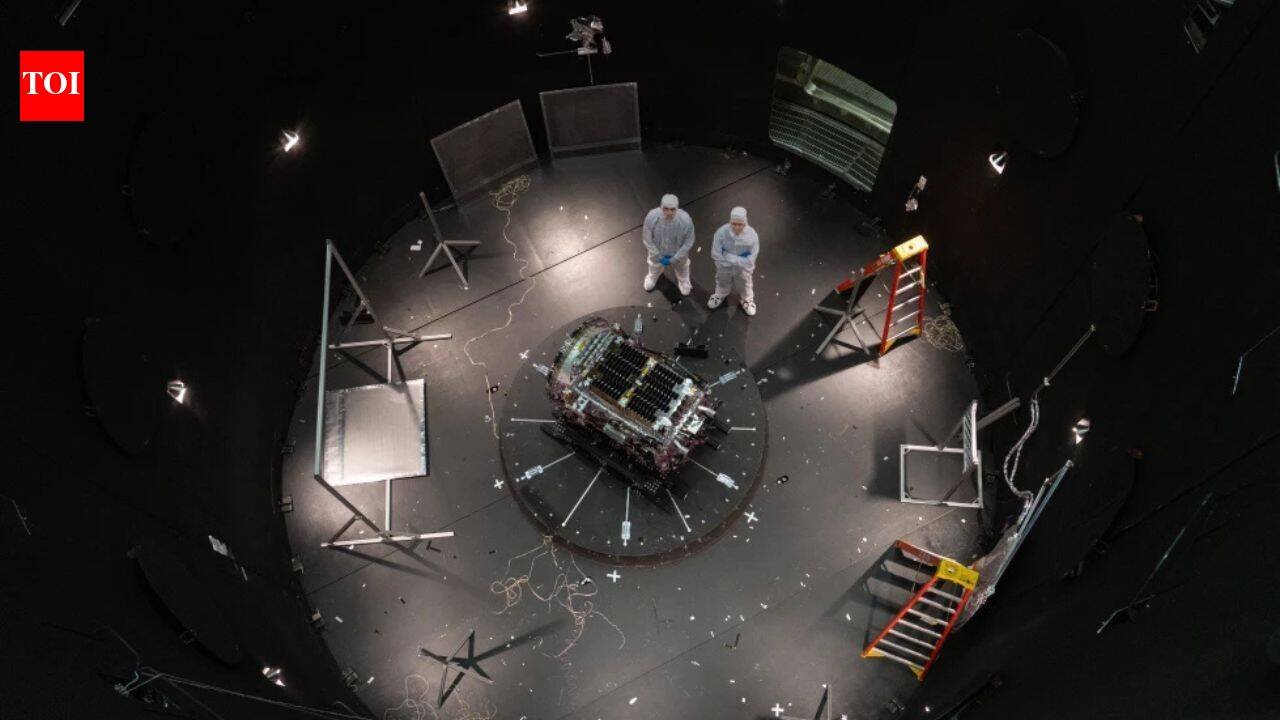
The US National Aeronautics and Space Administration (Nasa) is preparing to launch an rescue mission to save its ageing Swift Gamma-ray burst explorer (Swift Observatory) from falling back to earth.The mission will be carried out by a startup called Katalyst Space technologies, that aims to demonstrate a new era of satellite servicing. The mission is expected to get underway as early as this week.What is Swift?Launched by Nasa on November 20, 2004, the Neil Gehrels Swift Observatory, commonly known as Swift, is a space telescope designed to detect and study some of the universe’s most energetic and short-lived phenomena, particularly gamma-ray bursts (GRBs) which are immensely powerful explosions believed to occur when massive stars collapse into black holes or when neutron stars collide.Unlike conventional space telescopes that observe pre-planned targets, Swift was built as a rapid-response observatory. It continuously scans the sky using its Burst Alert Telescope (BAT) to detect gamma-ray bursts. Once a burst is identified, the spacecraft can autonomously rotate or “slew” towards the source in about a minute, allowing its X-Ray Telescope (XRT) and Ultraviolet/Optical Telescope (UVOT) to immediately observe the event.At the same time, Swift transmits the burst’s coordinates to observatories around the world, enabling scientists to begin follow-up observations within minutes. This ability to react quickly has earned it the nickname Nasa’s “first responder” for transient cosmic events.The Mission:The rescue mission will be carried out by Katalyst Space Technologies, a US-based startup specialising in on-orbit servicing technologies. Nasa awarded the company a $30 million contract in September 2025 to develop and execute a rapid-response mission aimed at extending Swift’s operational life.Instead of replacing the ageing observatory with a new one that will cost hundreds of millions of dollars, Nasa opted to test an emerging commercial capability that could revolutionise satellite servicing in orbit.Katalyst’s autonomous robotic spacecraft called Link, will be the main component of the mission. It will be launched aboard a Pegasus air-launched rocket, which is released from an aircraft before igniting its engines and carrying the spacecraft into low-Earth orbit.After separation from the rocket, Link will spend about a month gradually manoeuvring to match Swift’s orbit, using autonomous navigation systems to locate and approach the observatoryOnce the Lift will be able to match the speed and trajectory of the Swift precisely, the most challenging phase of rendezvous and capture will begin.Lift will deploy its three robotic arms, each equipped with two finger-like grippers designed to securely grasp the telescope. After securing Swift, Lift will use its propulsion system to gradually raise the observatory’s orbit from its current altitude of about 360 kilometres to around 600 kilometres. Once the desired orbit is reached, Lift will release Swift, allowing it to resume independent scientific operations.Nasa not first this timeWhile Nasa’s Swift rescue mission is a first for an American commercial company, the United States is not the first country to demonstrate the ability to rendezvous with, capture and relocate another satellite in orbit.China became the first nation to publicly showcase such a capability in January 2022, when its Shijian-21 (SJ-21) spacecraft docked with the defunct BeiDou-2 G2 navigation satellite and towed it from geostationary orbit into a higher graveyard orbit, a region reserved for retired satellites to reduce congestion in valuable orbital slots. The mission was officially described by China as a space debris mitigation demonstration.However, the objectives of the two missions are different. Shijian-21 was tasked with relocating a non-functional satellite to a disposal orbit, whereas Nasa’s Swift mission aims to extend the operational life of an active scientific observatory by boosting it to a higher orbit where it can continue conducting research.Beyond rescuing Swift, Katalyst views the mission as a stepping stone towards building a commercial in-orbit servicing industry. The company is already developing a next-generation robotic spacecraft, expected to launch next year, capable of servicing satellites in much higher orbits, including geostationary orbit nearly 35,800 kilometres above Earth.If the Swift mission succeeds, the technology could also be used to extend the life of other ageing space assets, including Nasa’s 36-year-old Hubble Space Telescope, with Katalyst targeting a similar life-extension mission as early as 2028.


