



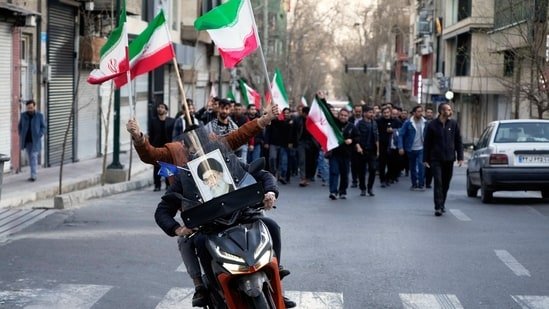
Iranians were experiencing a mix of shock, grief and joy after the death of supreme leader Ayatollah Ali Khamenei as Israeli and US strikes extended into a second day Sunday.


The attacks unleashed on Saturday killed Khamenei and top military leaders and prompted Iranian authorities to retaliate with strikes on Israel and across the Gulf.
At the first reports of Khamenei’s death, many Iranians erupted into cheers from apartment buildings in the capital Tehran while others blared car horns and blasted music in the streets.
In a reflection of the continued sense of wariness from Iranians about speaking freely of their rulers, none of the people AFP interviewed were willing to give their full name.
“We are on the road and celebrating the news,” said a woman in her 40s who had left the capital and headed west as strikes continued to pound Tehran.
Also read | How did US find Ayatollah Ali Khamenei’s exact location in Iran?
Others were stunned into silence. “I am in shock. I cannot believe what happened,” said a Tehran resident in his 30s.
Khamenei, who had final say on all state matters, had been Iran’s supreme leader for nearly four decades.
Around 5:00 am on Sunday, Iranian state TV announced Khamenei’s death, saying he had “fulfilled his lifelong dream” of martyrdom.
Within hours, Iranian mourners dressed in black took to the streets in Tehran’s central Enghelab Square.
Some were angry while others wept.
The grieving crowds chanted “Death to America” and “Death to Israel” and demanded revenge as they carried portraits of their dead leader, religious banners and the Iranian flag.
Similar gatherings took place in the southern city of Shiraz, Yazd and Isfahan in central Iran, Tabriz in the northwest and elsewhere, according to images broadcast on state TV.
Weeks of mourning
Iran announced a 40-day mourning period and seven days of public holidays.
As dawn broke, large areas of the usually busy capital were deserted and shops remained shuttered.
There were security checkpoints and police patrolled the streets in numbers that appeared larger than during last year’s 12-day war.
An AFP journalist at the northern Islam Qala border crossing saw the Iranian flag completely lowered, and a black flag raised.
The journalist said the crossing was open and people and trucks were passing through normally.
An Iranian cargo driver said he could not see things turning out well and had been “really worried” since he heard of Khamenei’s death.
“The situation right now in our country is not good at all,” the driver, who requested anonymity for security reasons, told AFP.
“I don’t know what will happen in the future, but it’s not a good future for us Iranians,” he said.
“The Americans have destroyed everywhere they’ve gone in the world,” he said, accusing them of wanting to take over Iran’s energy and mineral resources.
‘Names will change’
US President Donald Trump threatened on Sunday to unleash “force that has never been seen before” and urged Iran’s people to rise up and seize power.
Iran’s leadership has remained defiant.
President Masoud Pezeshkian described Khamenei’s assassination as a “declaration of war” against Muslims, and particularly against Shiites.
Top security chief Ali Larijani announced transition plans and warned Iran would hit Israel and the United States with a force “they have never experienced before”.
Umut, a director of a mining company, spoke to AFP after travelling overnight and passing through the Razi-Kapikoy border crossing into northeastern Turkey.
The 45-year-old Iranian had been in Tehran as news of Khamenei’s death began filtering through.
Although video footage showed some residents of Tehran celebrating on their balconies and at their windows, Umut said “there were no protests on the streets” — only a rush on fuel stations.
Iranian security forces recently crushed mass protests.
Umut said he was only planning to go home when the situation had died down, “if the streets are safe and there are no explosions at night”.
He did not expect Khamenei’s death to usher in a transformation.
“Just the names will change, but I think the regime will stay on,” Umut said.
“I don’t expect any regime change in the short run.”


