



Big cats are beautiful, though dangerous creatures; at times, they also serve as useful diplomatic tools.


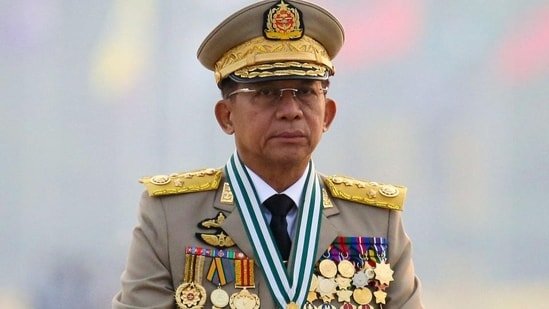
Min Aung Hlaing, President of Myanmar, was one of the VIP invitees to the International Big Cat Alliance Summit. While this summit, along with the India-Africa Forum Summit, was postponed due to the spread of Ebola in parts of Africa, it was decided to arrange a stand-alone visit by the president. A bold decision by New Delhi, it underlines the value of the Southeast Asian nation, which is struggling to regain normalcy and validation. The president’s five-day visit from May 30–his first visit abroad–is imbued with unusual significance.
The region, especially the member States of ASEAN, will be watching this visit carefully, as they strive to develop a coherent approach to the Myanmar question. Those among them plugging for a pragmatic policy will cheer, while the naysayers may be compelled to study closely the complex set of motivations guiding India’s policy. Beijing, too, probably miffed at Myanmar’s balancing act, will evaluate the visit’s outcome carefully. Nevertheless, New Delhi’s basic Myanmar policy has not changed. It remains centered on two tracks, indicating that it will cultivate cooperative ties with the government of the day, while encouraging and supporting Myanmar’s journey towards a democratic dispensation.
Recovering from five years of bloody civil war, internal conflicts, division, and displacement since the 2021 coup, the nation is struggling to secure some stability and normalcy. The president’s call for dialogue with the opposition seems to have few takers. Yet, all stakeholders concerned should be aware that the only way out of the current morass is reconciliation through dialogue. The president’s visit to India, the world’s largest democracy, should help visitors internalise that talks with people, rather than aerial strikes against their homes, are the proper way of governance.
Official sources in Delhi have noted that the working visit primarily focuses on strengthening India-Myanmar ties in the context of the rich civilizational and historical relations between the two nations. This task is overdue: the last visit by the president of Myanmar took place in February 2020, when President U Win Myint undertook a state visit, as Myanmar made the hybrid democracy model work. Much water has flowed down the Irrawaddy since then. An important goal before the principal interlocutors this time – Prime Minister Narendra Modi and President Min Aung Hlaing – is, or should be, to help Myanmar recommence its journey towards peace and reconciliation so that the India-Myanmar equation can be placed on stronger foundations.
As of now, the prevailing instability in parts of Myanmar, especially in its western region bordering India, has had a serious adverse impact on the Northeast. Reports indicate an all-round increase in the illegal flow of goods, drugs, arms, and people, as well as cyber scams that have robbed a vast number of Indians and others of their life savings. Thus, New Delhi has strong grounds to advocate dialogue with the presidential delegation. But to be effective and credible, the same plea needs to be made to the Resistance’s representatives as well. India should make it clear that, without interfering in their internal affairs and without offering to play a mediatory role, it expects all its friends in Myanmar to end violence and begin a serious internal dialogue that leads to a comprehensive settlement. A request to be kind to the 80-year-old and ailing Aung San Suu Kyi, the democracy icon, will go down well with the legion of her admirers in India and beyond.
The agenda for discussions with the Myanmar delegation is certain to include proposals to further strengthen diplomatic, security, and military-to-military cooperation. Recent measures – the visit of the minister of state for external affairs, the Chief of Naval Staff (CNS), and INS Sunayna – have already begun the process. The next logical step could be a visit by the external affairs minister and the commencement of periodic sectoral discussions at the official level.
On the economic site, discussions in Delhi and Mumbai at business fora should be a good beginning. However, the Myanmar delegation should be left in no doubt that new investments from India will only flow to a stable and peaceful country. But considering that people’s pain and suffering are real, Delhi needs to show generosity by offering a substantial grant for new Quick Impact Projects focused on health, education, agriculture, and digital public infrastructure. Mega connectivity projects will be reviewed, but no dramatic progress should be expected, given the prevailing complex security situation.
Finally, the discussions in Delhi should also focus on encouraging people-to-people exchanges for diverse purposes: medical, educational, business, tourism, and pilgrimage. Increasing exchanges among media, universities, and think tanks will also help both nations. Against the backdrop of a rising Chinese footprint in Myanmar, there is an urgent need for India to deepen its interactions across the board, methodically and purposefully.
The presidential visit has echoes from the past, specifically from October 2004, when the then head of State, Senior General Than Shwe, came to India on a State visit. As the ambassador in Yangon, this author had the privilege of escorting him on his swing through Delhi, Agra, Bodh Gaya, Bangalore, and Kolkata. The dignitary was highly impressed and pleased with what he saw and heard. On return, I found that the climate for bilateral relations had improved significantly. The government also expedited the task of drafting a new constitution, which was adopted in 2008. It opened the way for the establishment of a hybrid democracy under which the military shared power with elected representatives of the people. The experiment ran well from 2011 until early 2021, when a blend of political differences and personal ambitions created an explosive situation that culminated in a catastrophe.
President Min Aung Hlaing has begun his historic journey by offering prayers at Bodh Gaya, the site of the ultimate and everlasting bond between the two nations. The lofty message of Theravada Buddhism – love, compassion, and the Middle Path – will hopefully restore peace to the ‘Golden Land’ and help India-Myanmar relations prosper.
(The views expressed are personal)
This article is authored by Rajiv Bhatia, Distinguished Fellow, Gateway House, former ambassador to Myanmar and author, India-Myanmar Relations: Changing Contours.


