



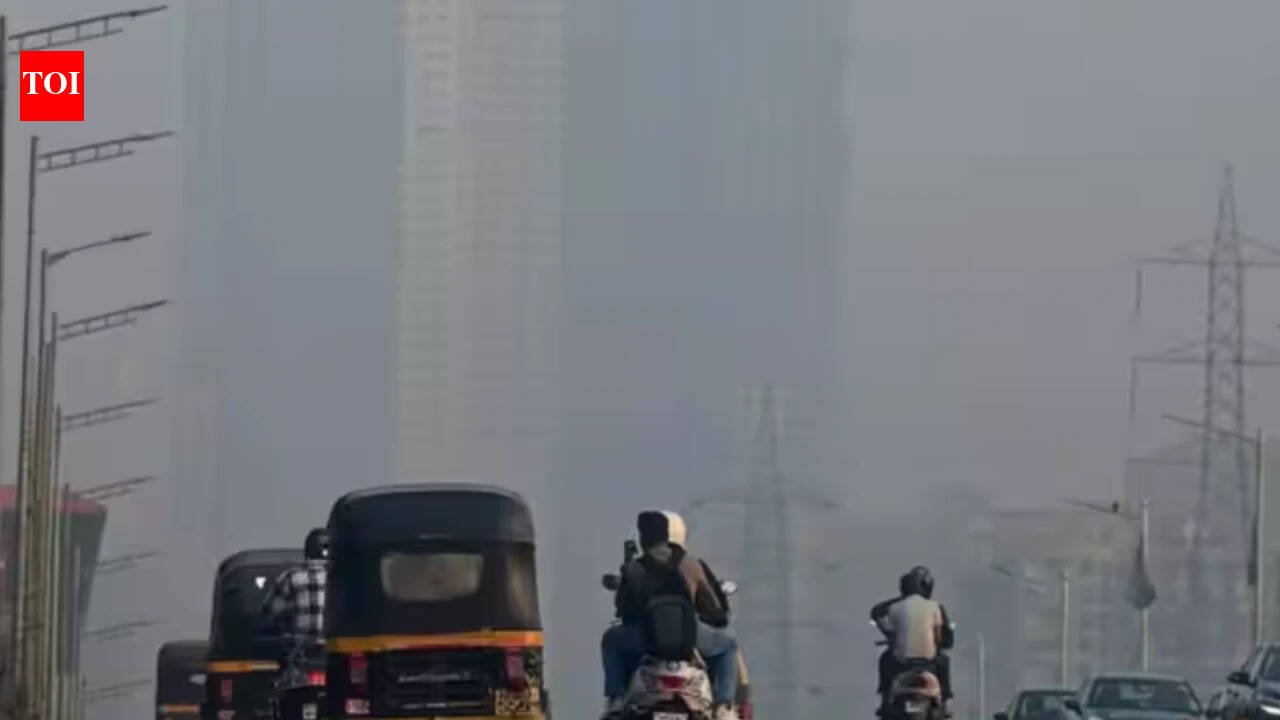
MUMBAI: A city-wide air quality reading may be giving Mumbaikars a false sense of comfort. Pollution levels can vary dramatically between neighbourhoods, with some parts of Mumbai recording nearly three times the seasonal PM2.5 levels of others, pointing to a growing need for pollution controls that target specific hotspots and sources rather than relying largely on municipal boundaries.A Centre for Science and Environment (CSE) analysis of real-time CPCB data through Jan 31, 2025 found Deonar had Mumbai’s highest seasonal average PM2.5 concentration at 80 micrograms per cubic metre, followed by Shivaji Nagar at 76 and Malad West at 75. Borivali East, in contrast, recorded 29 µg/m³ — about 2.8 times lower than Deonar.“The law supports what needs to be done; application & implementation need to catch-up,” said Justin Bharucha, managing partner, Bharucha & Partners, whose firm prepared the analysis.“We need an AQI data spine with localised data sourcing & dissemination for the MMR. A single AQI number is an effective disservice to the purpose of helping citizens assess and address our quality of air crisis.”The contrast is significant because a single Mumbai or MMR AQI can smooth out such local variations. For residents living close to an industrial cluster, landfill, congested traffic corridor or construction zone, the city-wide number may bear little resemblance to the air they actually breathe.
One MMR, many pollution profiles
The problem becomes more complicated outside Mumbai’s municipal limits. A snapshot cited in the analysis showed Thane, Bhiwandi, Dombivli, Mira Bhayandar and Mumbai at 52 on the US AQI scale at 7.30am on Aug 21, 2026, while Kalyan and Ulhasnagar were at 55, Tarkhad 53, Virar 54 and Badlapur 56 — all in the “Moderate” category.But such town-wide figures can potentially mask spikes around individual industrial clusters.The analysis specifically points to the TTC and Taloja clusters, while cautioning that this is an inference and that a current 2026 station-level breakdown for these clusters was not located.The larger point is that pollution follows sources and atmospheric conditions, not civic boundaries.That exposes a gap in the regulatory architecture. National Ambient Air Quality Standards prescribe common pollutant limits across India, while NCAP operates primarily through city-level action plans.The MMR, meanwhile, has multiple municipal corporations and councils, with no single airshed authority coordinating monitoring, data-sharing and enforcement across the region.Delhi-NCR has had the Commission for Air Quality Management (CAQM), a cross-jurisdictional mechanism, since 2021. No equivalent MMR-wide airshed authority has been adopted.
Ward-level action has its limits
Mumbai has already shown that pollution controls can be deployed at a much smaller scale. On Dec 30, 2024, BMC invoked Stage IV measures under Maharashtra’s graded response framework in Borivali East and Byculla, including a construction halt and a freeze on new trenching permissions.But the report records concerns that ward-based action may not correspond to the actual movement of pollutants. Environmental campaigner Bhagwan Kesbhat of Waatavaran has argued that stopping construction in one ward while allowing it in an adjoining ward may have limited effect when pollution crosses administrative boundaries.This raises a difficult question for regulators: should the trigger for action be a ward boundary, a pollution hotspot or the wider airshed?
Data infrastructure is catching up
There are signs that the information needed for more targeted regulation is emerging.BMC, in collaboration with IIT Kanpur, is developing MANAS (Mumbai Air Network for Advanced Sciences), a proposed network of 75 low-cost air-quality sensors. The system is intended to divide Mumbai’s airshed into grids and provide real-time hyperlocal PM2.5 and PM10 information. BMC has said the sensors will be validated against CAAQMS stations before public release.The city’s existing network has 28 CAAQMS stations across the MMR. The analysis notes that BMC treats each station as broadly representative of an area of around 2km, highlighting the limitations of using a relatively small number of reference-grade stations to identify neighbourhood-level pollution.A separate NEERI-IIT Bombay emission inventory and source-apportionment exercise commissioned by MCGM maps area, industrial and vehicular emissions at 2km × 2km resolution, which its analysis says can support micro-planning at ward level.
Different hotspots need different cures
The case for hyperlocal regulation is also strengthened by the very different nature of Mumbai’s pollution hotspots.In Deonar-Chembur-Mahul, industrial activity and the Deonar landfill are important parts of the pollution context.BMC has floated a Rs 2,368-crore tender for closure and remediation of the landfill over three years. The landfill, which has operated since 1927, covers 311 acres, receives about 4,000 tonnes of waste daily and has a waste mound about 40 metres high.In 2026, the Maharashtra Coastal Zone Management Authority cleared 124 acres for rehabilitation, subject to Bombay High Court approval.BKC, by comparison, illustrates a largely non-industrial hotspot profile, with construction dust, traffic congestion and metro and infrastructure works identified as relevant sources.Measures designed primarily around industrial emissions would therefore not necessarily address BKC’s principal pollution drivers.
Beware the AQI-number trap
There is another complication: not every AQI number available online is directly comparable.The report cautions that several recent hotspot readings came from aggregator platforms rather than CPCB’s National AQI system. AQI is also a dimensionless index, whereas PM2.5 and PM10 concentrations are expressed in µg/m³.Some aggregator readings use a US EPA-equivalent scale and can differ from CPCB readings for the same station-hour.For instance, a Chembur Collector Colony station was reported at a US-scale AQI of 78 on Aug 17, 2026, while Chembur Gaothan recorded raw PM2.5 concentrations ranging from 12 to 124 µg/m³ that day.The report notes that 124 µg/m³ falls in the “Very Poor” band under CPCB breakpoints, despite the aggregator labelling it “Severe”.The report therefore recommends that regulatory statistics be cross-checked directly with CPCB or MPCB before publication.For Mumbaikars, however, the central concern remains straightforward: a “Moderate” city-wide AQI does not mean every neighbourhood has moderate exposure.The emerging policy case is consequently not simply for more sensors, but for connecting better local data to local action — while ensuring that pollution-control measures continue across the entire airshed where pollutants cross ward and municipal boundaries.The challenge for Maharashtra will be to develop a system in which the regulatory response follows the pollution source and the people exposed to it, rather than stopping at the nearest administrative boundary.


