






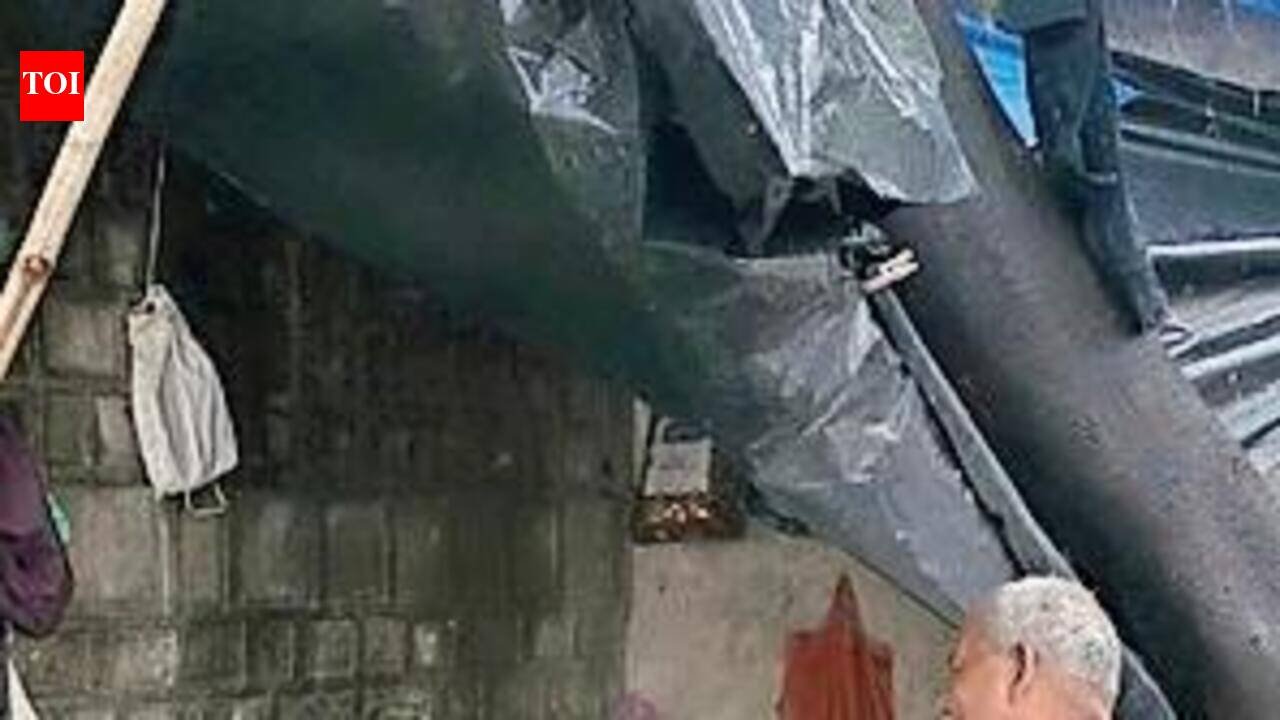
In Bandra East, Shabbir Khan (33) has stacked a month’s worth of dry firewood beneath the plastic-sheet shelter that eight members of his family call home. Once monsoon arrives, dry wood becomes nearly impossible to find.“We need it to cook whatever we have. This stock will last us a month,” said Khan, a daily wager from Banda village in Maharashtra who earns Rs 8,000–10,000 a month while living on a footpath.But rain is only one of his worries. “I lost my two-week-old child to diarrhoea two years ago. Children get malaria too because water stays accumulated for weeks, and nobody cleans it. It gets filthy.”Unlike Khan, Dadar’s barefoot ragpicker Mukesh Jha (27) has no fixed place to sleep. A BA graduate from Bihar, he earns barely Rs 150 a day collecting discarded bottles. Rains make even that uncertain. “People don’t buy as many bottles during monsoon, so I don’t find enough to sell. Many times, I sleep without eating anything.”On the streets, danger follows Jha every night. “Drug addicts come asking for tobacco or gutkha. If I wake up, it’s fine. But if I’m fast asleep, they use blades to empty my pockets.” Since arriving two years ago, he has been robbed twice, beaten and forced to beg.In Navi Mumbai, Vinodha Bhosle (40) from Amravati has come with her family for daily wage work, which often involves cleaning gutters before the monsoon. A couple earns Rs 1,000 a day, while an individual is paid Rs 500. “We come every summer and usually return before the rains, but this year our dues haven’t been cleared,” she said.Recent rain submerged the family’s shanties, pushing them under a bridge. “The contractor is not helping us. Yesterday, civic officials came, yelled at us and told us to leave. Aren’t we doing this work for them and for the city?”Half-blind Altesha Pawar (40), also from drought-hit Amravati, faces the same trap — stranded by unpaid wages, shelter destroyed by rain. “I wear my husband’s clothes while mine dry. I cannot fall sick; nobody will help.”Mumbai has over 1.5 lakh homeless but only 23 night shelters with space for around 2,500. Most are designed for individuals, forcing families to remain on pavements.Sitaram Shelar, director of Centre for Promoting Democracy, says the city’s homeless are not addicts or mentally ill, but workers who keep Mumbai running.. “The biggest misconception is viewing homelessness through a Western lens. This is nothing but caste bias. The homeless clean drains, recycle waste, and do much of the city’s dirtiest work. Mumbai depends on their labour but denies them basic facilities, turning survival into exploitation.”He notes that while summers have grown harsher, monsoon remains the sharpest pain point. “Extreme heat is getting worse, but at least you can find shade. The rains take away everything: shelter, dry food, livelihood, dignity. There is no hiding from monsoon when you have no roof.”Shelar said nearly 85% of Mumbai’s homeless are from Maharashtra and around 70% belong to historically marginalised denotified and nomadic tribes like Pardhis, Lamanis, and Vanjaris that continue to face systemic exclusion.“Not one homeless family we surveyed had benefited from Ladki Bahin or Pradhan Mantri Awas Yojana. Is this a coincidence?” he asked.For some, homelessness has become a permanent condition. On South Mumbai’s P D’Mello Road, Babu Samir Das (70) and his wife Sapna (50) have lived on the pavement for 25 years. Monsoon means less police harassment, but harder survival. “We stay awake all night fixing the plastic whenever water starts seeping in.” He refuses to leave the spot as it rarely floods and is near a hospital, where he feels safer living with his wife and their dog.Despite Supreme Court mandates recognising shelter as part of right to life under Article 21, Mumbai continues to rely on a handful of shelters that cannot accommodate even a fraction of those living on its streets. “If BMC can build a coastal road, it can certainly build 24/7 family shelters,” Shelar said. Referring to the 25,000 homes built under Mahatma Gandhi Path Kranti Yojana, he said the problem is not resources but intent.“The government’s focus should be on permanent housing. But I know nothing will happen. I have lost faith in those elected to govern.”For Jha, the promises of India’s financial capital have long faded. “They stole my bags, they beat me and took my phone,” he said.“Mumbai turned a graduate into a beggar.”


