



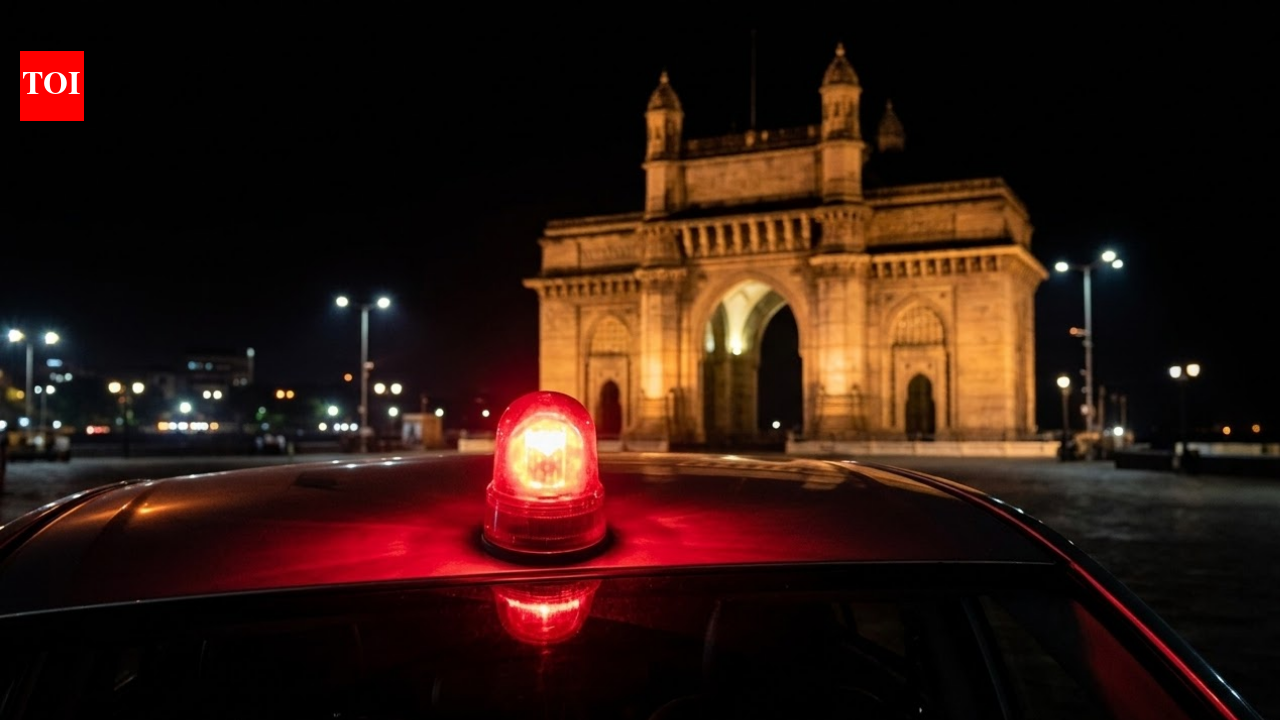
For nearly a decade, India believed it had ended one of the most visible symbols of political privilege — the red beacon light. The decision in 2017 to ban “lal batti” vehicles was presented as a cultural shift, not merely a traffic reform. It was meant to send a simple message: no public office-holder was above the ordinary citizen on the road.Yet in March 2026, a single image circulating on social media brought the debate back with unexpected force. The photograph showed the official vehicle of Mumbai mayor Ritu Tawde fitted with red-and-blue flashing lights — the kind normally seen only on police or emergency vehicles. Within hours, the image triggered criticism online, questions from activists, and eventually a political confrontation inside the Brihanmumbai Municipal Corporation.The civic body later removed the lights from mayor’s car as well as other vehicles allotted to office-bearers. But by then the issue had already evolved into something larger than a technical violation. It had reopened a national conversation about VIP culture, legal authority and the continuing gap between official rules and everyday practice.
How the controversy began
On March 11, a user on X uploaded a photograph of the official vehicle used by Mumbai mayor Ritu Tawde. The image showed the car fitted with red-and-blue flashing lights — the kind most citizens associate with police vehicles, ambulances and other emergency services.
The caption, “Does the Mumbai Mayor’s vehicle have permission to install police red-blue lights??,” simply asked whether the mayor’s car had permission to use such lights. But the question struck a nerve immediately.Within hours, more users began sharing the image. Some questioned whether the use of police-style flashing lights was legal. Others asked why an elected civic official needed a beacon at all when the Union government had already banned red-beacon culture years ago. The tone of the debate shifted rapidly from curiosity to criticism.
How the issue escalated in just a few days
The first public reaction came from social media users who openly questioned whether the mayor’s car was authorised to use red-and-blue lights. A user identified as @shivsainik007 asked whether the police had granted permission for the lights to be used on the mayor’s vehicle. Soon after, other users — including civil-society groups and activists — raised similar questions. Some pointed out that even the escort vehicle accompanying the mayor appeared to have similar flashing lights installed.The controversy moved beyond social media when RTI activist Anil Galgali formally wrote to the mayor and raised the issue. In his letter, he argued that the use of red-and-blue lights on the mayor’s official vehicle as well as the escort vehicle appeared to be unauthorised. He also referred to the instructions issued by the Union government in 2017, which clearly restricted the use of beacon lights to emergency services.The letter also demanded immediate action. Galgali argued that the matter should be taken seriously because it involved a violation of rules that had been introduced precisely to eliminate VIP culture.At that point, the controversy was no longer limited to online criticism. It had become a formal administrative issue.
The role of Brihanmumbai Municipal Corporation
As the debate intensified, officials in the Brihanmumbai Municipal Corporation confirmed that flashing lights had indeed been installed on the mayor’s official vehicle. They also stated that similar lights had been installed on other vehicles used by civic office-bearers, including the deputy mayor and the leader of the house.The BMC on March 14 removed these flashing lightsfrom the mayor’s car.
BMC
These were not traditional red beacons mounted on the roof — the symbol that had dominated Indian politics for decades. Instead, the lights were mounted on the front of the vehicle and flashed in red and blue, resembling the lights used by police vehicles.Officials later said the lights were removed after the issue came to their attention. But by the time the lights were taken off, the political and public reaction had already begun.
What the mayor said
Mayor Ritu Tawde responded to the controversy by describing the issue as an administrative lapse. She said the vehicle had been provided by the civic administration and that she had not demanded any beacon or flashing lights.
The BMC on Saturday, March 14, removed the red and blue flashing lights installed on the official vehicle of Mumbai Mayor Ritu Tawde and the escort vehicle accompanying her, following a controversy over their use.
Her argument, as mayor, she used the official vehicle that was allotted to her. If the vehicle had equipment that was not legally permitted, it was the responsibility of the administration to ensure compliance with the rules before handing it over.She also made it clear that she had no personal interest in using a beacon and that the matter had been exaggerated by political opponents. But the controversy did not end there. Instead, it quickly turned into a political confrontation.
Opposition leaders turn the issue into political debate
The strongest criticism came from opposition leaders inside the civic body. Former Mumbai mayor Kishori Pednekar accused the ruling party of bringing back VIP culture despite the Union government’s decision to end it. She questioned whether the mayor believed she was entitled to privileges that even senior national leaders had given up after the 2017 ban.Other opposition figures also criticised the use of flashing lights and argued that it reflected a mindset rather than a mistake. According to them, the problem was not the beacon itself but what it represented — the idea that political authority must be visibly displayed.
Why Devendra Fadnavis stepped in
The issue gained further attention when Maharashtra chief minister Devendra Fadnavis commented on the controversy. He said the mayor should not be blamed and that the beacon had not been installed in the traditional way on the roof of the vehicle. According to him, the mayor was fully aware of the rules and was being unfairly targeted.This intervention was politically significant because it shifted the debate from legality to intent. Supporters of the mayor argued that the controversy was being exaggerated for political gain, while critics insisted that the issue should be treated seriously regardless of intent.
Why red beacon remains such sensitive issue
For decades, the red beacon was one of the most visible symbols of power. It signalled authority on the road and often allowed vehicles to move faster through traffic. Over time, the number of officials using beacon-fitted vehicles increased dramatically. What had once been limited to a few high-ranking positions gradually expanded to include a wide range of political and administrative posts.Public resentment grew because the beacon came to represent inequality. Ordinary citizens were forced to stop in traffic while political leaders moved freely. Critics argued that the system created a psychological gap between public representatives and the people they represented.
The 2017 decision that was meant to end the practice
The turning point came in 2017 when the Union government announced a complete ban on the use of red beacon lights on vehicles used by public officials. The decision was presented as a major step towards ending VIP culture.Prime Minister Narendra Modi emphasised that every citizen should be treated equally and that public office should not be associated with visible privilege. From May 1, 2017, beacon lights were allowed only for emergency services such as police vehicles, fire brigades and ambulances.The decision was widely welcomed by the public. For many people, it symbolised a shift away from old political traditions that emphasised hierarchy and privilege.
The law explains why this matters
The rules governing beacon lights are contained in the Central Motor Vehicles Rules, 1989. For many years, these rules allowed both the Centre and the states to authorise the use of red beacon lights on vehicles used by certain high-ranking officials.Over time, the list of people entitled to use them grew steadily. Ministers, judges, senior bureaucrats and even local-level officials in some states were seen using beacon-fitted vehicles.Public criticism increased as the number of such vehicles grew. Courts also expressed concern that the practice created unnecessary traffic disruption and reinforced a culture of privilege.The turning point came after the Supreme Court issued strong observations in 2013 urging the government to restrict the use of red beacons. Following that, the Union government decided in 2017 to completely ban the use of red beacon lights on vehicles used by public officials — including the President, the Prime Minister and chief ministers.The political message behind the decision was clear. When Narendra Modi announced the ban, he described it as a step towards ending VIP culture and emphasised that every citizen should be treated equally on the road.From May 1, 2017, red beacons were permitted only for emergency services such as police vehicles, fire brigade vehicles and ambulances. The rules also restricted the use of multi-coloured flashing lights, which are typically associated with law-enforcement and disaster-response vehicles.In simple terms, civic office-bearers such as a city mayor are not legally entitled to use such lights.
Not the first such controversy
The Mumbai episode is only the latest in a long list of similar incidents that have occurred even after the 2017 ban.In 2017 itself, shortly after the ban came into force, the Regional Transport Office in Mumbai reportedly issued a notice regarding the use of a red beacon on the official vehicle of then mayor Vishwanath Mahadeshwar. That episode demonstrated how difficult it was to completely eliminate a practice that had existed for decades.
Another controversy surfaced in early 2025 in Punjab. In January that year, an RTI activist filed a formal complaint against Vaneet Dhir, alleging that the mayor was using a government-allotted vehicle fitted with red-and-blue beacon lights, a police-style siren and even an official flag. The complaint, submitted to the state governor and the director general of police, argued that the use of such symbols was a direct violation of the Union government’s 2017 decision to abolish VIP beacon culture.
According to the activist, the mayor’s vehicle had been equipped with these accessories without authorisation, despite clear rules stating that flashing red or blue lights can only be used by emergency and disaster-response vehicles.
The Pooja Khedkar episode
If the controversy involving Mumbai mayor Ritu Tawde reopened the debate locally, the case of Pooja Khedkar had already revived the issue nationally years earlier.Khedkar was not a senior bureaucrat, not a minister, and not even a confirmed IAS officer at the time. She was a probationary officer — someone still undergoing training and expected to follow the strictest administrative discipline.
Yet in 2024, images surfaced online showed a private vehicle allegedly being used by her fitted with a red-and-blue beacon and even a government-style insignia. The vehicle reportedly displayed markings that suggested official authority, something that is clearly restricted under existing rules.The reaction was immediate and far stronger than in earlier cases of beacon misuse. What angered many people was not just the use of a flashing light, but what it appeared to symbolise — a sense of entitlement before even formally entering public service. Critics argued that the 2017 ban had been introduced precisely to eliminate such displays of power, especially by young officials who were expected to represent a new administrative culture.
The controversy soon expanded beyond the vehicle itself. Questions were raised about the use of special privileges during training, the display of official symbols, and whether the rules governing government vehicles were being followed properly. The case quickly became a national story because it touched a deeper anxiety: if a probationary officer could appear to claim VIP privileges, what did that say about the success of the 2017 reforms?The government responded by transferring Pooja Khedkar from her posting, and the incident became one of the most widely discussed examples of how the red-beacon culture still survives in different forms.
The administrative angle: Lapse or system failure?
Another aspect of the controversy is the question of responsibility.Mayor Ritu Tawde said the vehicle had been provided by the administration and that she had not demanded a beacon. If that is correct, the issue raises broader questions about how official vehicles are prepared and whether existing rules are being properly followed by departments responsible for protocol.Critics argue that even a minor lapse can undermine the credibility of the 2017 reform. Supporters of the mayor argue that a mistake by the administration should not be turned into a political controversy.
A debate that keeps returning
Nearly nine years after the red-beacon ban came into force, the expectation was that the practice would gradually disappear. Instead, occasional controversies continue to surface across states and institutions.Each time a new case emerges, it reminds the public that the struggle against VIP culture is not only about legal rules but also about political behaviour and public perception.The controversy surrounding the mayor’s vehicle in Mumbai may have ended quickly once the lights were removed, but the debate it triggered is likely to continue.(With inputs from Richa Pinto)


