


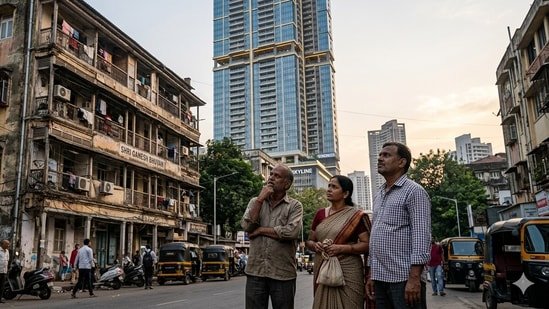
When 87-year-old Jayantilal Thakkar’s (name changed) old building in South Mumbai was undergoing redevelopment, the developer indicated a three-year timeline for completion. For Thakkar, however, the uncertainty of timelines and his advancing age made waiting an unattractive option. Unsure whether he would be around to see the project through, he chose to sell his apartment rather than move into temporary accommodation.

“I am currently in the negotiation stage with homeowners of an old building in South Mumbai. However, one 87-year-old senior citizen, the sole member of his family, has informed our team that he does not wish to wait for redevelopment and would prefer to sell his apartment. We are therefore considering purchasing the unit as a special case,” a developer, who did not wish to be named, told Hindustan Times Real Estate.
“The senior citizen also told us that he plans to use a portion of the proceeds to purchase another home, while donating the remainder towards an old-age home.”
Thakkar is not alone. In another instance, a senior citizen couple in the Kandivali area of Mumbai sold their apartment to the developer at a discounted price when their society opted for redevelopment. Rather than waiting for the redevelopment to materialise, they chose to relocate to a ready home in Mira Road, from the money which they got from the developer.
Sell or wait? What homeowners should do when redevelopment stalls
For the uninitiated, redevelopment is the process of demolishing an old, dilapidated, or inefficient building and constructing a new one in its place, typically with improved design, enhanced amenities, and greater structural safety.
According to real estate experts, redevelopment is financially rewarding as it often results in a significantly larger apartment, modern amenities, and a substantial increase in property value. In prime locations, appreciation can far exceed the discounted prices developers offer to buy out existing residents. Younger homeowners or those with the financial ability to manage interim arrangements may find it worthwhile to wait, treating redevelopment as a long-term investment.
Also Read: Mumbai redevelopment: Why some flat owners choose not to move back after redevelopment is complete
For example, US-based Bollywood actor Preity Zinta was in the news last month for selling her Mumbai apartment for ₹18.50 crore after the redevelopment of her old building. According to property registration documents, she sold the apartment located in the Pali Hill area of Bandra for ₹18.50 crore. The apartment was allotted to Zinta in April 2025 following the redevelopment of her old building.
“A section of residents who do not wish to return typically opt out at an early stage of the redevelopment process by selling their flats to the developer. In many projects, around 20–30% of members choose to exit at the agreement stage. Larger developers, particularly in premium and luxury segments, are more likely to offer buyouts, making it easier for some residents to exit upfront,” said Ritesh Mehta, Senior Director and Head (North and West), Residential Services and Developer Initiatives, JLL India.
“Ultimately, the decision depends on individual circumstances. Age, health, financial stability, and risk appetite all play a role. For senior citizens or those seeking immediate certainty, selling may provide a clean and stress-free exit, but at a discounted price,” said Nitin Shah, a real estate consultant based in Mumbai’s western suburbs.
“For others willing to navigate delays and temporary inconvenience, redevelopment can unlock considerable value. However, the risk is always there, but there is a bigger risk to reside in an old building and not undergo redevelopment,” Shah said.
Challenges for redevelopment?
According to real estate developers, while redevelopment is lucrative, it also comes with challenges, including delays in obtaining approvals, funding constraints, litigation, and construction issues.
“During this period, homeowners are either shifted to transit accommodation or paid rent, both of which come with their own uncertainties. For elderly residents especially, the physical and emotional toll of relocation, coupled with the risk of prolonged delays, can outweigh the potential upside of receiving a larger or upgraded home,” Shah said.
Take the case of 30-year-old Shyam Joshi, a resident of Borivali in Mumbai. “I was 17 when my building went for redevelopment in 2013, but construction stopped midway after just two floors were built,” he said. “Today, many homeowners are still living on rent, and the developer hasn’t paid monthly rent for the past 10 years.”
Also Read: 5 locations in the Mumbai real estate market offering affordable sea-view apartments
“We are fortunate to have bought another apartment, but survival has been extremely difficult for many others. We are now receiving proposals from new developers, but homeowners want them to also compensate for the pending rent owed by the previous developer. For the project to move forward, a middle ground has to be found. Redevelopment is never easy, but for ageing and dilapidated buildings, it remains the only viable solution,” Joshi added.
