



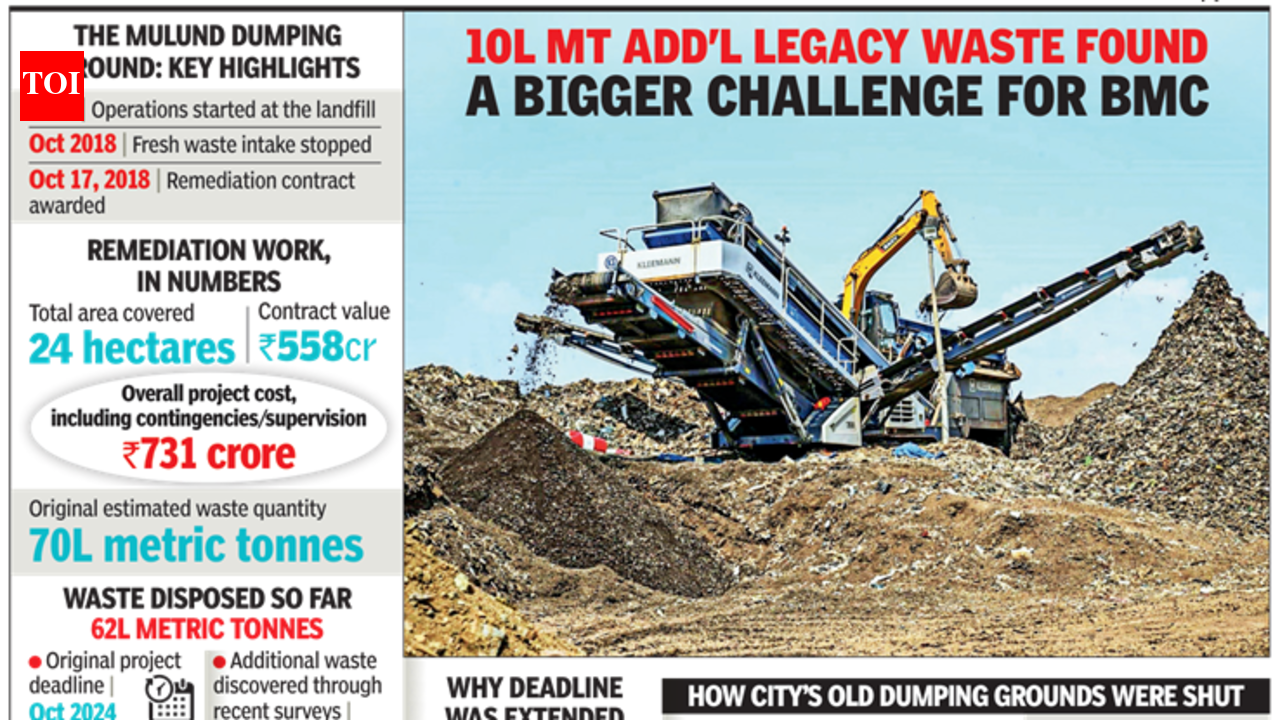
Mumbai: On a scorching Thursday afternoon, our vehicle crawls across the uneven terrain of the Mulund dumping ground, lurching over mounds of excavated waste and freshly processed earth. Giant excavators claw into decades-old garbage while conveyor belts, trommel screens and compactors work relentlessly under a cloud of dust. This is not an active landfill. The Mulund dump stopped receiving municipal solid waste in Oct 2018. Yet, nearly eight years later, Mumbai’s battle with one of the city’s oldest garbage mountains is not over.Spread across 24 hectares, the landfill that began operations in 1968 once held an estimated 70 lakh metric tonnes of legacy waste, stacked between eight and 32 metres high. Since 2018, BMC has been attempting to erase that mountain through biomining and bioremediation, a process that involves excavating old waste, separating reusable fractions and reclaiming land.The scale of the operation shows that almost 300 workers and dozens of machines operate across the site every day. Waste is dug out, loosened and arranged into long windrows where microbial cultures accelerate decomposition. The material is then fed into screening plants that separate soil-like material from combustible waste, plastics, stones and debris.What emerges at the other end barely resembles the garbage that entered the system.“The fine soil fraction, known as bio-soil, is transported for land-levelling and filling of low-lying areas. Stones and inert material are similarly reused for filling works. Combustible material is converted into refuse-derived fuel (RDF) pellets used by industrial boilers, while plastic waste is sent to processing facilities, including pyrolysis plants that convert plastic into furnace oil,” said a civic official who was monitoring operations at the site.According to civic records, the almost Rs 558 crore remediation contract was awarded in Oct 2018 to a consortium led by Bio Mining India Pvt Ltd. Including supervision costs, contingencies and associated expenses, the overall project cost is estimated at around Rs 700 crore.The original deadline was Oct 2024. That deadline has long passed.BMC officials and contractors attribute the delay primarily to the Covid-19 pandemic, which brought work to a near standstill and triggered a prolonged labour shortage. Even after restrictions were lifted, many workers were reluctant to return, causing recovery to take nearly 18 months, says a representative of the contractor whom TOI met at the site. “The civic body has imposed penalties of nearly Rs 10 crore on the contractor for failing to achieve project milestones,” added a civic officer. Yet, an even bigger challenge has emerged.As the waste mountain shrank, fresh surveys revealed that the original estimate of 70 lakh metric tonnes may have underestimated the actual quantity of waste present at the site. A drone- and LiDAR-based survey found approximately 9.5 lakh cubic metres of waste still remaining. Based on density assessments carried out this year, officials estimate that this could translate into an additional 10 lakh metric tonnes of waste — roughly 10% more than what was originally accounted for.The discovery has forced the BMC to reconsider its strategy. The contractor has sought permission to utilise the contract’s 10% physical contingency clause, which would allow processing beyond the originally estimated quantity without floating a fresh tender, and sought a further extension for completing the works. Kiran Dighavkar, deputy municipal commissioner in charge of the solid waste management department, said, “An extension up to Jan 2027 is being proposed to clear the remaining portion of the waste. It will be tabled before the civic standing committee for approval. As the existing contractor has the required man and machinery in place, the civic body is considering continuing with the same agency for the additional quantum that is still remaining.”Mulund MLA Mihir Kotecha said the BMC had assured local representatives that the legacy waste at the site would be cleared by June 2026, a deadline that has clearly been missed.“If fresh surveys have revealed additional legacy waste, someone must be held accountable for the miscalculation. The BMC must also act against the contractor for the repeated extensions and delays,” Kotecha said.He added that he continues to advocate for the 24-hectare site to be developed into a public golf course once remediation is complete, saying it would significantly enhance open spaces in Mumbai’s eastern suburbs.As of now, around 62 lakh metric tonnes have been fully disposed of, while processing of the original estimated quantity is largely complete. The remaining challenge lies in transporting and disposing of processed material, as well as tackling the newly identified waste buried in the lower layers of the landfill. Officials estimate that if approvals are granted and work continues uninterrupted, complete remediation of the site may take until next year.Besides Covid-related disruptions of the past and labour shortages, officials said the project as of today also faces logistical setbacks due to diesel supply constraints linked to the ongoing Iran conflict. The remediation exercise depends on around 150 heavy vehicles making hundreds of trips a day to transport processed waste from the site. According to officials, disruptions in fuel-related supplies and rising diesel costs created bottlenecks in transportation, slowing the pace of disposal even as processing continued on site.For Mumbai, the Mulund project was envisioned as a model for reclaiming valuable urban land from decades of accumulated waste. While substantial progress is visible on the ground, the city’s experience also has shown the complexities of remediating ageing landfills, where the true scale of the problem often becomes apparent only after excavation begins. Advocate Sagar Devre, who resides in Mulund and is associated with the Shiv Sena (UBT), said the BMC should have involved experts who had prior experience of such work. “The contractor appointed was new and so the work pace wasn’t maintained. The project would have benefited if it had experts in place and work pace should have been much faster than what we saw. This also was due to lack of supervision from the BMC’s end,” said Devre.Nearly eight years after fresh garbage stopped arriving, the mountain may be smaller, but almost two years after its original deadline, it has not disappeared.


