






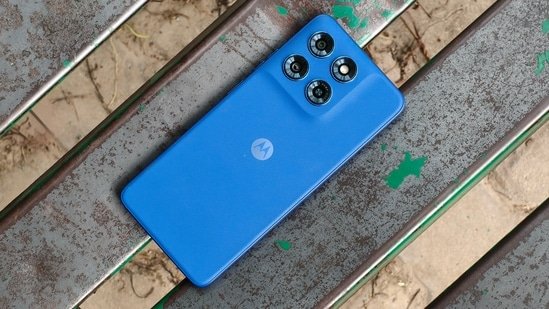
Motorola G37 Power Review: Motorola seems eager to undergo a massive “character development”, as the G37 Power became the first real roadblock on its otherwise stellar 2026 record. Initially launched at ₹15,999, the G37 Power had a few strengths going for it. Amid rising memory costs and a shrinking pool of compelling smartphones in the sub- ₹20,000 segment, its substantial battery capacity, a headphone jack, and a durable body helped it stand out.
Now, after receiving a price hike of up to ₹6,000, Motorola’s new smartphone has entered a competitive segment where options offer a complete package, from a high-definition AMOLED display to a stacked camera setup. With this recent development, the G37 Power has made my job much harder to recommend. To understand why I feel this way, we need to take a closer look at the phone itself.
Motorola G37 Power Specifications:
Design and Build Quality: Premium looks, practical compromises
Like Samsung, Google, and Apple, Motorola maintains a consistent design language across its smartphone lineup. As such, the G37 Power shares a similar visual identity with other Motorola smartphones positioned much higher on the price ladder, making it look quite premium for its price. That said, Motorola has also focused on introducing a bit of personality to the phone with fun colours, particularly the Nautical Blue, which I truly appreciate.
Aside from looks, the G37 Power also does a commendable job in terms of in-hand feel. The vegan-leather back feels soft to the touch. Moreover, the boxy chassis with contoured edges sits well in the palm without causing any sharp pain. While the phone feels comfortable to hold overall, its 215-gram weight makes it tiring to carry after extended use.
In terms of build quality, the G37 Power doesn’t look rugged. However, its durable shell, backed by MIL-STD-810H protection, convinces me it will never trigger a fight-or-flight response, even when the phone is handled roughly. That said, at its updated price, Motorola’s new smartphone offers subpar protection against water and dust compared with rivals such as the Vivo T5x, which offers both IP68 and IP69 ratings.
Battery and Charging: Built to last, slow to refill
Design aside, the G37 Power is hard to ignore for its battery endurance. Its 7,000mAh battery is exceptionally well optimised, letting the phone last 17 hours in the PCMark battery test. For context, the benchmark continuously runs a series of real-world smartphone tests, including video and photo editing, web browsing, and more, until the battery drops to 20%, with the display brightness set to 60% and Wi-Fi enabled.
Even in real-world use, the G37 Power’s battery has delivered seven to eight hours of screen-on time while still leaving enough charge in reserve for the next day. For reference, my use case includes social media browsing, internet research, and casual gaming. However, the charging speed is what annoys me, as its 30W charger takes 2 hours and 17 minutes to fully recharge the depleted battery.
Display and Audio Quality: A dated display with a welcome surprise
With the design and battery out of the way, it’s time to address the G37 Power’s much longer list of shortcomings, starting with the display. First and foremost, the phone features an LCD panel.
At its initial launch price, Motorola’s choice of an LCD panel for the G37 Power was easier to justify, given that most other devices in the segment used the same display technology. Hence, the lack of rich, vibrant colours on the LCD in movies and series didn’t feel like a compromise in the grand scheme of things.
But the recent price hike has put the G37 Power right up against the competition, including the Infinix GT 30 and the POCO M8, which offer far better AMOLED screens. Phones with this display technology deliver richer colours, deeper blacks, and superior contrast. Against this backdrop, the G37 Power seems even more disappointing. But the compromises don’t end with the panel technology. Motorola has also settled for an HD+ resolution on the G37 Power, a decision that was hard to defend at launch and is virtually indefensible today. With Full-HD+ displays now common across price segments, the G37 Power’s screen feels outdated compared with the competition.
While the G37 Power leaves much to be desired in the display department, it somewhat redeems itself with the audio quality. The stereo speakers get reasonably loud, though the sound can become a little harsh at higher volumes. Keeping the volume at a moderate level helps, but the speakers still lack richness in the mids and the bass. What actually impresses me the most is the inclusion of a headphone jack. This near-extinct slot has let me enjoy songs such as Chicago in higher fidelity through my IEMs, which most TWS earbuds struggle to reproduce.
Performance: A budget chipset in a pricier package
Performance is another area where the G37 Power falls behind, with or without the price hike. The MediaTek Dimensity 6400 SoC inside the phone belongs to the Dimensity 6000 series, which is often reserved for phones priced under ₹13,000. In turn, the G37 Power performs on par with extreme budget phones, rather than going toe-to-toe with its equals. And this shows in its benchmark results:
| Benchmark | Score |
| Antutu | 539314 |
| Geekbench Single-Core | 821 |
| Geekbench Multi-Core | 1333 |
For reference, the Realme P4x and the Vivo T5x retail at a similar price to the G37 Power. Yet they both run on the Dimensity 7400, a chipset meant for mid-range phones, helping them achieve scores around 1 million on Antutu and 2000 on Geekbench multi-core tests. As you would expect, performance of this calibre struggles to deliver a smooth gaming experience.
While the G37 Power supports 60 fps in BGMI on the lowest graphics settings, it often struggles to maintain a frame rate above 48 fps. During short gameplay sessions, I have also experienced constant stuttering and frame drops, often leaving me to desire a better gaming experience.
Software: A functional UI that lacks polish
Given the sluggish performance, smartphone brands often try to offset this glaring weakness by offering a better, optimised UI with smoother animations. However, this isn’t the case with the G37 Power, which is shipped with the Hello UI based on Android 16. Throughout my usage, I frequently encountered stutters while performing basic tasks such as swiping across the home screen or opening apps like Google Maps.
The software experience also lacks meaningful generative AI features, such as text refinement and summarisation tools, which rivals like Realme now offer as standard. Motorola’s software update policy is equally disappointing: it offers only one guaranteed Android update, whereas competitors typically promise two or more. To make matters worse, the UI includes pre-installed apps like Game Space that feel more like bloatware than genuinely useful additions.
Camera: Competent, but rarely impressive
The camera system does little to improve the G37 Power’s standing against the competition. The single 50MP rear camera delivers acceptable daylight shots, but fine detail is often lacking.
Colours can also appear more saturated than intended, particularly shades of orange, while the image processing tends to apply noticeable sharpening.
Low-light photography remains a challenge as well. To brighten scenes, the camera frequently resorts to slower shutter speeds, which can introduce blur and reduce the consistency of the final image. The 8MP selfie camera follows a similar pattern, producing usable images in good lighting but struggling to retain details and consistency once the ambient light drops.
Verdict:
The Motorola G37 Power is a difficult smartphone to recommend in its current form. While its premium design, durable build, excellent battery life, and headphone jack remain genuine strengths, they are no longer enough to offset its shortcomings. An HD+ LCD display, an underpowered chipset, an inconsistent software experience, average cameras, and slow charging make the phone feel outmatched by rivals at its revised price. Had Motorola retained the original pricing, the G37 Power would have been far easier to justify.


