



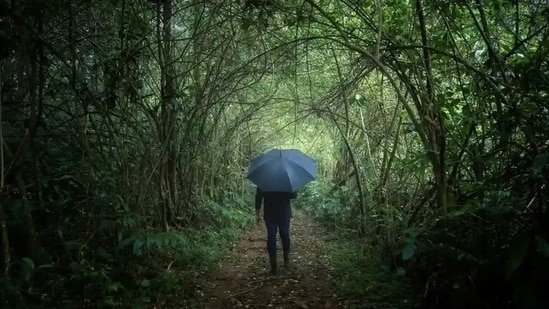
In the heart of the Western Ghats, where the mist clings to ancient canopies and the soil breathes with life, Poomaale Estate, a collective managed by Beforest, is challenging the traditional boundaries between real estate, travel, agriculture, and conservation. Also read | Tried forest bathing? Rediscover life’s simple joys in Coorg
What began as a personal quest for ‘slow life‘ by Sunith Reddy, CEO and co-founder of Beforest, has evolved into a sophisticated ecological model. “I started thinking about growing my own food and watching the sunset,” Sunith tells HT Lifestyle, reflecting on his 2018 exit from the corporate world.
“But in reality, it was about fixing broken pipes and battling pests. I wondered: can life really flow? Can food grow on its own? That is how the idea of food forests captured my imagination,” he adds.
A forest that works
Unlike traditional ‘protected areas’ that exclude human activity, Poomaale operates as a working forest. The estate balances a productive coffee plantation with strict conservation by mimicking natural cycles.
Sunith explains: “Imagine coffee as a living system. Instead of adding synthetic fertilisers, we use the nitrogen provided by leaves shed from the canopy trees. We connect the output of one element to the input of another. It moves from being a line to a circle.”
He shares that this ‘circular’ approach has yielded staggering ecological results:
⦿ 90 percent increase in the species richness indeX (SRI).
⦿ 50 percent of the estate dedicated exclusively to a ‘wilderness zone’.
⦿ Zero irrigation: The estate runs entirely on harvested surface water, offsetting approximately 12 million litres of water annually.
The four returns of success
For Sunith, success isn’t measured just by coffee yields: Beforest utilises the ‘4 returns framework’ to monitor the landscape’s health over a 20-year generational timeline:
⦿ Return of inspiration: a sense of purpose in the land.
⦿ Return of social capital: rebuilding the fabric of local human connections.
⦿ Return of natural capital: enhancing biodiversity.
⦿ Return of financial capital: creating long-term, reliable income.
“Most of our rural landscapes are being depleted on all four fronts,” Sunith notes, pointing out that many villagers now aspire only to move to cities. “We want to reverse that. When a system spontaneously encourages these four capitals to grow, that is when Poomaale is successful,” he adds.
Guardians of the land
The estate’s health is meticulously monitored by resident experts, including Aranya Bagchi, hospitality manager and naturalist. He says, “The presence of certain species indicates a healthy ecosystem.”
“Frogs have sensitive skin; their presence highlights a clean space. Similarly, having a diversity of dragonflies — the apex predators of the insect world — means our water is uncontaminated,” Aranya adds.
This commitment to the environment has turned Poomaale into a sanctuary for those fleeing urban exhaustion. In the Poomaale collective, living a forest-friendly life is not just about changing address, it is a shift from being a consumer to a steward of the land.
Dr Madhavi, a homeowner at Poomaale from Hyderabad, describes the move as a transition from a ‘suffocating concrete jungle to a serene jungle’.
She says, “Buying property here was a profitable investment, gaining healthy life years as returns. It brings back childhood memories of grandparents’ homes. My future grandchildren will have similar memories in this pristine nature bed.”
‘Rewilding’ the human
Ultimately, the goal of the Poomaale collective is more than just co-ownership; it is about intentional community. By integrating with local Kodava culture — including architecture modelled after traditional homes — the project seeks to foster a deep-seated gratitude for the land.
“We want to get guests used to the wild — the bees, the bugs, and the free-flowing water. A guest who was uncomfortable walking at night starts enjoying stargazing by day three. We don’t want to make this an escape from life, but life itself. Our entire agenda is to rewild the human,” Sunith concludes.
This article was produced following a three-day hosted stay at the Poomaale Estate in Coorg, upon editorial invitation.


