






Persian Gulf oil exports have surpassed prewar levels, as an improvised shipping system under U.S. protection is helping tankers move oil through one of Iran’s fiercest waves of attacks in the Strait of Hormuz.

Middle East oil flows, including shipments through Hormuz and alternative routes across the region, averaged more than 24 million barrels a day in the week through Oct. 18, surpassing prewar levels of 23.3 million, according to ship tracker Kpler.
Preliminary figures show Hormuz oil flows, including offshore transfers in the Gulf of Oman, came to around 14 million barrels a day on average for the same period, or 82% of prewar levels.
Oil prices remain high, and benchmark Brent crude has risen in recent days to around $108 a barrel Tuesday. Traders are concerned the improvement in Hormuz might not be sustainable, particularly if fighting breaks out again. Thinning global inventories leave little margin for error. The operation is also expensive, costs that ultimately flow through to consumers at the pump.
Still, the resilience of oil flows marks a shift in the battle over the world’s most important energy chokepoint. Iran can still make shipments dangerous and expensive. But its ability to deter transits has faded, weakening Tehran’s leverage with the U.S.
“The big picture is that the system for shipping through a dangerous Strait of Hormuz is now well-established and the risk appetite of those involved in exporting oil has risen,” said Hamad Hussain, a senior commodities economist at Capital Economics.
Pipelines across Saudi Arabia and the United Arab Emirates are also moving oil along different routes. In September, about 40% of the non-Iranian crude shipped out of the Gulf bypassed the strait, compared with 17% before the war, Kpler estimated.
The success contrasts with the chokehold on Iran, whose own oil exports have been bottled up by a U.S. maritime blockade. The risk is Iran could try to re-establish its influence by striking harder and potentially drawing the U.S. into another confrontation before the U.S. midterm elections in two weeks.
Gulf oil is flowing despite escalating violence around the strait. About 30 attacks on ships have been reported this month, according to a Wall Street Journal tally based on reports by the U.K. Maritime Trade Operations Centre and maritime security companies.
The incidents in October account for 20% of the ships attacked during the war, said Michelle Wiese Bockmann, a senior analyst at maritime intelligence firm Windward.
“Iran is trying to reassert its blockade of the strait,” said Christopher Long, a former British naval officer now at Neptune P2P Group.
For many oil traders and shipowners, the risk of crossing Hormuz is worth it. Compared with before the war, traders can earn $20 a barrel more reselling Iraqi oil, or about $40 million on cargo from a supertanker, estimated Homayoun Falakshahi, Kpler’s head of crude oil analysis. Three such voyages could repay the $100 million cost of a secondhand tanker.
Seafarers also are being offered bonuses to make the dangerous crossings. Crew members have been lured by payouts two or three times their typical monthly salary to work on ships that venture into the Persian Gulf. One China-based ship-staffing company offered as much as $25,000 for a round-trip, which normally takes a week or two, The Wall Street Journal reported.
“The volumes remain high despite rising attacks, because profits make it worth the risk,” Falakshahi said.
Some shipowners are repositioning older vessels that used to ferry Venezuelan and Russian oil to the Persian Gulf because of the unprecedented tanker rates in the region, shipbrokers said.
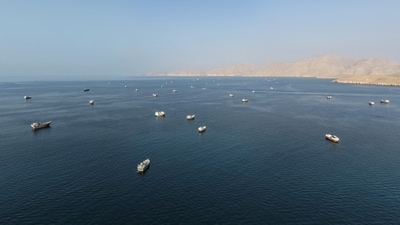
Many of the vessels are making short shuttle runs through the danger zone. American air cover provides some protection through a corridor along the Omani coast. Tankers load oil inside the Gulf and transport it via Hormuz, often with their tracking signals switched off. They then stop near Oman and transfer their cargoes to ships bound for distant markets before heading back into the Gulf, where they face the most risk of being hit.
Iran’s Islamic Revolutionary Guard Corps, meanwhile, is using drones and missiles to stop ships that try to make the run. It also has turned to guerrilla tactics long employed by Yemen’s Houthis to target traffic around the mouth of the Red Sea, deploying spotters in small fishing boats and sending fighters out onto the water.
The crossing remains dangerous. Before September, the Tanzania-flagged supertanker Loyalty spent years ferrying Venezuelan crude to China. Since September, it has entered the Persian Gulf twice, both times heading to Iraq to load crude.
A crew member said the ship informed the U.S. Navy about each trip and had security personnel onboard. In early October, Loyalty transferred 2 million barrels of Iraqi crude oil in the Gulf of Oman to an unidentified tanker, then went back into the Gulf to pick up a new load, according to Kpler and the crew member.
The crew member said the ship management company sent the crew body armor and helmets for the second trip.
On Oct. 16, Loyalty was struck by a rocket-propelled grenade launched from a small boat, according to maritime security company Vanguard. The projectile carved a hole in a fresh water tank. At the time of the attack, Loyalty was carrying 2 million barrels of Iraqi crude oil, the crew member said.
The attacks are raising the cost of getting Gulf oil to market. Freight for a supertanker carrying Gulf crude to China was near a record $37.37 a barrel this week, Kpler said. War-risk insurance has climbed to as much as 10% of a vessel’s value from less than 3%, according to Windward’s Wiese Bockmann.
“In April, the problem was a shortage of crude. In October, it is the cost of moving it,” said Natasha Kaneva, head of the global commodities strategy team at JPMorgan.
But oil is still getting through, despite Iran’s threats that it won’t allow its neighbors to ship their oil if it couldn’t export its own.
“Iran would have to be more aggressive to achieve the same degree of control it previously possessed over oil flows from the region,” Capital Economics’ Hussain said.
Write to Benoit Faucon at benoit.faucon@wsj.com, Georgi Kantchev at georgi.kantchev@wsj.com and Rebecca Feng at rebecca.feng@wsj.com


