


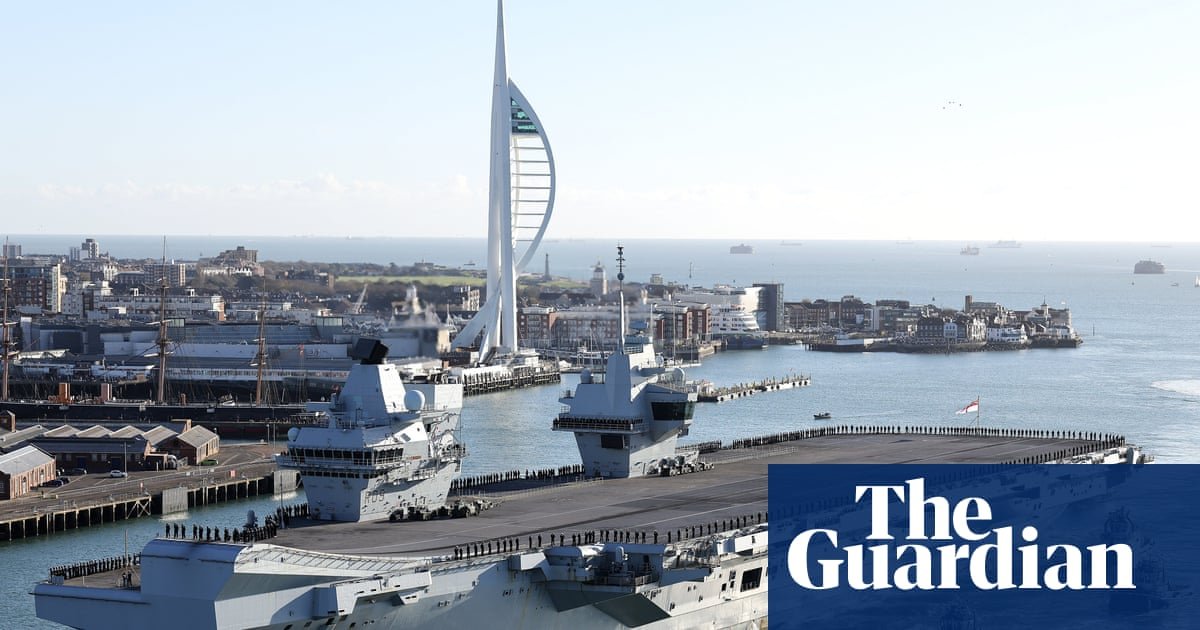
A technical issue has been detected on the UK navy’s flagship as it was docked in Norway, after the warship worked with Nato and the Joint Expeditionary Force (JEF), the government has said.
Earlier this month, the HMS Prince of Wales – one of Britain’s two flagship aircraft carriers built for £6.4bn – set sail for Nordic waters from Loch Long, Argyll and Bute, Scotland, to provide security in the Atlantic and High North regions.
The Ministry of Defence (MoD) said a “minor technical issue” was identified during its latest stop in Stavanger, a port city in south-western Norway. The vessel is expected to sail in the coming days, the ministry added.
“HMS Prince of Wales is currently conducting a port visit to Stavanger as part of the Carrier Strike Group’s deployment across the North Atlantic and Arctic, we expect her to set sail in the coming days,” an MoD spokesperson said.
The ship, which is generally based in Portsmouth, was joined by Type 45 destroyer HMS Duncan and tanker RFA (Royal Fleet Auxiliary) Tidespring on its way to Nordic waters. It is capable of carrying up to 72 aircraft and can accommodate up to 1,600 people. It worked with Nato and the 10-nation coalition JEF throughout the deployment.
The ship, which is regularly based in Portsmouth, had been readied by Royal Navy workers in March, meaning it could be deployed more quickly if a decision was made to mobilise it to the Middle East. An MoD spokesperson at the time, said HMS Prince of Wales could also undertake other planned missions.
The vessel is one of Britain’s two flagship aircraft carriers along with HMS Queen Elizabeth, which was forced to pull out of a Nato exercise off of the Norwegian coast in 2024 after pre-sailing checks uncovered a coupling problem on its starboard propeller shaft. Maintaining and repairing the ships has already cost more than £1bn.
The HMS Prince of Wales, which took its place in that exercise, has also previously suffered from mechanical issues. In 2022, the vessel broke down in August after setting sail for the US, because of a broken propeller shaft, which was misaligned when installed. The vessel had also been flooded twice in its first year of service, after being commissioned in 2019.
In March, the UK’s military capacity came under scrutiny after a British warship, HMS Dragon, was belatedly deployed to Cyprus, home to two UK military bases, in a defensive move following the joint US and Israel’s attacks on Iran.
A persistent complaint among military figures is that government ministers, from both Labour and the Conservatives, have been reluctant to acknowledge a “rhetoric to reality gap” where the UK’s positions itself as a global power when in reality global military capabilities are stretched very thin.
At the end of the cold war, the UK had 51 destroyers and frigates after a period during which Britain spent 3.2% of its GDP on defence. The UK now spends 2.4% of GDP on defence, a figure that Labour has promised to lift modestly to 2.5% by April 2027.
