






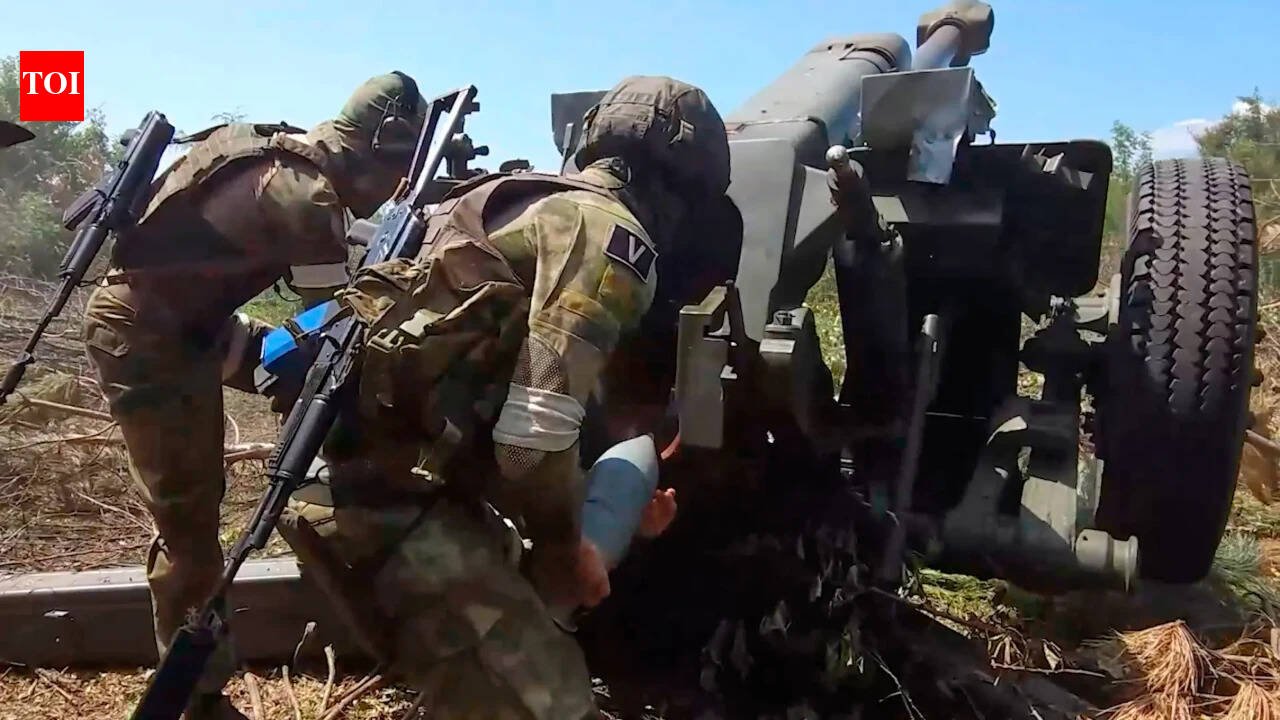
Russian troops fighting in eastern Ukraine are receiving an unusual form of support as the war enters another winter. Relics of medieval Russian rulers and warrior saints are being taken to military bases and units at the front.In early September, a fragment of the remains of Dmitry Donskoy, the Moscow prince celebrated for his victory at the 1380 Battle of Kulikovo, was sent to Russian troops and is now being moved around military bases in Russian-occupied Ukraine. The relic is a fragment of his right hand, the same hand the Russian Orthodox Church says he used to wield his sword in battle.The military department of the Moscow Patriarchate said the “saint commander” would invisibly stand “shoulder to shoulder” with Russian soldiers. The move is part of a broader role the Russian Orthodox Church has played during the war, with religious symbolism being used alongside state narratives about Russia’s military campaign, according to a CNN report.“The church has practically merged with the state to the point of being indistinguishable,” the report quoted Sergei Chapnin saying, a religious scholar and director of communications at Fordham University’s Orthodox Christian Studies Center. “From my point of view, the maximum (closeness) has been reached.”
Why Donskoy’s relics were taken to the front
The practice of taking sacred relics to troops is not new in Orthodox Christianity. But experts say Donskoy’s medieval military legacy gives the relic a particular significance in the context of the Ukraine war.Chapnin said Donskoy is presented not as an aggressor but as a defender of his homeland, allowing the historical figure to be linked to Russia’s present-day narrative about the war.“He was not himself an aggressor, but a defender of the fatherland,” the scholar told CNN. From the government’s perspective, “it is very important to show that Russia is not the aggressor, that we are defending our territory.”Chapnin described this connection between Russia’s medieval past and its current war as “a mobilizing myth.”“These myths, which connect different times and eras, can act quite powerfully on mass consciousness,” he said, adding that the relics are presented as “a magical artifact.”Metropolitan Vladimir, the Russian-installed Orthodox leader in Donetsk and Mariupol, said the relic would help soldiers and civilians “mobilize both their spiritual and physical strength” and “triumph over the enemy.”Donskoy is not the only medieval Russian ruler whose relics have been taken to the war zone. Earlier this year, relics of Prince Alexander Nevsky, another ruler later turned into a symbol of Russian military glory, were also taken to troops.
From Kremlin to Church, a closer wartime relationship
The use of religious relics comes against the backdrop of a closer relationship between the Kremlin and the Russian Orthodox Church since Russia launched its full-scale invasion of Ukraine in 2022.The Church has repeatedly used religious language to support Russia’s military narrative. The recovery of Donskoy’s remains in August was itself given religious and historical significance by Russia’s political and religious leadership.President Vladimir Putin called the recovery an “absolutely unique” and “marvelous discovery”, while Patriarch Kirill described it as “a special sign of God’s providence.”The relics have also been displayed in Moscow, where thousands participated in religious events involving Donskoy’s remains. An annual religious procession in September drew more than 100,000 people in Moscow alone, according to official figures.But the role of the Church in the war has drawn criticism from within the wider Orthodox community.For Rev Alexander Zanemonets, an Orthodox priest and historian, the use of Donskoy’s remains “has nothing to do with Christianity.”“It is undoubtedly the exploitation of Christianity and the exploitation of the church for ‘patriotic’ purposes,” CNN quoted him saying. He argued that the Church’s strong state backing creates incentives to align with the Kremlin, calling the use of the remains a “cynical calculation.”
What soldiers make of it
The religious symbolism does not necessarily have the same meaning for troops at the front.Some Russian soldiers say faith has become more important as the war continues. A former Russian serviceman told CNN that soldiers often turn to God during difficult moments.“Not all of us talk to God when things are going well, but everyone talks to God when things are bad,” he said.He described makeshift churches at the front, soldiers praying before missions and priests visiting military units and hospitals.“Like a field kitchen, there should be a priest everywhere,” he said, quoting a popular Russian expression: “We are Russians. God is with us.”A Russian soldier serving in the Zaporizhzhia region described being able to speak to a priest, pray or touch a holy object as “serious moral support.”But not all soldiers see the relics as meaningful.One serviceman in the Donbas region called the decision to send them to the front “a very unconventional solution to our problems in the 21st century.”“My view is that they are needed more by the mothers of the guys who died in this military operation,” he added.The war has also raised questions within the Orthodox community over the role priests should play in supporting soldiers. Rev Grigory Mikhnov-Vaytenko, a Russian priest who helps Ukrainian refugees displaced by the war, said spiritual support should not become a means of reinforcing an illusion about the conflict.“We need to support people, including those in military uniform,” he said. “But the question is how we support them.”“On the one hand, (you must) not deny people spiritual help, and on the other, not lead them into an illusion,” CNN quoted the priest as saying.The debate comes as the war enters its fifth year, with Russian soldiers describing mounting strain at the front. For the Kremlin and the Russian Orthodox Church, however, the medieval warrior saints and their relics offer a way to connect Russia’s military present with its religious and historical past.


