


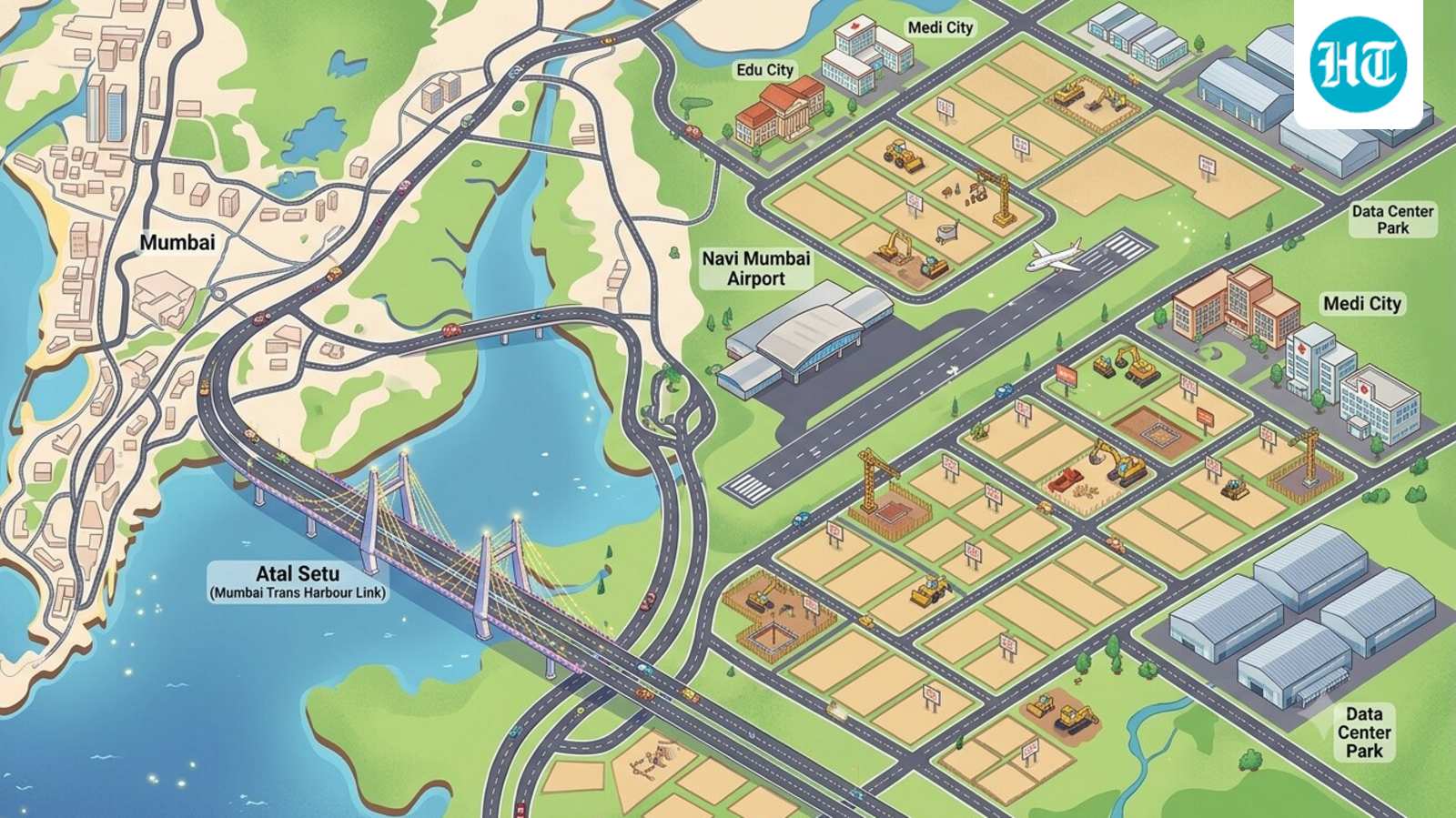
The Mumbai Metropolitan Region Development Authority (MMRDA) has entered into an agreement with a Singapore-based firm to prepare a vision document and a comprehensive master plan for Mumbai 3.0, which is expected to cover 323.44 sq km, including 124 villages in the Panvel, Uran and Pen talukas of Raigad district, exactly 50 km from main Mumbai.
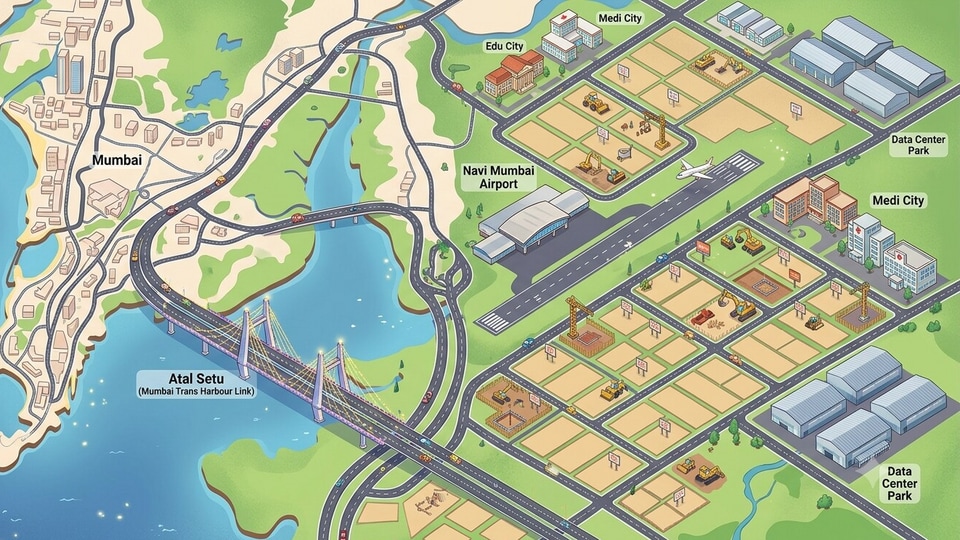
The plan will include land use, transport networks, housing, industrial and commercial zones, social infrastructure and other civic amenities.
According to MMRDA officials, Mumbai 3.0 could open up a major new growth market within the MMR for the real estate sector, driven by planned urban development, infrastructure and investment. With the Navi Mumbai International Airport and other connectivity projects boosting investor confidence, the region could see new residential, commercial and mixed-use hubs emerge.
The proposed land policy by the MMRDA, which combines monetary compensation with land-based benefits, could also encourage landowners to participate in development, helping unlock larger land parcels for future real estate projects, MMRDA officials said.
What is Mumbai 3.0?
Mumbai 3.0, also known as Third Mumbai, spans approximately 323.44 sq. km, covering 124 villages across the Panvel, Uran, and Pen talukas of Raigad district. The Maharashtra government notified the project on October 15, 2024 under the Maharashtra Regional and Town Planning Act, 1966, designating MMRDA as the New Town Development Authority.
Strategically located within the influence area of Atal Setu and in proximity to the Navi Mumbai International Airport (NMIA) and Jawaharlal Nehru Port (JNP), Mumbai 3.0 is conceptualised as a large, integrated urban and economic centre supporting residential, commercial, industrial, institutional, logistics and employment-led development. Through integrated planning, world-class infrastructure, and globally benchmarked urban development principles, MMRDA aims to develop Mumbai 3.0 not merely as an extension of the existing metropolis but as a new economic engine for the Mumbai Metropolitan Region and Maharashtra.
Also Read: Mumbai real estate: Why are developers betting big on ‘buy now, pay later’ schemes this monsoon?
What has MMRDA proposed?
The MMRDA has proposed drafting a master plan on the Mumbai 3.0 framework, detailing what can be developed over the coming decades by integrating infrastructure, housing, transportation, commercial development and new economic centres. The MMRDA region extends beyond Mumbai city and includes areas such as Thane, Navi Mumbai, Kalyan-Dombivli, Vasai-Virar and other emerging urban centres. A long-term master plan could therefore influence where future development takes place and how infrastructure is planned around it.
According to a statement issued by the MMRDA, under the plan, the Singapore-based firm will establish the comprehensive planning foundation for Mumbai 3.0 through an inception plan, an existing situation analysis, a vision plan, a draft concept land use plan, stakeholder consultations, and a final concept plan.
Who will prepare the report?
The MMRDA has signed an agreement with Singapore-headquartered Surbana Jurong Infrastructure Pte. Ltd. to prepare the vision document, the master plan, and related planning framework for Mumbai 3.0.
The engagement brings to Mumbai 3.0 the urban-planning legacy and international expertise of an organisation whose roots are closely linked with Singapore’s own transformation into a globally recognised model of planned urbanisation, housing and industrial development, according to an MMRDA statement.
What will the report include?
According to MMRDA, the planning exercise for Mumbai 3.0 will begin with a detailed assessment of land use, transport networks, population, socio-economic conditions, utilities, environmental features and public amenities. Based on this, the Vision Document will outline the new city’s economic positioning, growth strategy, investment opportunities, key projects and placemaking principles, with the aim of creating a globally competitive and sustainable urban centre.
The plan will draw on international best practices in smart infrastructure, mixed-use development, public spaces, renewable energy, digital systems and Transit-Oriented Development. The draft plan will integrate land use, mobility, and infrastructure, identifying growth corridors, development nodes, mass transit and multimodal connectivity, along with requirements for water, sewerage, waste management, power, and social infrastructure. Consultations with government departments and stakeholders will help shape the final land-use plan, which will cover residential, commercial, industrial, institutional, recreational, transport, and conservation zones, the MMRDA said.
By when will the report be presented?
According to MMRDA, the planning exercise for the report will be completed within 30 weeks as Phase-1 for the consultancy. The report timeline for the same is as follows:
1) Inception Report – 4 weeks
2) Existing Situation Report – 10 weeks
3) Vision Document – 16 weeks
4) Draft Concept Land Use Plan – 24 weeks
5) Stakeholder Interaction Report – 26 weeks
6) Final Concept Plan – 30 weeks
World Economic Forum at Davos: What’s the connection with Mumbai 3.0?
The MMRDA said that the agreement builds on the strategic collaboration initiated during the World Economic Forum at Davos in January 2026, when MMRDA and Surbana Jurong signed an MoU for cooperation in master planning, architecture, infrastructure engineering, project management, and transaction advisory services.
“Subsequently, through its letter dated 4 June 2026, the Government of Maharashtra approved the appointment of Surbana Jurong on a Government-to-Government (G2G) basis. The signing of the present agreement, therefore, marks the transition of the partnership from strategic intent to implementation, with Surbana Jurong now undertaking the detailed planning exercise for Mumbai 3.0,” the MMRDA statement reads.
What does it mean for the real estate sector?
According to MMRDA officials, Mumbai 3.0 could open up a major new growth market within the MMR for the real estate sector, driven by planned urban development, infrastructure and investment. With the Navi Mumbai International Airport and other connectivity projects boosting investor confidence, the region could see new residential, commercial and mixed-use hubs emerge. The proposed land policy by the MMRDA, which combines monetary compensation with land-based benefits, could also encourage landowners to participate in development, helping unlock larger land parcels for future real estate projects, MMRDA officials said.
“Mumbai 3.0 is envisioned as a new global growth centre for the MMR. Our innovative and people-centric land policy, which, for the first time, combines land-based benefits with monetary compensation, ensures that landowners become stakeholders and beneficiaries in the development process. With progressive land policy and global planning expertise coming together, we are laying a strong and inclusive foundation for Mumbai 3.0,” said Sanjay Mukherjee, IAS, Metropolitan Commissioner, MMRDA.
According to real estate consultants, Mumbai 3.0 is currently an emerging development region rather than a fully built-up real estate market, with land largely comprising villages, agricultural parcels and undeveloped land, alongside some industrial, residential, and commercial development. Land prices vary sharply by location, with available market listings and transactions in surrounding areas broadly ranging from a few thousand rupees to over ₹10,000 per sq ft, depending on connectivity, land use and proximity to major infrastructure such as the Navi Mumbai International Airport.
Also Read: What is driving the growing interest of large corporates in Mumbai’s cluster redevelopment projects?
According to local brokers, land parcels in plotted development projects are available anywhere from ₹10 lakh to ₹1 crore, depending on the location, size, and the brand developing the project.
