



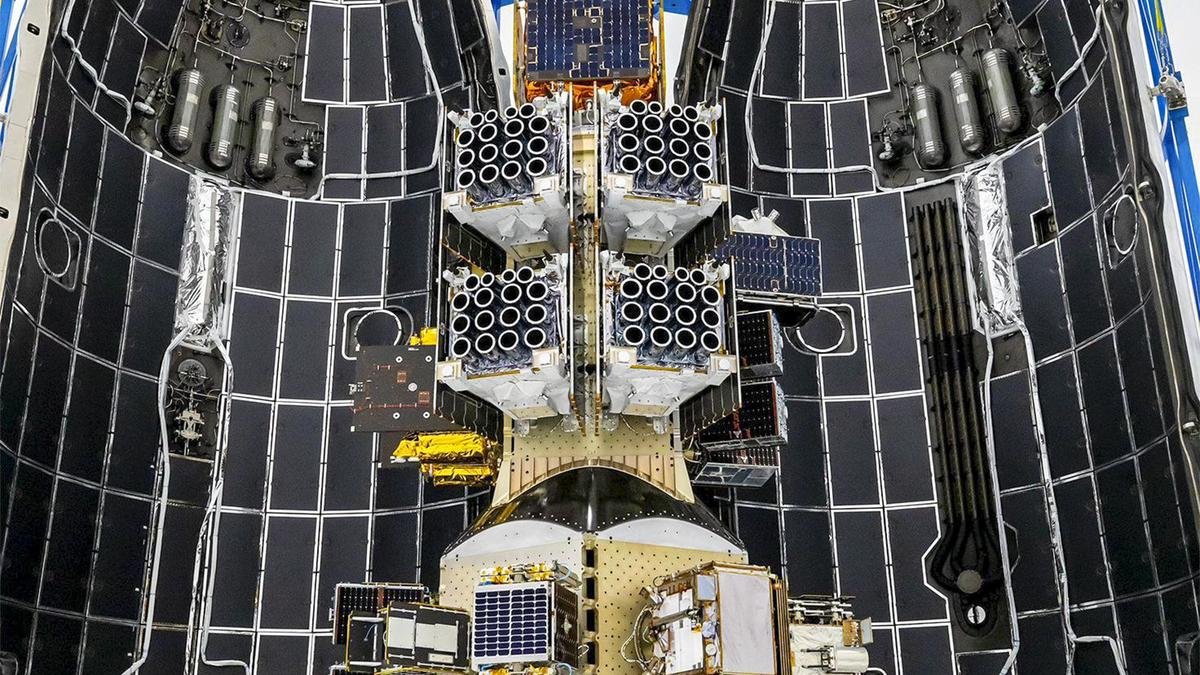
GalaxEye’s Mission Drishti, also described as the world’s first OptoSAR satellite combining optical cameras and all-weather radar, before its launch.
| Photo Credit: File photo
Mission Drishti, the world’s first OptoSAR satellite developed by Bengaluru-based space start-up GalaxEye, which was launched in May, encountered an anomaly following a geomagnetic solar storm during the final stage of the Launch and Early Orbit Phase (LEOP). Mission Drishti is also India’s largest privately developed Earth observation satellite.
On July 7, GalaxEye provided an update on the mission. “In the final stage of LEOP, the maiden spacecraft encountered an anomaly following a geomagnetic solar storm. Initial root cause analysis indicates that radiation effects associated with the event likely impacted a critical onboard system,” the company informed.
It added that, subsequently, communication with the spacecraft became intermittent and was eventually lost.
“While recovery efforts are ongoing, the likelihood of recovery currently appears low,” the company added.
Mission Drishti was launched on May 3, 2026 aboard a Falcon 9 by SpaceX from Vandenberg, California.
GalaxEye said that Mission Drishti successfully established communication and completed a major portion of its planned LEOP. Key spacecraft systems successfully executed critical deployment and attitude control activities, operated onboard computing and communications systems, and demonstrated GalaxEye’s fully in-house mission operations capability through its Mission Control Centre in Bengaluru.
During its active operating phase over a few weeks, Mission Drishti successfully validated critical technologies, operational processes, and infrastructure required to design, build, launch, and operate advanced space systems.
“Mission Drishti marks the culmination of years of innovation, engineering, and execution by our team. While the satellite experienced an anomaly following an extreme space weather event, the mission has provided invaluable engineering insights that will directly strengthen our future missions. Learning from the mission, we are accelerating our transition toward bringing a significant portion of our supply chain, manufacturing, and satellite development processes in-house, giving us visibility and control over the entire value chain. The team is excited, and ready for the next leg of our growth,” said Suyash Singh, founder & CEO, GalaxEye.
GalaxEye is incorporating the learnings into its next-generation spacecraft architecture.
“The company aims to launch two new OptoSAR satellites within the next 24 months while significantly expanding its in-house capabilities to further strengthen quality, reliability, and execution,” the company stated.
Published – July 07, 2026 11:34 am IST


