



In Naples, Dante and two active volcanoes form the inspiration for a subway stop designed by Anish Kapoor.
In Paris, an inverted skyscraper lets playful natural light dance all the way down to platforms 50 metres below the surface.
In China, a spiral Shenzhen Eye crafted in glass and steel signals the aspirations of a booming business district.
So why the dramatic designs now? According to the Belgium-based research non-profit International Association of Public Transport, there are currently such networks in 202 cities across 63 countries, up from 101 cities in 2001 and under 50 cities in the 1980s. Sub-Saharan Africa just got its first, with a major, high-capacity link opening in the Cote d’Ivoire last year.
As new cities are proudly added to the map, and existing ones (such as Naples and Shenzhen) undergo radical change, architectural experiments are reframing the identity of these vital, popular transit links. Take a look.
* A sunken aluminium portal leads to an underworld, in the heart of Naples.
The Monte Sant’Angelo subway station opened to the public in September. Designed by British artist and architect Anish Kapoor, its smooth, brick-red curves are reminiscent of his iconic Cloud Gate public art installation in Chicago.
Fashioned out of weathered steel, it is inspired by Dante’s Inferno, and by the two active volcanoes, Mount Vesuvius and Campi Flegrei.
“In the city of Mount Vesuvius and Dante’s mythical entrance to the Inferno… The idea was to turn the tunnel inside-out, like a sock,” Kapoor has said.
The interiors, in keeping with this theme, resemble a cavern.
Not far away, as part of the same revamp of this ancient city, the Toledo station designed by Spanish architect Oscar Tusquets Blanca and opened in 2012 mimics an underwater world. Its large conical portal allows natural light into underground halls covered in mosaics in blue and silver.
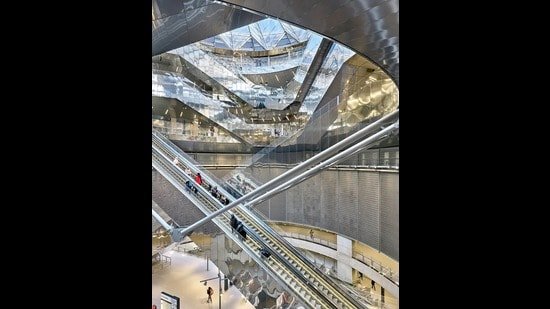
* At Paris’s Villejuif-Gustave Roussy, a 230-ft-wide cylindrical shaft, covered in a glass roof webbed with stainless steel mesh and aluminum wire, houses a network of platforms 50 metres deep. Designed by Dominique Perrault Architecture, the subway stop opened last year.
The roof lets natural light stream all the way down to levels that sit 15 storeys below the surface. The idea, the architects have said, was to shift the commuter’s understanding of what it is like to be belowground.
In scenes that look straight out of a sci-fi film, the various levels, also crafted in glass and stainless steel, are linked by footbridges, balconies and escalators, some of which house activity centres and commercial outlets.
Paris is currently nearing the end of a 15-year expansion effort that began in 2015. Four new lines, and 68 new stations, have been added across the metropolitan region. Among these are Saint-Denis Pleyel, which opened in 2024 and was designed by Japanese architect Kengo Kuma, with a frame made entirely of timber, and a park on its roof.
And Vitry-Centre, designed by French company Atelier King Kong, with sweeping brushed-steel interiors and a massive concourse and walkway above ground, connecting with a local park.
* In Xiamen, China, the Wuyuanwan subway station got a dramatic facelift in 2024. The new façade by Ateno Architects creates a continuous wave effect in panels of red concrete that draw inspiration from the region’s traditional Minnan red brick or cuo architecture.
Meanwhile, about 600 km to the south, along the same eastern coast, the Gangxia North metro station in Shenzhen, drawn up by the London-based Sepanta Design and opened in 2022, draws inspiration from the nearby business district, and the iconic, 49-storey Shenzen Stock Exchange.
At the centre of this structure sits a spiral dome nicknamed the Shenzhen Eye. It directs sunlight down through three underground levels of platforms and commercial spaces.
WHY THESE STOPS?
What makes the metro station the preferred canvas for this kind of engagement with art?
It is, in some ways, a full-circle moment.
The first subway stops in the world may have been rather makeshift affairs, in 1860s London, but as more countries took to the revolutionary idea of an underground mass transit solution that could take messy, chaotic vehicles off the streets — and get everyone where they were going far faster — the thrill of the modern age began to be reflected in the interiors.
Russia turned its stops into palaces of the people; countries across Europe built culture stations that reflected local art forms and history; or paid tribute to local icons.
Think of the Arts et Métiers stop in Paris, parts of designed with curved walls of brushed copper, to resemble the submarine in the French writer Jules Verne’s 1870 sci-fi classic, Twenty Thousand Leagues Under the Sea. Sections of wall from the historic Bastille prison, meanwhile, are preserved at the Bastille station. And Stockholm took elements of crumbling and due-to-be-demolished heritage homes, including water fountains, statues and intricately carved columns, and preserved them, at such stops, underground.
Then the networks expanded, in a sort of ho-hum manner. Focus, in construction, shifted to functionality and speed. As new stops now join the network, and older ones are rejuvenated, they are once again being treated as precious canvases in super-dense cities.
The experience begins with how a metro station is perceived, says Mumbai-based architect and urban designer Samarth Das.
A good metro station is capable of getting the hurried commuter to “pause and marvel, as they begin or end their day but I wish this attention was paid to rail and bus stations too,” adds Smruti Koppikar, journalist and co-founder of the urban-planning research and engagement platform Question of Cities.
BRUSH HOUR
India is not yet at the full-circle moment. Networks are galloping forward; in terms of km covered, metro links have quadrupled over the past decade.
India’s first metro line opened in Kolkata in 1984. Delhi came next, in 2002. Then Bengaluru, Gurugram and Mumbai by 2015. There are now 26 cities in the country with such links. The largest of these are Delhi (416 km), Bengaluru (launched in 2011; 96 km so far), Mumbai (launched in 2014; 80 km so far) and Kolkata (launched in 1984; 73 km), with the smallest active systems in Agra (2024; 6 km so far), Kanpur (2021; 16 km so far) and Jaipur (2015; 12 km so far).
Our most interesting metro stations, though, remain the oldest.
Kolkata’s Kalighat, Maidan, Rabindra Sadan and Tollygunge feature the region’s Kalighat patachitra art, and mosaic murals featuring beloved Bengali icons such as Nobel laureate Rabindranath Tagore and actor Uttam Kumar.
Among the factors holding us back on the metro architecture front, Das says, is a systematic disinvestment in public infrastructure since the 1990s. Private operators tend to prioritise speed and cost-effectiveness over prestige design.
“It’s not a paucity of resources. It’s a paucity of imagination,” counters Koppikar, of Question of Cities. “Form must follow function, but function need not completely dictate form.” That, she adds, is how Anish Kapoor ended up designing the volcanic marvel in Naples and how the well of light took shape in Paris.
With each new station we build in a hurry, Das agrees, we sidestep an opportunity to create a beautiful and aesthetic landmark.
Perhaps India will eventually revisit the ones we have; that is, after all, how Naples’s Monte Sant’Angelo did it too.


