



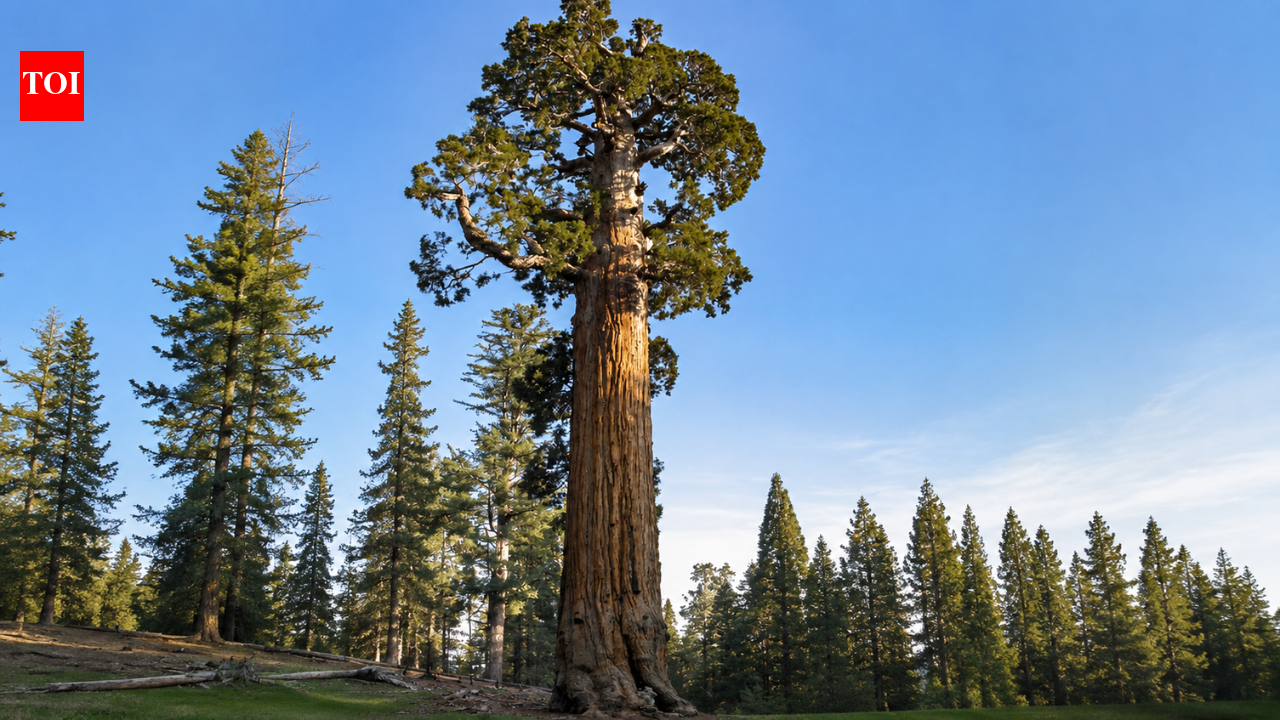
Most people who have heard of giant sequoias can usually name one tree: the General Sherman Tree. Far fewer realise that another extraordinary giant stands only a short distance away in California’s Sequoia and Kings Canyon National Parks. The General Grant Tree does not hold the title of the world’s largest tree, yet its dimensions remain difficult to grasp even when standing beneath it. Beyond its sheer size, it has accumulated a remarkable public history over the past century. It has become the United States’ National Christmas Tree, the country’s only living National Shrine, and an enduring symbol that blends natural history with national remembrance. Together, those distinctions make it unlike any other tree on Earth.
General Grant Tree size: How tall is the world’s second-largest tree
The General Grant Tree is a giant sequoia (Sequoiadendron giganteum) growing in Grant Grove within Kings Canyon National Park in California. Although it is widely recognised as the second-largest tree on Earth when measured by trunk volume, that description only hints at its scale.According to the US National Park Service, the tree stands 268.1 feet (81.7 metres) tall. Around its base, the trunk measures 107.5 feet (32.8 metres) in circumference and contains an estimated 46,608 cubic feet (1,320 cubic metres) of wood.Looking upward from the trail, visitors often struggle to judge its height because the immense trunk continues almost uninterrupted before disappearing into a dense canopy high above the forest floor. The experience simply: “It is difficult to comprehend the immense size, age and stature of the General Grant Tree, but it is easy to let your mind and spirit rise as its trunk carries your gaze toward the skies.”A short paved loop of roughly one-third of a mile leads visitors to the tree while also passing other features of Grant Grove, including the Fallen Monarch, the Gamlin Cabin and the Centennial Stump.
How the General Grant Tree became America’s National Christmas Tree
As per the US National Park Service, the tree’s cultural story began with an unexpectedly ordinary moment. In 1924, Californian visitor R.J. Senior was standing beside the General Grant Tree with a young girl when she remarked, “What a wonderful Christmas tree it would be!” The comment stayed with him.Working alongside Charles E. Lee, Senior organised a Christmas gathering beneath the giant sequoia the following year. The ceremony was held at noon on Christmas Day in 1925, establishing a tradition that continues nearly a century later.Their efforts eventually reached the White House. On 28 April 1926, President Calvin Coolidge officially designated the General Grant Tree as the Nation’s Christmas Tree.Annual celebrations continued through changing times and difficult winters. National Park Service records describe people travelling through snow, returning year after year, and in one instance making the journey even after heavy snowfall forced the official ceremony outside the park. Rangers still placed the traditional wreath beneath the tree, preserving the custom despite the conditions. The annual “Trek to the Tree”, organised by the Sanger Chamber of Commerce, continues each December.
Why the General Grant Tree is America’s only living National Shrine
The General Grant Tree gained another unique role three decades after receiving its Christmas designation. In 1956, President Dwight D. Eisenhower declared it a National Shrine dedicated to “the men and women of the Armed Forces who have served and fought and died to keep this Nation free…”Unlike traditional monuments built from stone or metal, this memorial is alive. The National Park Service states that it remains the only living shrine in the United States.During the dedication ceremony, Fleet Admiral Chester Nimitz compared its significance with one of America’s best-known memorials, describing it as having “equal stature with that other great shrine in Arlington Cemetery, the Tomb of the Unknown Soldier.” That combination of ecological importance and national remembrance gives the tree a role unlike any other giant sequoia.
Why the General Grant Tree remains one of California’s greatest natural landmarks
Grant Grove contains many impressive giant sequoias, but the General Grant Tree naturally draws the greatest attention. Nearby walking routes continue through the grove, passing additional mature trees, open meadows and seasonal streams before connecting with longer trails into surrounding wilderness.Travellers exploring California’s sequoia parks often compare the General Grant Tree with the nearby General Sherman Tree in Sequoia National Park. Sherman remains the largest known tree on Earth by trunk volume, while Grant occupies second place.Even without holding the top ranking, the General Grant Tree represents something broader than size alone. Over generations, it has become woven into annual public ceremonies, military remembrance and the shared history of one of America’s oldest protected landscapes. Few living organisms combine those roles while continuing to grow quietly in the same place where visitors have gathered for more than a hundred years.


