


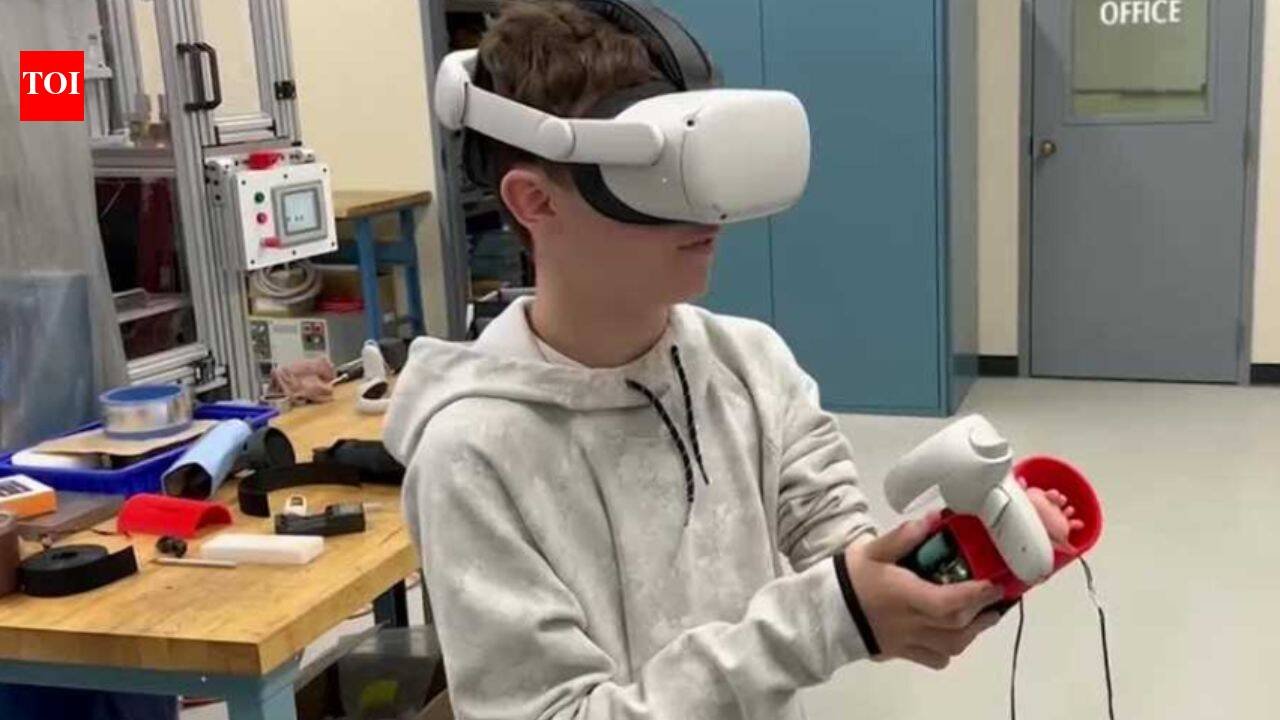
For 14-year-old Scott Merrow of Auburn, New Hampshire, playing video games has always meant finding his own way to use a standard controller. A gamer who enjoys playing virtual reality games with his friends, Scott has a condition called symbrachydactyly, in which fingers may be underdeveloped or may not develop at all, according to Boston Children’s Hospital.According to Wmur, Scott refers to his left hand as his ‘little hand’. While playing with a traditional game controller, he developed his own way of using it. He would keep the controller in his lap and divide its controls between his left and right hands.“And I’d basically just section the controller off, so half would be my little hand; the other half would be my right hand that really just adapted to it,” Scott says. “I can’t explain how it works, because I grew up with it. I don’t know what it’s like to have two hands,” he adds.That approach worked for a traditional controller, but virtual reality gaming created a different problem. VR systems use a headset and controllers designed to be held in each hand. Scott could not grip the left-hand controller in the usual way, so instead of giving up on the games, he decided to build something that could work for him.“This was how it all started out,” Scott, an eighth grader at Auburn Village School, says while referring to the first of three versions of his adaptive VR controller.
From a school project to a working prototype
Scott began the project as a school assignment and asked his uncle, Brandyn Lewis, a mechanical engineer, to help him. Lewis agreed, and the two began working together on the design and programming.The project went through several versions as they tried to solve different problems. Scott worked with Lewis at his shop at New Hampshire Ball Bearings, where they continued developing the controller.Lewis said he enjoyed helping Scott work through the problems involved in creating the device. He also praised the teenager for continuing to work on the project despite the challenges involved.“I like being able to try to help him solve problems, you know, come up with solutions that will benefit him. He’s put a lot of work into this, a lot of effort, to step through this and stuck with it, which has impressed me,” Lewis says.Scott’s third prototype uses a 3D-printed sleeve that wraps around his arm. A sensor inside the sleeve can be pressed by Scott. The system then uses a computer to interpret different amounts of pressure and send signals to the controller.In simple terms, the pressure Scott applies to the sensor is used as an input. The computer reads that input and tells the VR controller which buttons to press. This allows him to operate controls without having to grip the standard left-hand controller in the usual way.
Moment controller finally worked
The third prototype gave Scott a moment he had not experienced before. While testing the adaptive controller, he was able to use it to throw a paper airplane in a game using the left-handed controls. “Oh!” Scott said during the test. “I threw it, by the way.”The controller is not yet a final product. Scott says there are still adjustments that need to be made as he continues working on it.His been presenting the invention through the Invention Convention, a worldwide education programme for students from kindergarten through Grade 12.After winning second place in the New England region, he is set to travel to Michigan for the national convention next month.
Sharing the experience
Scott’s mother, Kristine Merrow, said he has been comfortable explaining his invention and showing people how it works. She said he has been able to speak about the project without needing much practice.“Seeing him kind of hold court as other people go around and with his board and talk about this and stand up, and some of the videos he’s made, that’s with zero practice,” she said. “Scott can kind of naturally talk to people.”Scott has also been sharing his experience on social media and advocating for the adaptive community. A post about his project in the WMUR U Local Facebook group had received nearly 7,000 likes.His parents have supported his work throughout the process. His father, Barry Merrow, said the family is proud of Scott and excited that he wants to continue with the project.“(We are) beyond proud of him,” Barry says. “I mean, he really is excited for this, and I’m excited that he wants to do this.”As Scott continues making adjustments to his adaptive VR controller, he is also encouraging other children who may face similar difficulties not to stop trying.“Don’t give up,” he says. “Just keep trying. Just figure out another way. There’s always going to be another path.”
