



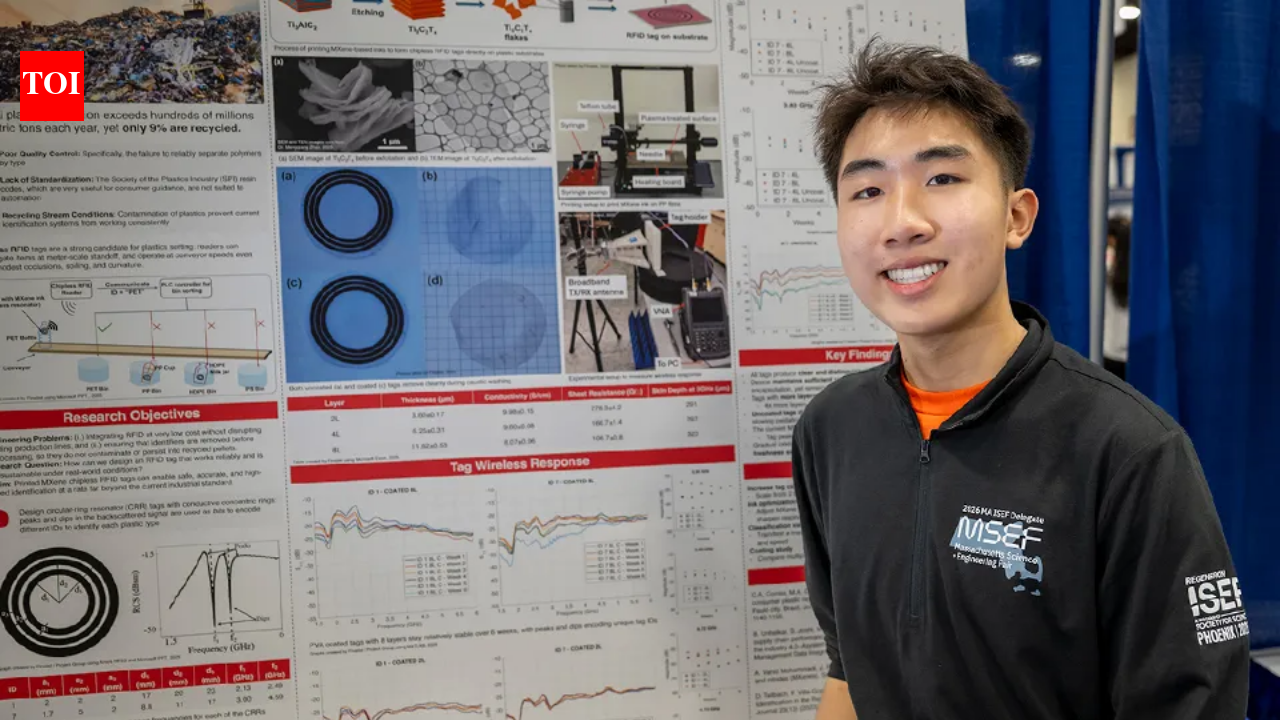
At just 17, Kevin Sun of Andover, Massachusetts, has developed a technology that could address one of the biggest challenges in plastic recycling: sorting different types of plastic accurately. Sun created a dissolvable radio-frequency tag that works like a wireless barcode, allowing plastic materials to be identified during the recycling process. According to the Society for Science, which organises the Regeneron International Science and Engineering Fair (ISEF), Sun received the 2026 Craig R. Barrett Award for Innovation and a $10,000 prize for his project. His invention is designed to provide useful information about plastic without leaving behind material that could contaminate the recycled product.
A wireless barcode for plastic
Plastic recycling depends heavily on proper sorting. Different plastics have different chemical and physical properties, meaning they often need to be processed separately. However, identifying the exact type of plastic can be difficult, particularly when materials are coloured or carry labels and other features that make conventional sorting less reliable.Sun’s idea was to give plastic a kind of digital identity. He printed a radio-frequency tag directly onto plastic materials, creating a system that can transmit information wirelessly. Rather than functioning like a conventional barcode that needs to be visually scanned, the tag can communicate through radio-frequency signals.According to the Society for Science, it acts as a “wireless barcode” that can identify the type of plastic for sorting purposes. This could potentially allow recycling facilities to recognise materials more accurately before they are processed. The approach is particularly interesting because the tag is designed to disappear during recycling rather than remain attached to the finished material.
Kevin Sun (Image Credit: Society For Science)
Why the tag dissolves
A major part of Sun’s project was choosing materials that could perform their job during sorting but would not become a permanent contaminant. The radio-frequency component is made using MXene, a conductive material capable of transmitting radio-frequency signals. Sun printed the material onto plastic, then covered the tag with a thin protective coating.That coating is designed to dissolve in alkaline water. This is important because recycling plants already use hot washing processes to clean plastic before it is further processed.As per the Society for Science, experiments showed that both the tag materials and protective coating quickly broke down during the hot-washing step used in recycling facilities. Once washed away, the plastic can continue through the recycling process without the tag remaining as an unwanted part of the material.In other words, the technology is intended to perform a temporary job: identify the plastic while it needs to be sorted and then disappear during processing.
Testing showed promising results
Sun’s experiments also examined how long the printed tags could remain readable before entering the recycling process. The tests found that the tags remained readable for at least six weeks, suggesting that they could retain their identifying information for a meaningful period before recycling.That durability is important because a tag would have limited usefulness if it stopped transmitting information shortly after being applied. At the same time, the tag must break down at the appropriate stage so it does not interfere with the recycled plastic. Sun’s project therefore combines two seemingly opposite requirements: the tag must be sufficiently durable to identify plastic during handling and sorting, yet dissolvable enough to disappear during recycling. This provides a potential way to improve plastic recycling.Sun’s work earned him recognition at the 2026 Regeneron ISEF, where nearly 1,700 students from more than 65 countries, regions and territories participated. His $10,000 Craig R. Barrett Award for Innovation recognised the potential of his dissolvable tagging system to address a real-world recycling problem.The invention does not solve every challenge associated with plastic recycling, and further development would be needed before such technology could be widely adopted. However, Sun’s project demonstrates how materials science and wireless technology can be combined to tackle a practical environmental problem. For a high school student, the idea represents an ambitious attempt to rethink one small but important part of the recycling process: knowing exactly what kind of plastic is passing through the system.


