
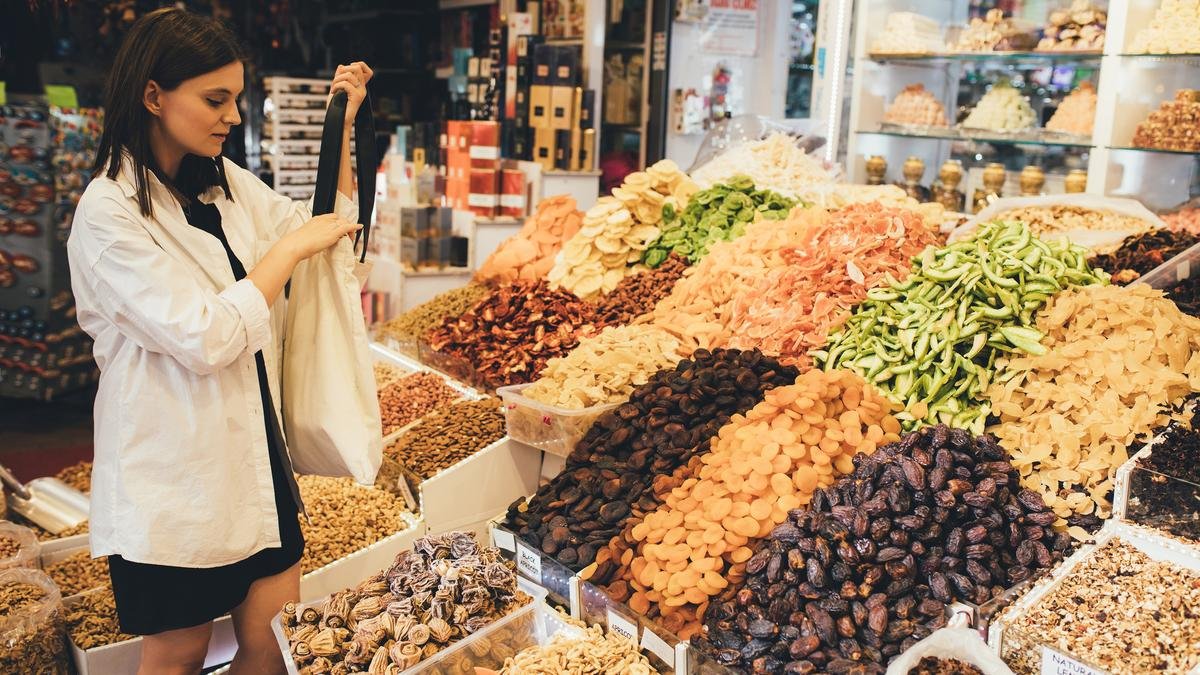
Karthika Ganapathy, a Chennai-based finance professional, has several culinary-focussed Google Lists on-hand. From ingredients and snacks to meats and cookware, she whips out these lists when on holiday or shares them with a travelling friend who can help her check off must-buys.
Read more | Supermarket tourism offers an insight into local culture
‘Will travel for food’ is long past just a slogan on a T-shirt, with several travellers like Karthika tailoring their itineraries solely around a region’s culinary offerings. Once termed ‘grocery tourism’, the new hashtag is ‘Shelf Discovery’ with Skyscanner’s Travel Trends 2026 report noting a rise in travellers exploring grocery stores to experience destinations. Travel predictions for this year by booking.com include a boom in ‘Shelfie Souvenirs,’ or grocery finds that replace traditional keepsakes, given that 84% of Indian travellers are open to buying design-led kitchen or pantry staples when on holiday.
A child and his mother picking groceries at the farmers market
| Photo Credit:
MStudioImages
Southeast Asia and West Asia are Karthika’s favoured destinations. “When visiting the former, I shop for local ramen, pandan leaves that are my go-to for baking, fresh ube, and more. I have lived in West Asia for a while and still source my zaatar, dates and rose water from trusted vendors there. On holiday, I always set aside one suitcase to bring back such delicacies,” she says, adding that a road trip across the Northeast last year had her glued to local markets. “I shopped for spices like dried chillies, gondhoraj limes, greens, and bamboo shoots. and would cook in my Airbnb. I always ask my hosts for recommendations and even ask locals and chefs for suggestions for lesser-known ingredients or restaurants to visit.”
Chef Thomas Zacharias at a supermarket in Dimapur, Nagaland
| Photo Credit:
The Locavore
For Mumbai-based Thomas Zacharias, this way of exploring cities has always been a part of his learnings as a chef. Long before he started The Locavore — a platform that champions regional food cultures via storytelling, community events — Thomas says he was “drawn to markets because they felt like the most honest way into the food culture of a place”. “You can eat at restaurants to understand a cuisine, but if you really want to understand how a place and its people eat, you go to its markets. You look at what people are buying, what is in season, what feels abundant, what is being displayed proudly, and what is quietly disappearing.”
Thomas looks for…
What is genuinely local and seasonal at that moment.
What people are actually buying and cooking, as opposed to what is simply being displayed.
Ingredients he doesn’t recognise, or ones he recognises but hasn’t seen used in that particular way.
The relationship between vendors and customers. In many places, food still moves through trust, memory, and habit, not just transactions.
This learning, he says, inevitably finds its way back into how he cooks, what he writes about, and the work at The Locavore. The latter reflects in Chef on the Road, wherein Thomas takes small groups of travellers on journeys to explore how ‘food actually lives in specific landscapes, seasons, and communities’.
Read more | Chef Thomas Zacharias on his culinary tours and the food souvenirs he brings back
“This year alone, we’ve done three such trips, to Maharashtra, Mishmi Hills in Arunachal Pradesh, and to Jharkhand during the Mahua harvest. In all of these, markets, farms, producers, and local food economies are central, not as sightseeing, but as a way of helping people understand food more deeply,” explains Thomas, who, after his time in the US, travelled through France, Italy, Spain, Portugal, and Japan. “Those trips were shaped almost entirely by food. I spent time in markets, bakeries, small stores, farms, and neighbourhood food spaces. That was my way of understanding a culture.”
Goan choris pork sausage and coconut vinegar on sale at Ferns Pork Centre at New Market, Margao, Goa
| Photo Credit:
The Locavaore
Writer Anubhuti Krishna who also helms the experiential platform Lucknow with Anubhuti (₹15,000 per person for a two-day tour), says she has noticed an interesting shift in people travelling for food experiences. As part of a food and aromatics tour organised in Delhi and Lucknow this March, she took a group of Indian and international travellers on the Lucknow leg. “We visited attar shops, perfumeries, and organised meals that highlighted how aromatics such as clove, mace, and nutmeg are central to Lucknowi cuisine. In fact, even kebabs are infused with vetiver and sandalwood,” says Anubhuti, adding that the group was taken to local markets to shop for spices. “Guests enjoy visiting local markets to buy namkeen (dal moth, namak paras), mithais (motichoor ladoos), spices (buknu, kebab masala), and attar. In the winter, sweets like gajak and revdi are popular.”
Local supermarkets offer an insight into a region’s food culture
| Photo Credit:
LPETTET
Down South, Jayanti Rajagopalan has been hosting city and culinary tours in Hyderabad since 2008. Named Detours India, the outfit also showcases India to tourists through food. “I explore the connections between food and culture, geography, and history.” Her annual Khanasutra festival takes travellers across 3-4 cities, and this year it will be held in November and guests will explore Hyderabad, Puri, Amritsar, and Uttarakhand.
Read more | Chefs reveal the best meals they ate on their travels
“These tours are not just about eating, but understanding the country better. Most clients enjoy food walks (₹4,000 per person) that involve a cooking experience at a local’s home. Post this, they are keen on buying the utensils, ingredients and produce rather than packaged stuff at the airport. Popular items on their shopping lists include tiffin boxes, masala dabbas, and spices like gongura for which we take them to local shops,” says Jayanti, whose tours include experiences such as learning how tandoors are made in Amritsar, chatting up women at an Ahmedabad cooperative who talk about how their ability to cook is empowering in trying family situations, or learning the link between food and health at an Ayurveda centre in Kerala.
Keep in mind
Almost all ingredients can be carried on flights if they are checked in, but packing becomes important especially with liquids, pickles, or anything that might leak.
In hand baggage, liquids above 100 ml, along with things like pickles or spice powders and chillies, are usually not allowed.
With perishables, it really comes down to handling. If they’re properly refrigerated beforehand and stored immediately once you arrive, they’re generally fine for shorter journeys.
The trend is picking up among hospitality majors too. For instance, at The Four Seasons in Jimbaran Bay, Bali, ‘A Day in the Life of a Jimbaran Fisherman’ tour takes guests on a seven-hour experience on a traditional boat to learn local fishing techniques. This includes a stop at the local Kedonganan Fish Market to choose ingredients to cook back at the resort’s Jala Cooking Academy. Closer home, The Lotus Palace Chettinad launched Suvaii last year: a three-day immersive culinary festival that comprised elaborate wedding-style feasts, talks on heirloom recipes, traditional cooking methods, distinctive cookware, and more.
Roni Mazumdar (far left) co-founder of New York City-based restaurant group Unapologetic Foods, with his team on a tour with Lucknow with Anubhuti
| Photo Credit:
Special Arrangement
Anubhuti explains how this trend is evolving and now many seasoned chefs sign up for the tours to explore lesser-known delicacies. “We have hosted chef teams from restaurants within India such as Masque, and international outposts such as Dishoom in the UK, and Semma in New York.” For Thomas, learnings from his independent sojourns have found their way back into his cooking. “I remember spotting tiny marble-sized local potatoes in a market in Assam’s Dibrugarh, which eventually inspired a dish, guti aloo kulambu. In Indore, discovering the jeeravan spice mix led to a bhutte ka kees-inspired dish, and tasting kalari cheese in Srinagar resulted in a fritter on the menu at The Bombay Canteen.”
Shop smart
Keep baggage limits in mind, and purchase ingredients that you will not get locally or online.
For pickles and similar products that come with a risk of spillage, ask vendors if they can ship them to your home address.
If travelling within India, most branded snacks are available online so only shop for unique finds.
When abroad, opt for local markets rather than airport stores for a more authentic experience.
Thomas says it is important not to lift something directly out of context, “but to spend time understanding it”. “If I’m trying to recreate a dish, I’ll first bring back the ingredients, figure out sourcing, and cook it as faithfully as possible. Only after that do I start interpreting or adapting it. So while the starting point is often a market or a single ingredient, what it really becomes is a longer process: of understanding, translating, and slowly building it into my own cooking.”
A tourist shopping for seafood and snacks at Don Hoi Lot seafood market in Samut Songkhram, Thailand
| Photo Credit:
Tuayai
For Delhi-based private chef Khaja Zafarullah, also known as Zafar, his tryst with shelf discovery began by accident 25 years ago when he picked up sumac, Marash peppers, and baklava at a market in Istanbul. “After this trip, every time I went to a different country, I would go to a store or market and pick up local cheese, spices, and cured meats which I would bring back and use in my kitchen,” says Zafar, who has been on several culinary-led journeys with experts in the field. These include trips to Georgia and Thailand with cookbook author Naomi Daguid; with British author Fuchsia Dunlop to Yunnan; to name a few.
A vendor picking dried corn at Tlacolula Market in Oaxaca, Mexico
| Photo Credit:
Khaja Zafarullah
He explains, “These trips almost always include a visit to markets or specialty stores. On some of these tours, we take cooking classes, which also give us an opportunity to learn about and bring back specialised ingredients like wagyu beef from Japan, and long pepper, fresh bay leaves, sausage and dried meat from Mehalaya.” Some of his most interesting finds include hand-harvested fennel pollen from California that he uses sparingly on ice creams and salads, Sichuan dried meat from Yunnan, rare chilhuacle chillies found only in Oaxaca, Mexico, that Zafar uses to make mole and barbacoa.
A woman selling fruit from her boat in the Mekong river delta, Vietnam
| Photo Credit:
Bartosz Hadyniak
Kitchen essentials
Alongside fresh produce and dry snacks, utensils and traditional cookware also feature on the shopping lists of culinary-focussed travellers. Zafar, for example, has picked up crockery, glasses, knives, and kitchen tools from around the world. “I have a specialised truffle shaver, cheese knives specific to particular cheeses, and beautifully glazed bowls. In India, I love visiting cottage industries: weavers for tablecloths and napkins, potters for tableware and bowls.”
Utensils and traditional cookware also feature on the shopping lists of culinary-focussed travellers
| Photo Credit:
Phynart Studio
Pots, pans, and baking trays feature on Karthika’s Google lists. “I shop for ceramics, old pyrex ware, crystal ware, and more. I am still on the lookout for oreshki pans (walnut cookie pans), a German obsttorte (fruit flan) pan, and a cast iron waffle pan. These aren’t expensive buys, but are specific kitchenware I keep an eye out for.”
Read more | Discover the hidden culinary gems of Lucknow with Anubhuti Krishna
Akin to Thomas who recently picked up a mortar and pestle in Vietnam made of coconut wood. “It’s simple, but works beautifully, and carries with it a memory of where it came from. You can’t fully understand the food without understanding the vessel it is cooked in, and traditional cookware carries technique, but also memory and rhythm,” he says, adding that whether it’s an earthen pot, a fermentation jar, a particular kind of pan, or even a very specific ladle, these tools shape flavour, texture, and process in ways we often overlook.
A woman selling bananas in a Balinese temple in Ubud
| Photo Credit:
VisualStories
Getting back from a vacation with a bag full of edible souvenirs is a dream, but given current times where air fares are soaring as are freight costs, practicality comes into the picture. “The fact that almost everything is available online these days is a double whammy: on one hand it takes out the fun of say experiencing a snack being made in front of you, and on the other hand, ordering online saves one the hassle of lugging it back home. Domestic baggage limits are a hindrance, and spillage issues as well,” says Jayanti, who prefers buying all consumables such as olive oil, saffron, and paprika from a local supermarket rather than at the airport.
A vendor at a fish market in Negombo, Sri Lanka
| Photo Credit:
Khaja Zafarullah
If you are planning to head out on a similar culinary trail, these experts recommend taking one thing with you: an open mind. “I don’t like going with a fixed idea; I like to browse through the aisles and find unique ingredients. I was in Chiang Mai and found pineapple Kit Kat. Who knew? If you have a shopping list, fine, but take the time to slow down and browse without an agenda; you never know what you might find. In the end, it is not just about going shopping for ingredients; but understanding their stories and the history they carry,” concludes Zafar.

