






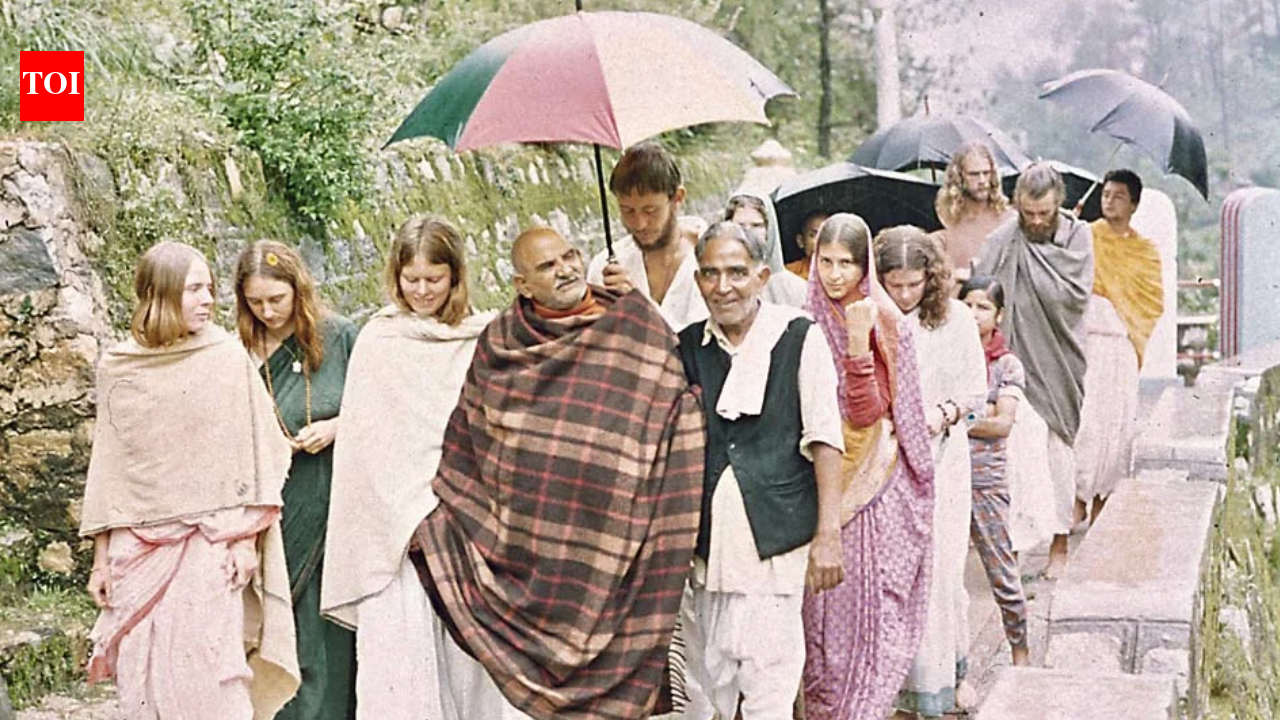
More than five decades after his death, Baba Neeb Karori continues to amaze.‘Hanuman Ansh’, a film inspired by his life, has emerged as an unlikely box-office phenomenon, upsetting conventional rules of filmmaking with its modest budget, slow start and eventual turnaround.People are hearing the songs from the movie on loop and the actor playing his role is being treated by some as Baba’s incarnation.For devotees and the makers of the film too, there is a little mystery in the film’s journey. They see it as the latest addition to the long list of miracles associated with Baba, whose greatest virtue was his simplicity.“The entire journey of this movie is a garland made of pearls of Baba’s grace,” producer Ragini Sona says.Born in Lucknow and based in Nainital, Sona, who is into fashion designing and film production, says her association with Baba goes back to her childhood.
Followers and the inspired ones
“I saw Baba ji as a child with my father. When the idea for this film came, I felt I was engaged in a ‘Ram kaaj’ (godly task). There were no second thoughts,” Sona recalls.Sharing his experiences, director Vishal Chaturvedi says, “Baba Neeb Karori is a household name among Lucknowites, but I experienced his divine energies when I went to his ashram in Kainchi during my internship days. Probably, the seeds of the thought of making a film on him were sown there. His blessings showered on all of us in the form of the film’s success,” he told reporters in Lucknow.80% of movie on Baba was shot in UP’s ChitrakootThe lead actor, too, emerged from an unexpected turn of events. Shobhinaw Satyaa had joined the project as an assistant director and was working behind the camera when the actor cast as Neeb Karori Baba fell ill on the first day of shooting. Chaturvedi asked Satyaa to audition for the role.The screen test lasted nearly five hours before he was chosen. “I never imagined that I would play Neeb Karori Baba,” says Satyaa, who belongs to Khairabad in Sitapur. The filmmakers count several turning points among the instances of Baba’s grace. Executive producer Piyush Thakur, a native of Kanpur, says the project went through several trials in its initial stages.“But then Baba’s grace took over and every problem was miraculously solved. At many places, the ‘Sankat mochaks’ (problem solvers) were either linked to Hanuman or Hanuman Ansh (Baba Neeb Karori),” he says.Adding that nearly 80% of the film was shot in Chitrakoot, with locations including Shivram Pur, Punjabi Baba Ashram, Arogyadham and Parsauja village, Thakur says, “The film’s first scene was shot at Punjabi Baba Ashram on the banks of the Mandakini. There was an unexpected spiritual connection to the location. After selecting an old room at the ashram for the opening sequence, director Vishal Chaturvedi learnt that Baba Neeb Karori had once stayed in the same room.”The production also brought local residents into the film and turned it into a community exercise in Parsauja. Residents recall that Chaturvedi personally moved through the village with a microphone, greeting and inviting them to come dressed in ‘dhotikurta’, ‘kurta-pyjama’ or ‘sadri’, while women were asked to participate in sarees.Chitrakoot’s Ravi Sahu plays a subedar, a role he got after meeting Chaturvedi. His scenes were filmed inside the old building of a junior high school in Shivram Pur, which was transformed into a Fatehgarh police station and jail. It is here that Baba Neeb Karori is shown being imprisoned — only to disappear after the jail is locked. “I never thought that I would become part of such a big spiritual film,” Sahu says, recalling his scenes with Baba.He also remembered the devotional atmosphere on the sets, where Ganesh puja and recitation of Hanuman Chalisa were conducted every day. When a Hanuman idol was being installed and a hut and cave were being constructed, a black monkey appeared at the site. Sahu says it was the first such sighting there in 14-15 years. The animal sat on a banyan tree watching the construction before moving towards the cave.


