



It’s one of the first things to go in an apocalypse, or so all the science-fiction suggests.
In the slow-burn but often-riveting second season of the streaming series Paradise, for instance, a mega-volcano has shut out the sun; civilisation has fallen; it is three years on. At swap meets held in high-school gyms, people trade precious objects such as tools, bullets, batteries. Items most in demand include any forms of food from the before world, including sachets of ranch dressing.
In Cormac McCarthy’s masterful 2006 novel The Road, a wallet offers a chilling reminder of how little inherent value money has, outside the systems that hold it up.
In the real world, even centuries after money took over most trade, alternative currencies endure: easily quantifiable items that represent value because they are considered rare and vital, and can easily be swapped for something else. Before we get to those, a quick look back at bits of history that serve as a reminder of how new the concept of money really is.
In the US state of Virginia, remote settlers living largely outside the reach of banking systems, used tobacco as currency until as late as the 1750s. Tobacco grew locally, aged well, was much in demand, and so the system worked smoothly.
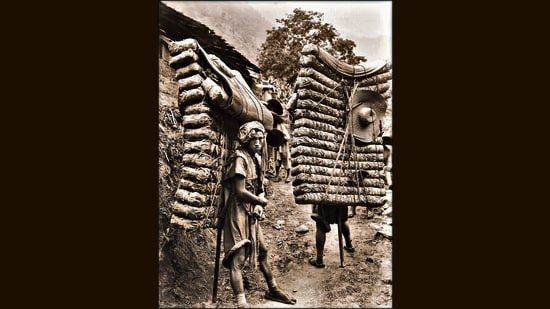
In China, for similar reasons, tea served this purpose, until the 1390s. One could pay for goods, services and livestock using compressed tea bricks, whose dense form didn’t just preserve flavour but also mellowed and enriched it over time.
Bricks of tea, rather incredibly, continued to be used in remote parts of Tibet, Mongolia and Siberia until the 1920s.
The Maasai in East Africa traditionally bartered cattle, a key measure of wealth, for goods such as grain, tools and other forms of livestock. Metal tools remain a vital element that cannot easily be made or accessed within remote tribal communities, in parts of Africa as well as in regions such as India’s Andaman Islands and the Amazon rainforest, so these, alongside clothes and everyday items such as pens, are among the few goods acquired from the outside world. Since such tribes tend to avoid money, out of a sense of both distrust and bafflement over how it works, livestock or home-brewed alcohol are generally offered in exchange.
Meanwhile, across colonial America, with little infrastructure and little use for money itself in the early years, dramatic new forms of barter evolved. For 200 years, between 1620 and 1820, the beaver pelt served as a standard unit of exchange. Writings from this period indicate that a rifle could be acquired with 12 beaver pelts, a pistol with four. A single pelt could buy a kettle or 1lb of tobacco, 20 fishhooks or as many pieces of flint.
The pelts, incidentally, were usually taken to the nearest city or trading post, where they fetched good money. They were shipped from there to Europe, where they were all the rage among the wealthy and fashionable. So even in this widespread barter system in the earliest years of America, it was eventually capitalism at work.
Traditional bartering continues, in informal economies (remote regions, rural areas) and during times of crisis (such as war, conflict, hyperinflation or currency collapse).
Ancient Mesopotamia perhaps had it somewhat right. Goods such as barley were considered so valuable, they were used as currency alongside (if not equivalent) to silver. Something to think about, in the Anthropocene.
(Adam Jacot de Boinod is the author of The Meaning of Tingo. The views expressed are personal)


