



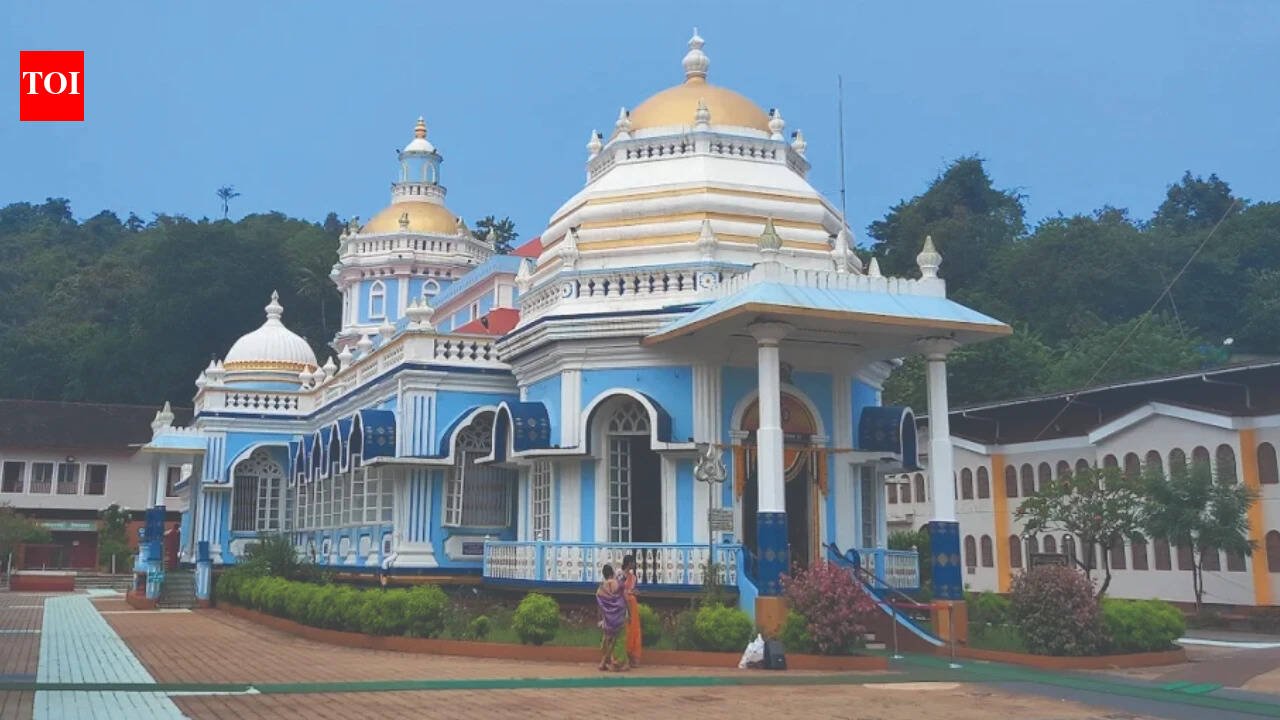
Navratri in Goa is marked by a rich variety of religious traditions, and Makharotsav is one such tradition that holds a special place, bringing together devotion, craftsmanship, heritage and community participation.
Celebrated at temples across the state, Makharotsav is known for its elaborate Aaras, the decorative arrangement surrounding the deity, their different forms, their ‘vahanas’ and ceremonies that reflect Goa’s cultural heritage. Most temples in Ponda, including Shree Mangesh, Shree Mahalaxmi, Shree Nagesh, Shree Ramnath, Shree Shantadurga, Shree Navdurga and Shree Nagesh, each observe the festival through their own customs and traditions.Shree Mahalaxmi Temple, Bandora
At Mahalaxmi temple, Makharotsav is marked by the changing forms of the deity and elaborate decorations of the Aaras. Each day, the goddess is adorned in a distinct form, with decorations associated with her different avatars, said temple priest Sameer Datte.For devotees, witnessing these changing forms is more than a visual spectacle, said Datte, adding that the daily rituals and changing representations of the goddess strengthen the connection between the devotees and their religious heritage.The festival reflects the devotion of the community and the importance of passing traditional practices from one generation to the next, he said.Shree Shantadurga Temple, Kavlem
Shree Shantadurga Temple, Kavlem
At Shree Shantadurga Temple, the festival begins with ‘ghatasthapana’ and ‘punyavachan’, said purohit Vinayak Pendse.Daily rituals during the festival include ‘sukhasan’ and the setting up of the ‘makhar’, an elaborately decorated structure in which the deity is placed. The decorations change according to the occasion and the form of the goddess being worshipped.
On Panchami, the fifth day of Navratri, the idols of five goddesses are placed together in a single makhar, making it a distinctive part of the celebrations. On Ashtami, the eighth day, the forms of Mahakali, Mahalakshmi, Mahasaraswati and Mahaganapati are placed in the ‘makhar’. On Navami, the ninth and final day of Navratri, the goddess appears as ‘Mahishasuramardini’.The celebrations continue on Vijayadashami with a traditional palkhi procession that extends beyond the temple premises. The palkhi visits houses in the vicinity of the temple, where devotees offer ‘oti’ to the goddess as an expression of reverence.The palkhi also visits nearby temples and the Kavlem mutt before returning to the temple past midnight.Shree Mangesh Temple, Mangeshi
Makharotsav at Shree Mangesh temple dates back more than 150 years, said temple pujari Damodar Alavni. One of the most distinctive features of Makharotsav is the presentation of the deity on different vahanas (the divine vehicle of deities) on all nine days of Navratri, said Alavani.“On the first day, lord Mangesh appears on a ‘nandi’ (a bull), followed by ‘ghodo’ (a horse) on the second day, ‘gendo’ (a rhinoceros) on the third and ‘kalvit’ (a reindeer) on the fourth. The fifth day the lord is seated on a ‘mayur’ (a peacock), the sixth day on a ‘haran’ (a deer), on the seventh day, on a ‘simha’ (a lion), followed by a ‘gaja’ (an elephant) on the eighth and ‘wagh’ (a tiger) on the ninth day,” the priest said.He added that another distinctive feature is the ‘gandbhairav’ ritual. When Navratri extends to 10 nights, ‘gandbhairav’ is presented on the ninth day in the form of a bird with two peaks.Shree Ramnath Temple, Ramnathi
At Ramnath temple, Navratri is celebrated over 11 days, with rituals honouring the temple’s seven deities—Lakshmi Narayan, Ramnath, Sateri, Kamaxi, Betal, Kal Bhairava and Siddhnath. The first nine days are dedicated to goddess Kamaxi and goddess Sateri, while Vijayadashami (Dussehra) and Ekadashi (the 11th day) are devoted to lord Ramnath, a form of lord Mahadev, said pujari Prakash Bhat.Akhand diyas are kept burning throughout the nine days, while flowers are offered to both the devis through a ritual known as ‘Mala Bandhan’. Evening ‘kirtans’, changing vahanas and the presentation of different avatars of goddess Kamaxi add to the festivities.
On the first day, goddess Kamaxi appears in her own form. On the second day, she is seated on an ‘Ambari’ (an elephant howdah). On the third day, she appears as Simharudh (riding a lion), followed by Ashwarudh (riding a horse) on the fourth day. The fifth day is dedicated to Mahalakshmi, while the sixth features ‘Vyagheshwari’, associated with a tiger. The seventh day features ‘Mayureshwari’, associated with the peacock, while the eighth day is associated with ‘garud’, the eagle. On the ninth day, the devi appears as ‘Mahishasuramardini’, the slayer of the buffalo demon ‘Mahishasura’.The celebrations take on special significance on Vijayadashami with Tarangavani, Shree Ramnath golden ‘palkhi’ and Shree Kamakshi ‘vijayrath’, along with other religious observances, said Bhat.Vijayadashami also features the traditional Abhisar, referred to locally as Bhat, and a palanquin procession that travels beyond the temple boundaries for special pujas. The celebrations continue on Ekadashi with the ‘kaul prasad’ ritual.
