


A nation-state speaks in a register of credibility. It uses terms like “tribal welfare,” “land acquisition,” “rehabilitation,” “development displacement,” “encounter killing.” This vocabulary is neutral, almost soothing. It converts eviction into policy, starvation into statistics. The language creates distance between action and consequence, between what the state does and what that doing means for the people it’s done to. On paper, through proper channels, violence becomes governance.
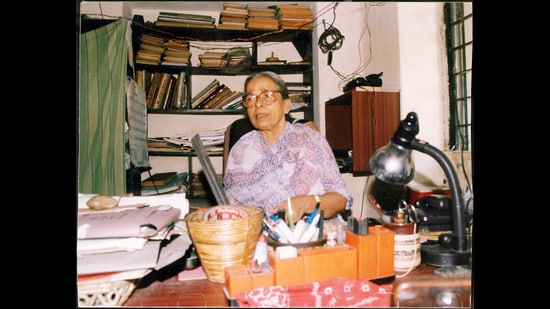
But language has its limits. In India’s famine belt and forest regions, vocabularies are different. Here, “land acquisition” translates to homelessness, “development” to displacement, “resettlement” to abandonment, “encounter” means murder, “loan” means bondage. The gap between what the state calls an action and what that action does to a life is where Mahasweta Devi built her work.
She wrote, for six decades, in that narrow crack, translating the untranslated. Her literature exposes the nation-state as a set of decisions that determine who may live with dignity, who may speak and be heard, who belongs, and who must vanish.
That gaze came from her childhood, from her Santiniketan. In Ek Jibonei, she writes, “Had I not lived in Santiniketan during those times, my ear would not have become attuned to hearing the unspoken utterances of the mute humanity… I would not have been moulded into the kind of person I am.”
The Queen of Jhansi, her first major book, reconstructs Rani Lakshmibai through oral memory, regional histories, avoiding colonial archives or nationalist hagiographies. Who controls the past controls the present and literature, in her hands, was a tool for wresting history away from those who use it to justify their power.
A Naxalite, a political actor, a son is reduced to Corpse No 1084 in Mother of 1084. The book is his apolitical mother Sujata’s journey to reclaim her son from the filing system. “Did Brati die so that these corpses with their putrefied lives could enjoy all the images of all the poetry of the world… Did he die for this? To leave the world to these corpses?” “Freedom could not come from the path society and the state offered,” she would conclude.
The nation-state drops its mask entirely in her writing about Adivasi communities, its development rhetoric stripped away. In Aranyer Adhikar, her novel about Birsa Munda, the forest is the condition of life itself. The fight over it is the fight over existence. “The Munda people could not see… They are there, right there in the land of Chota Nagpur, and yet not in Chota Nagpur, because they have no claim to that soil. Between them and their motherland stand hundreds of walls.”
These same walls, these colonial laws — forest acts, land revenue systems — was readily inherited by the Indian state, laws that translated commons as state property, inhabitants as encroachers. This translation is seen in her novel, Chotti Munda and His Arrow, which also follows the Munda community, across decades this time, watching the seamless transition of colonialism into postcolonial “development.” The future gleefully arrives to “rescue” a backward region from itself. What doesn’t change is who benefits and who pays. Progress is merely a very old violence wearing modern vocabulary.
In the introduction to Bitter Soil, Devi writes, “My Palamau is a mirror of India.” She means the nation without its decorations — the bonded labour, the land theft, the sexual exploitation, the bureaucratic indifference.
The female body, in Mahasweta’s fiction, is evidentiary. It’s the place where policy, economics, traditions and social dynamics inadvertently leave their marks. Her novella Douloti the Bountiful has a tribal woman sold into prostitution through systems of debt and patriarchal control. “Today, on the fifteenth of August, Douloti has left no room at all in the India of people like Mohan for planting the standard of the Independence flag. Douloti is all over India.” The body spread across the nation is the physical manifestation of how the nation operates, what it requires to function. Women’s bodies as resources to be exploited and discarded. Or as the story Giribala keeps hammering, “a girl’s by fate discarded, lost if she’s dead, lost if she’s wed.”
In Rudali, the wealthy hire lower-caste women to cry at funerals because authentic grief is beneath or beyond them. Sanichari becomes a rudali out of necessity, weeping professionally. Death is a clinical fact of life, to be dealt with and moved on. “Is it possible to feed so many mouths on the meagre scrapings they bring home? Two dead, just as well. At least their own stomachs would be full.” Extreme poverty makes death feel practical, turns loss into economic calculation. A society that requires such calculations, that makes death a relief, has failed its most basic obligation to human life.
Whether in her fiction or non-fiction, the author never fails to name the system, to point at perpetrators. “With a mainstream society long used to exploiting them, a bureaucracy that is, at best, indifferent to their problems, and political parties mainly interested in mobilizing their votes, the largely illiterate and numerically few tribals can do little,” she writes in her essay, Land Alienation Among Tribals.
Even when she recreates revolutionary history, as in Titu Mir, she’s asserting a politics of solidarity cutting across religion and caste, grounded in shared exploitation. “I believe unshakeably that the poor weavers, both Hindu and Muslims, the farmers, cotton ginners, fabric dyers… will definitely respond to your call… Our fight is against injustice of all kinds, against all torture and oppression.” The moral universe of her work is organized around the line between the needful and the needless, the oppressed and those who benefit from oppression.
Mahasweta Devi’s activism and her writing were never separate practices. From founding bonded-labour unions to editing Bortika to letting rickshaw pullers and Adivasis author their narratives, she refused to accept a world where certain lives exist just to be exploited and forgotten.
For six decades, she wrote as if the nation were standing trial. The evidence is overwhelming. The verdict is clear. What remains is the question she leaves behind, unanswered and unanswerable: What kind of country requires this — this erasure, this cruelty, this apathy, this endless conversion of human beings into waste — just to function? And if this is what it takes, what exactly are we trying to save?
Amritesh Mukherjee is a journalist, writer, and editor fascinated by the stories that shape our world. Instagram/X: aroomofwords
