






A nail-biting election is expected in Brazil as the country prepares to vote for its next president. Based on the latest media polls, incumbent president Luiz Inacio Lula da Silva is projected to hold a narrow lead over Senator Flavio Bolsonaro, the son of former president Jair Bolsonaro.

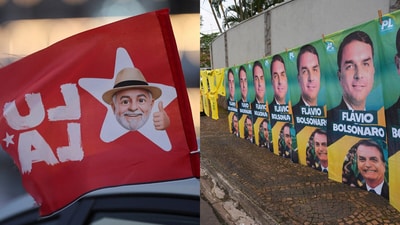
The first round of voting in the presidential election will take place on October 4 from 8am to 5pm Brasilia time (4:30pm to 1:30am IST). The second round of voting, or a run-off, if needed, will be held on October 25.
Around 159 million Brazilians are eligible to vote in this tense political showdown, and based on the polls, the vote is likely to head into a run-off.
Who are the candidates?
At 80, Lula is fighting his seventh election and eyeing a fourth term at the top post. The octogenarian has been a key figure in Brazilian politics and was named the candidate for the Workers’ Party or PT, for the 2026 elections.
Against Lula is 45-year-old senator Flavio Bolsonaro, the son of former president Jair Bolsonaro, who is the candidate of the right-wing Liberal party.
Flavio has pledged a hard stance on crime and close cooperation with the United States, which the Lula administration has worked to move away from.
Apart from the key contenders, Augusto Cury, Ronaldo Caiado, Renan Santos and Romeu Zema are also in the race for president.
Lula projected to take narrow lead over Bolsonaro
To secure a term as the next president, a candidate must secure 50 per cent of the votes. If neither candidate secures 50 per cent, the election goes into a run-off, where another round of voting is held.
Based on the current polls, incumbent Lula da Silva is expected to maintain a slight lead over far-right Bolsonaro.
As per the CNT-MDA poll, Lula is projected to secure around 47.8 percent of the votes, with Bolsonaro close behind at 42.1 percent.
Majority of the surveys in Brazil have predicted a close contest between the left-wing incumbent and the far-right senator.
Here’s a look at some of the other polls –
- Datafolha – 45 per cent for Lula and 42 percent of Bolsonaro.
- Quaest poll – 46 percent for Lula and 45 percent for Bolsonaro
- Bloomberg and AtlasIntel- 47 percent for Lula and 44.1 percent for Bolsonaro
Despite the polls, last-minute decisions from voters are expected to play a key role in who will become the next president of Brazil.
Why the US will keep a close eye
The presidential elections in Brazil will be one which is closely watched by US President Donald Trump as the Republican leader works towards establishing ties with Latin America.
This also comes as Trump allies find support in recent years in Latin American countries such as Argentina, Colombia and Peru; and the looming threat of a US intervention, as seen in Venezuela earlier this year.
Flavio Bolsonaro has often touted his proximity to the White House and insisted Brazil needs to strike better deals with the Trump administration, including the rare minerals economy.
While Trump has not endorsed Bolsonaro, the US president has often praised his father and also showed his support by sanctioning the Supreme Court justice who chaired the probe regarding Jair Bolsonaro’s sentencing.
Also Read | Donald Trump imposes 50% tariff on Brazil, calls Jair Bolsonaro’s trial a ‘witch hunt’
Meanwhile, the Lula administration has found itself to be at odds with Washington over tariffs, trade and its active participation in the BRICS bloc.
Brazil also denied visas to two US officials who sought to travel to the country, saying they planned to cast doubt on the integrity of Brazilian elections, adding to tensions.
Furthermore, Trump himself has also used false claims of rampant fraud to justify efforts to remain in office despite his election loss in 2020.


