



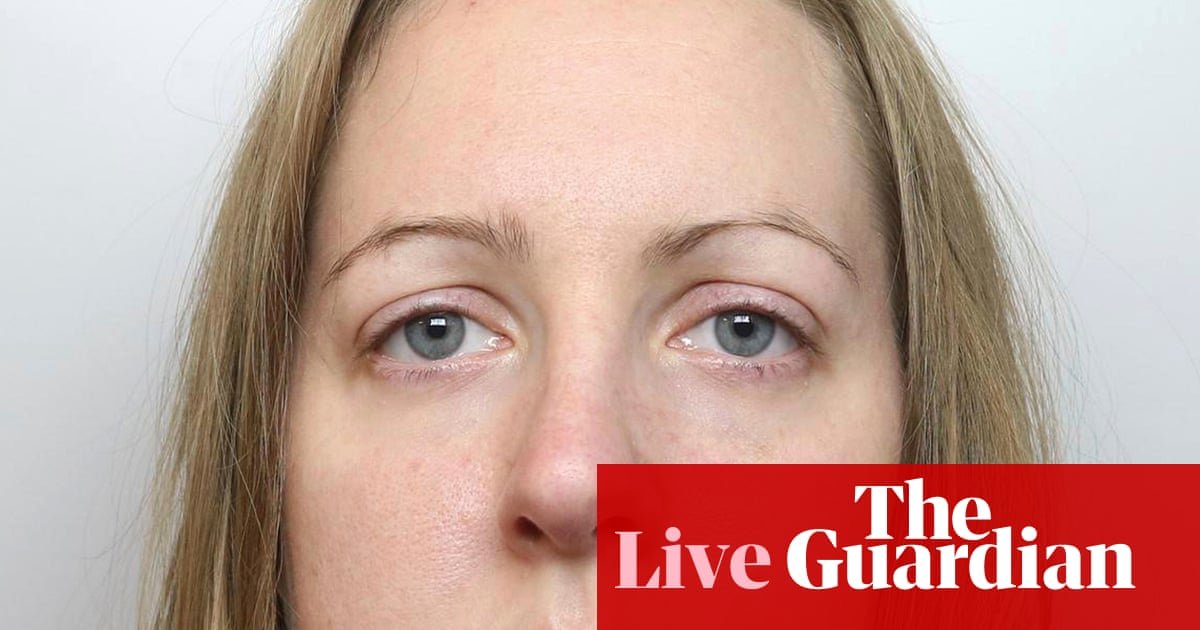
Lucy Letby inquiry report to be published after repeated delays
The findings of the long-awaited Thirlwall inquiry – set up to examine how the former nurse Lucy Letby was able to murder babies at a neonatal unit over a two-year period – is set to be published early this afternoon.
Letby, now 36, was convicted of murdering seven babies and attempting to murder seven more in 2015 and 2016, when she worked as a nurse in the neonatal unit of the Countess of Chester hospital.
She was sentenced to 15 whole-life orders, and was twice denied permission to appeal against her convictions in 2024.
However, the Criminal Cases Review Commission, which investigates potential miscarriages of justice, is considering evidence presented on Letby’s behalf by an international panel of medics who claim poor medical care and natural causes were the reasons for the babies collapsing.
Letby has always protested her innocence and there have been some reports casting doubt on the safety of her convictions. A number of doctors, scientists and statisticians have publicly challenged the way the evidence was presented to jurors at her trial.
The public inquiry, chaired by one of the country’s most senior judges, Lady Justice Thirlwall, was formally established in October 2023 by the former health secretary Steve Barclay, two months after Letby’s multiple convictions.
Justice Thirlwall heard evidence at Liverpool Town Hall from numerous witnesses between September 2024 and February 2025, including from the parents of Letby’s victims.
The inquiry did not examine Letby’s convictions or possible motives, focusing instead on the conduct of those working at the Countess of Chester Hospital, including managers, nurses and midwives, with regard to Letby’s actions, whether Letby should have been suspended earlier, if police should have been informed sooner of suspicions about her, and whether her managers should have responded differently when concerns about her were first raised.
The inquiry has also considered how effective NHS management and governance structures were, and what information parents received regarding their babies’ care. It says its aim is to seek “answers for the victims’ families” and ensure that “lessons are learned”.
The report was first expected to have been published in November 2025 but was set back by a string of delays.
Inquests into the deaths of babies who Letby was convicted of murdering are to take place in May 2027.
Key events
Experts quit Lucy Letby’s defence team a day before inquiry report is published
Josh Halliday
Two experts withdrew from Letby’s defence team on Monday. They said that although they stood by their assessment that it was “very unlikely” two of the babies were poisoned, some of the arguments being put forward on her behalf were “inconsistent with the available evidence, science and established physiology”.
Helen Shannon, a British chemical engineering expert, and Geoff Chase, a professor of bioengineering based in New Zealand, produced a 100-page report last year casting doubt on her convictions for poisoning two babies with insulin.
They told the Guardian last year there was a “very strong level of reasonable doubt” about those two convictions, which formed a central part of the prosecution case against Letby. The 36-year-old nurse was convicted in 2023 of trying to murder two newborn boys, known as Baby 6 and Baby 12, by spiking their feeding bags with insulin.
Letby is serving 15 whole-life orders after she was convicted across two trials at Manchester crown court of murdering seven babies and attempting to murder seven others, with two attempts on one of her victims, between June 2015 and June 2016.
Shannon and Chase said on Monday they stood by their assessment, but could not support other evidence used by Letby’s defence team relating to the insulin cases. You can read the full story here:
What crimes was Lucy Letby convicted of?
My colleagues Jamie Grierson and Josh Halliday have summarised the crimes Lucy Letby has been convicted of in a useful explainer I have linked to at the bottom of this post.
In August 2023, Letby was found guilty of murdering seven babies and attempting to kill six more, making her the worst child serial killer in modern British history.
Her victims included two identical triplet brothers, killed within 24 hours of each other, a newborn weighing less than 1kg (2lb) who was fatally injected with air, and a girl born 10 weeks premature who was murdered on the fourth attempt.
The jury was unable to reach verdicts on six further counts of attempted murder, relating to five babies. She later faced retrial on one count of attempted murder.
In July 2024, Letby was found guilty of trying to kill a two-hour-old baby girl on the same hospital ward where she murdered seven other infants.
The infant, known as Baby K, was born 15 weeks premature and weighed only 692g when Letby tampered with her breathing tube, causing a “life-threatening” deterioration. Letby was sentenced to another whole-life order.
Lucy Letby was moved from the neonatal unit to administrative duties in July 2016 after consultants expressed concerns about her to the hospital’s executive team.
Hospital bosses opted to carry out a number of reviews into the increased mortality in 2015 and 2016, but did not invite Cheshire Constabulary to investigate until May 2017, as Letby remained on site until her arrest more than a year later.
Lucy Letby inquiry report to be published after repeated delays
The findings of the long-awaited Thirlwall inquiry – set up to examine how the former nurse Lucy Letby was able to murder babies at a neonatal unit over a two-year period – is set to be published early this afternoon.
Letby, now 36, was convicted of murdering seven babies and attempting to murder seven more in 2015 and 2016, when she worked as a nurse in the neonatal unit of the Countess of Chester hospital.
She was sentenced to 15 whole-life orders, and was twice denied permission to appeal against her convictions in 2024.
However, the Criminal Cases Review Commission, which investigates potential miscarriages of justice, is considering evidence presented on Letby’s behalf by an international panel of medics who claim poor medical care and natural causes were the reasons for the babies collapsing.
Letby has always protested her innocence and there have been some reports casting doubt on the safety of her convictions. A number of doctors, scientists and statisticians have publicly challenged the way the evidence was presented to jurors at her trial.
The public inquiry, chaired by one of the country’s most senior judges, Lady Justice Thirlwall, was formally established in October 2023 by the former health secretary Steve Barclay, two months after Letby’s multiple convictions.
Justice Thirlwall heard evidence at Liverpool Town Hall from numerous witnesses between September 2024 and February 2025, including from the parents of Letby’s victims.
The inquiry did not examine Letby’s convictions or possible motives, focusing instead on the conduct of those working at the Countess of Chester Hospital, including managers, nurses and midwives, with regard to Letby’s actions, whether Letby should have been suspended earlier, if police should have been informed sooner of suspicions about her, and whether her managers should have responded differently when concerns about her were first raised.
The inquiry has also considered how effective NHS management and governance structures were, and what information parents received regarding their babies’ care. It says its aim is to seek “answers for the victims’ families” and ensure that “lessons are learned”.
The report was first expected to have been published in November 2025 but was set back by a string of delays.
Inquests into the deaths of babies who Letby was convicted of murdering are to take place in May 2027.
