



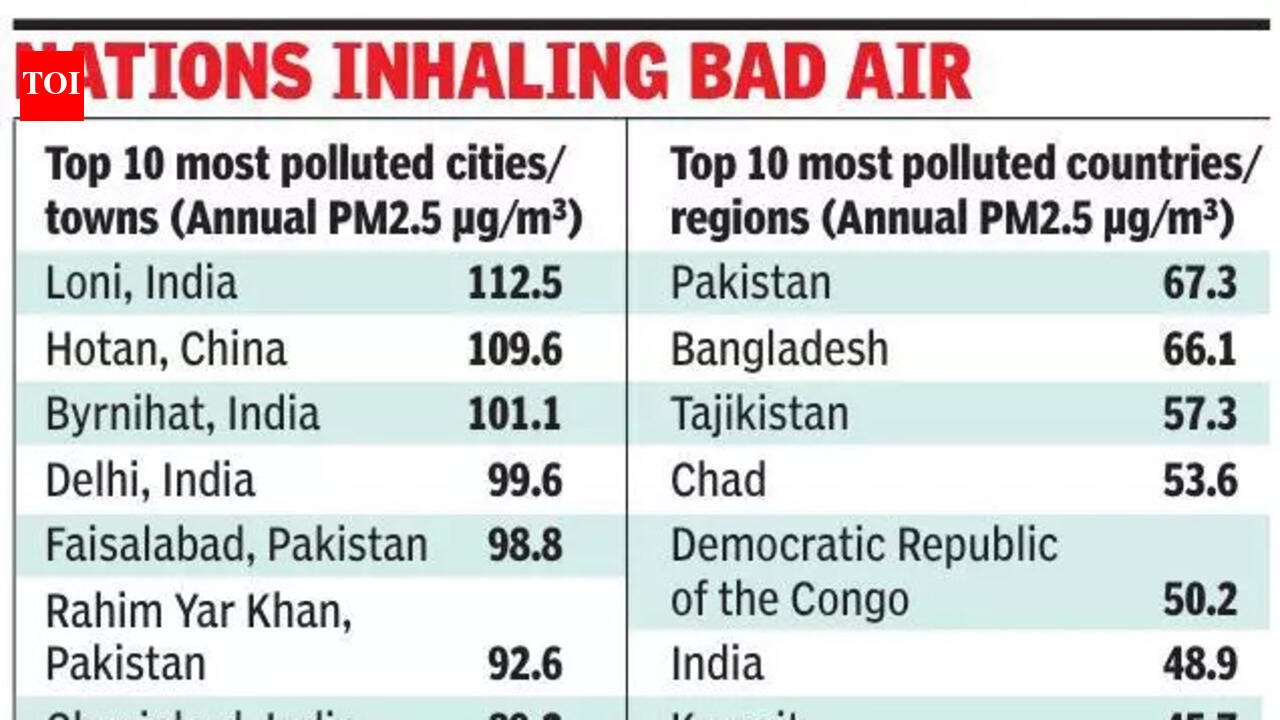
Lucknow: The city has been ranked the 58th most polluted place in the world in 2025, according to a report by Swiss air quality agency IQAir.The report draws from a wide global dataset. It analysed air quality in 9,446 cities/towns across 143 countries using more than 40,000 monitoring stations and sensors. Within India, Lucknow stands at 34th out of 259 that were part of the study. The ranking is based on the city’s annual average PM2.5 level of 54.2 µg/m³ (micrograms per cubic metre). This is nearly 10 times higher than the safe annual average limit of 5 µg/m³ set by the World Health Organisation (WHO). PM2.5 refers to very fine particles in the air that are small enough to enter deep into the lungs and even the bloodstream. Prolonged exposure can cause breathing problems, worsen asthma, and increase the risk of heart disease, stroke, and lung cancer. Children, the elderly, and those with existing health conditions are especially vulnerable, as the damage caused in the early stages can be long-lasting. Experts say everyday factors are driving this pollution. These include poor roads, potholes, dust, vehicle emissions, and construction and demolition waste. India remains 6th among the worst affected, with 64 cities and towns figuring among the world’s 100 most polluted. The situation is particularly severe in UP. Several cities and towns from the state feature high on the list. Loni, a town in Ghaziabad district, is ranked the most polluted place in the world. Its PM2.5 level is about 12 times higher than WHO limits. Other urban centres in India also show high pollution levels. Ghaziabad ranks 7th, Noida 18th, and Greater Noida follows. Muzaffarnagar is 29th, Hapur 34th, and Baghpat 35th. Bulandshahr ranks 36th, Meerut 42nd, Khurja 67th, Kanpur 146th, and Gorakhpur 150th. Experts say the rankings look worse because global standards are stricter. India’s Central Pollution Control Board allows higher PM2.5 levels than WHO guidelines. This often creates confusion when people compare global and local data. Pulmonologist Prof Ved Prakash from King George’s Medical University said the findings show rising global concern and called for strict action in Lucknow. He said National Green Tribunal norms must be followed to control dust, waste burning, and emissions. Steps like road sweeping, better roads, vehicle checks, public transport, and proper waste handling can help.He added that the World Economic Forum sees air pollution as a major risk, while the United Nations links it to heart disease, stroke, and cancer. The World Health Assembly aims to halve such deaths by 2040.


