



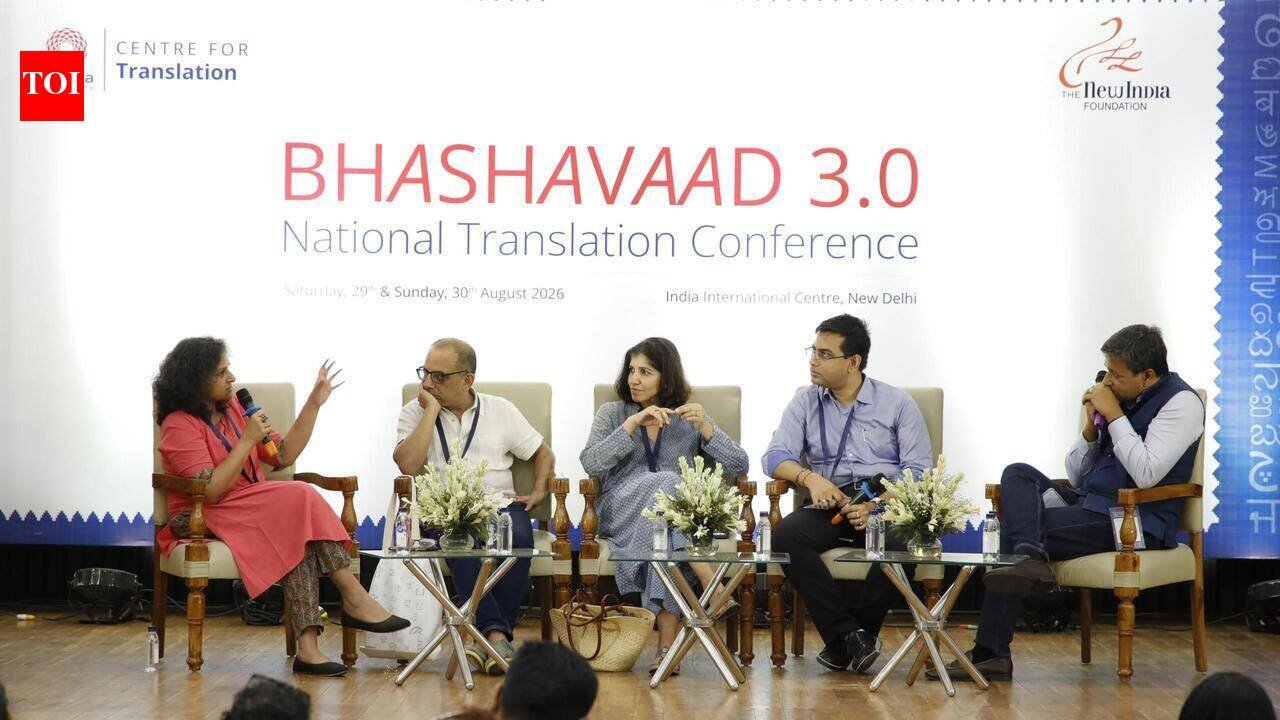
New Delhi: As artificial intelligence continues to transform the way we communicate across languages, the role of the human translator is facing a defining moment.Can technology replicate the cultural understanding, nuance and creative judgement that lie beyond simply converting words from one language to another? This question took centre stage at Bhashavaad 3.0, a National Translation Conference organised by the Centre for Translation, Ashoka University at India International Centre, Delhi, on Aug 29 and 30. It brought together translators, writers, researchers and publishers to examine the future of translation in an increasingly AI-driven world.The Centre for Translation’s Bhashavaad.in, a searchable database of translations, offers a way to map India’s diverse translation ecosystem. With over 30,000 entries, the platform allows users to search translated works across languages, authors, translators and genres, making visible the movement of literature between India’s diverse linguistic communities.With AI tools now capable of producing translations within seconds, the technology promises to make translation faster and more accessible. But literary translation involves more than linguistic accuracy. Idioms, humour, cultural references, dialects and an author’s individual voice can often resist direct translation. “Using AI to simplify a classic for a 5-year-old is fine. But as publishers, we want to retain the nuance, empathy and shared imagination that AI lacks,” said Karthika VK, publisher, Westland Books.“AI can help translate a book through tools like Bhashini and become available for students who cannot read a book in English. That is a great breakthrough for the education sector. Contrary to the belief that AI will trigger an unprecedented translation revolution, I think AI is just another tool but not the only tool available to a translator. Specifically for literary translations, AI cannot capture the voice and the literary sensibilities of a text. That is where human intervention becomes essential,” Prof Dr. Rekha Sethi from Indraprastha College for Women, who is an eminent translator herself, told TOI.The growing use of AI could also fundamentally alter the translator’s role. Rather than replacing humans entirely, AI may increasingly be used to assist the translators for research and proofreading rather than actually writing the draft and restoring cultural and literary context. “The notion that authors are producers and translators are secondary to them needs to be broken. Translators must be seen as co-producers of knowledge which is what differentiates them from AI. AI is fed data, so essentially it is not creating anything new,” said author, editor and translator Nishat Zaidi.The issue becomes particularly significant in India’s multilingual landscape. While AI could make literature from regional languages accessible to wider audiences, languages with limited digital resources may not receive the same technological support as languages with larger datasets. This could potentially widen the existing gap between dominant and lesser-represented languages.“AI may have the potential to democratise access to literature from India. But access is not the same as representation, and representation is not the same as the purpose literature serves in a society. If datasets and models continue to privilege dominant languages, literary traditions and particular caste, class and gender locations, AI may reproduce the very hierarchies it appears to dismantle,” said Kamna Singh, a research scholar and translator.As AI becomes an increasingly powerful translation tool, the debate may therefore shift from whether machines can translate to whether they can translate meaning, context and culture. The future may not be about choosing between humans and machines, but about deciding where technology should assist — and where human judgement and sense of discernment must remain at the heart of translation.


