


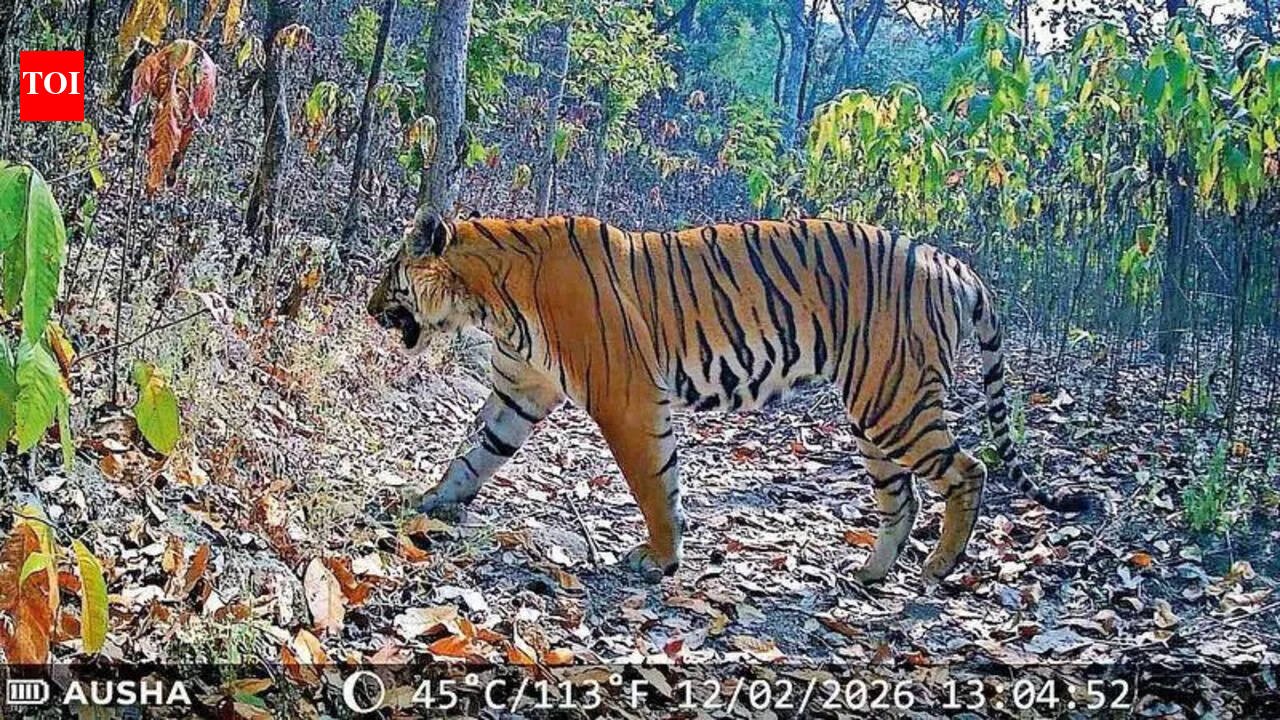
Ahmedabad: After more than 33 years without a resident tiger, Gujarat is witnessing a rare wildlife milestone. A solitary big cat completed one uninterrupted year in the state on Sunday. The development reignited hopes of conservationists and forest officials, who now aim to transform Gujarat into a full-fledged tiger state, home to all 3 of India’s iconic big cats: the Asiatic lion, the tiger, and the leopard.Gujarat had effectively been considered without tigers after the 1989 census, which relied largely on pug mark evidence. In 1992, in the absence of photographic proof, the state was excluded from subsequent national tiger estimations and classified as a non-tiger state.A brief reappearance in Mahisagar district in Feb 2019 had sparked optimism, but that tiger died within a fortnight, reportedly due to starvation.Then, a lone tiger entered Gujarat on Feb 22, 2025. And after three decades, Gujarat formally regained its tiger-bearing status as of Dec 2025. The current tiger established a territory that gradually expanded from about 120 sq km to nearly 150 sq km in eastern Gujarat.Encouraged by this development, the Gujarat forest department stepped up conservation measures. Chief Conservator of Forests Sandeep Kumar said habitat improvement, water management and prey augmentation works were carried out within the tiger’s territory. Ungulates were released to bolster prey density, and dedicated funds were allocated for ecological restoration.Kumar said the department is now focused on institutional preparedness. “We are in the process of forming a dedicated rescue and rehabilitation team. Cages and equipment are being procured to ensure swift response in case of emergency,” he said. Around 100 high-tech camera traps were ordered and will soon be installed to strengthen monitoring and gather photographic evidence.”Officials said the rescue team was formed to ensure that, if the tiger needed to be rescued, expert manpower was ready with equipment to ensure that no major casualty took place.The officials said that the recent developments added a new layer of intrigue. Forest staff reported scratch markings in every part of the 150 sq km territory — a behaviour associated with scent marking and territorial assertion. Interestingly, such markings were not observed earlier.“We also noted variations in pug marks, raising suspicion of a possible second tiger entering the landscape. However, there was no visual confirmation so far. The scratch marking is a significant behavioural change. It could indicate either territorial consolidation by the resident tiger or possible fresh intrusion,” an officer said. Surveillance was intensified to determine whether Gujarat may soon host more than one tiger.Forest officials said the tiger proved to be a strictly wild hunter within its one-year stay in the area. Scat analysis by research teams showed the tiger’s primary prey to be barking deer, with traces of nilgai and wild boar. Officials said there was no evidence of livestock predation. The animal has largely remained within forested zones and avoided human settlements, reducing the risk of conflict.Gujarat is already the only home of the Asiatic lion, found in Gir National Park, and supports a robust leopard population. With the tiger’s return, the state now aspires to sustain the Bengal tiger, the Asiatic lion and the Indian leopard together — a rare conservation distinction.Senior forest officials believed that if habitat connectivity, prey density, and protection efforts continued to improve, Gujarat could see a gradual increase in tiger presence in the coming years. For now, the tiger’s one-year stay stands as both a symbolic comeback and a practical foundation for restoring Gujarat’s place on India’s tiger map.


