


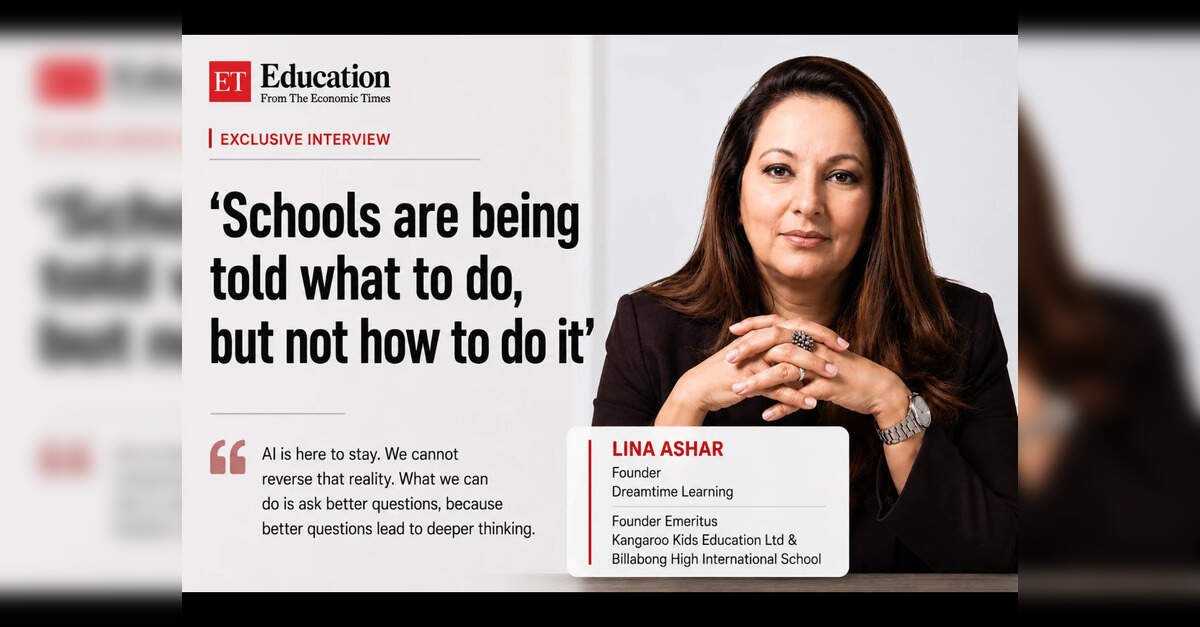
Lina Ashar, Founder, Dreamtime Learning; Founder Emeritus, Kangaroo Kids Education Ltd and Billabong High International School chain has been at the forefront of experiential and future-ready learning in India for over three decades. In an exclusive conversation with ETEducation, she shares her views on the implementation of the National Education Policy (NEP) 2020, the changing expectations of parents, teacher retention, artificial intelligence in classrooms, student well-being, and why she believes India’s education system needs a fundamental rethink.Q: It has been six years since the National Education Policy (NEP) 2020 was announced. What has genuinely changed in Indian classrooms, and which reforms have seen the least progress?
Lina Ashar: Not enough has changed because there is a significant gap between policy and implementation. We’ve seen this before. When Continuous and Comprehensive Evaluation (CCE) was introduced, it eventually had to be rolled back because schools were not adequately prepared for such a shift.
The NEP is asking schools to make a transformational leap, but many institutions have been functioning in a conventional way for decades. Schools are being told what to do, but not how to do it. Take project-based learning, for instance. The policy advocates it, but in reality, most schools are still merely assigning projects. There is a huge difference between giving students projects and implementing genuine project-based learning. Unless teachers are trained to understand that distinction, implementation will remain superficial.
Q: What, in your view, can bridge this implementation gap?
Lina Ashar: Teachers cannot be expected to suddenly implement neuroscience, behavioural science and future-ready learning approaches without adequate support. That’s unrealistic.
Schools need structured frameworks that simplify implementation. Teachers should not have to guess how project-based learning works or spend months researching it themselves. They need practical tools and clear processes that help them translate policy into classroom practice. Ultimately, implementation succeeds only when teachers feel confident and supported.
Q: Parents today increasingly view education as an investment and expect measurable returns. Are schools delivering better outcomes?
Lina Ashar: I believe the media, schools and parents together have created a narrative that equates success with marks, toppers and admissions into elite institutions. As long as we continue celebrating only these outcomes, schools will naturally focus on producing them.
We need to redefine what return on investment actually means. Many parents still believe the biggest ROI is getting into an IIT. But if a significant proportion of graduates struggle to find employment, then we need to ask whether that alone represents success.
The real return is whether a child knows where to place their attention. Are they constantly distracted by social media and entertainment, or have they developed the ability to pursue their interests with curiosity and purpose? Engagement, not merely financial outcomes or college admissions, should become the new measure of educational success.
Q: Teacher retention has become a growing concern across schools. How can institutions retain quality educators?
Lina Ashar: Most people don’t become teachers because of the salary. They enter the profession because they want to create transformation.
However, when teachers spend most of their day completing administrative tasks and delivering transactional lessons, they lose the very reason they joined the profession. Schools also need to create meaningful career pathways. Teachers should be able to see how they can grow into coordinators, curriculum designers or academic leaders, and schools must invest in preparing them for those roles.
Growth is not only about higher salaries. For many teachers, it is about building a new professional identity and continuing to evolve.
Q: Artificial Intelligence is rapidly entering classrooms. How should schools adopt AI without compromising creativity and critical thinking?
Lina Ashar: The first thing we need to change is what we value. If education continues to reward memorisation and information retention, AI will simply make students dependent on technology. But if we redesign learning around inquiry, analysis and creation, AI becomes a powerful tool instead of a substitute for thinking.
Instead of asking students to memorise how social media platforms work, ask them to investigate how different algorithms function, use AI tools to research them, and then create something original based on their understanding. AI is here to stay. We cannot reverse that reality. What we can do is ask better questions, because better questions lead to deeper thinking.
Q: Student well-being has become a major concern, particularly after the pandemic. What behavioural and mental health changes have you observed among students?
Lina Ashar: The challenge isn’t limited to students; it affects all of us. Technology has evolved at an extraordinary pace, but the human brain hasn’t. Our brains are still wired for a very different world, while technology continues to advance exponentially.
The real question is how we develop human consciousness, wisdom and emotional intelligence faster than technology. Technology itself isn’t the problem. Like nuclear power, it can be used for good or bad. Schools therefore need to move beyond academics and focus on ethical leadership, intentional thinking and helping children make responsible choices.
Q: If you had to identify one major gap in India’s school education system today, what would it be? What policy intervention is most urgently needed?
Lina Ashar: We need to rethink education from the ground up. Our current education system is largely inherited from the British model, whereas India once had rich traditions of learning through the gurukul system. We cannot simply keep making incremental improvements to an outdated structure.
Henry Ford once said that if he had asked people what they wanted, they would have said “faster horses” instead of cars. That’s exactly where education is today. We’ve entered the age of AI, but we’re still operating with an old mindset.
It’s like we’ve built cars without roads, traffic rules or signals. We now need to teach students how to navigate this new world, including the ethical boundaries of AI. AI is capable of extraordinary things, but our wisdom has not yet caught up with its capabilities.
Q: Which trends in school education do you believe are overhyped, and what are educators underestimating?
Lina Ashar: I believe we’ve become obsessed with the wrong metrics. Infrastructure is overhyped. Sports and performing arts are often showcased without asking whether they genuinely contribute to deeper learning. Above all, marks and percentages continue to dominate our understanding of success.
If we continue measuring the wrong things, we will continue producing the wrong outcomes. India once had a rich educational philosophy that nurtured curiosity, wisdom and self-discovery. We need to bring that spirit back instead of reducing education to standardised scores.
Q: How are you trying to bring that philosophy into your own schools?
Lina Ashar: The biggest shift is changing the questions we ask. Take the topic of matter in science. Traditionally, students are taught about solids, liquids and gases. Instead, we begin by asking questions that provoke curiosity: Is a thought made of matter? Such discussions encourage students to think beyond textbook definitions.
Eventually, students still learn the scientific concepts they need to know, but they do so through exploration rather than memorisation. Sometimes we also introduce students to passages from science fiction written a century ago and ask them what modern inventions the author may have imagined. Many realise the description resembles today’s iPad.
Everything that exists today first existed in human imagination. Schools need to create more space for awe, possibility and imagination. When students question, debate and explore ideas, they not only learn the curriculum but also develop the creativity and higher-order thinking the future demands.
