



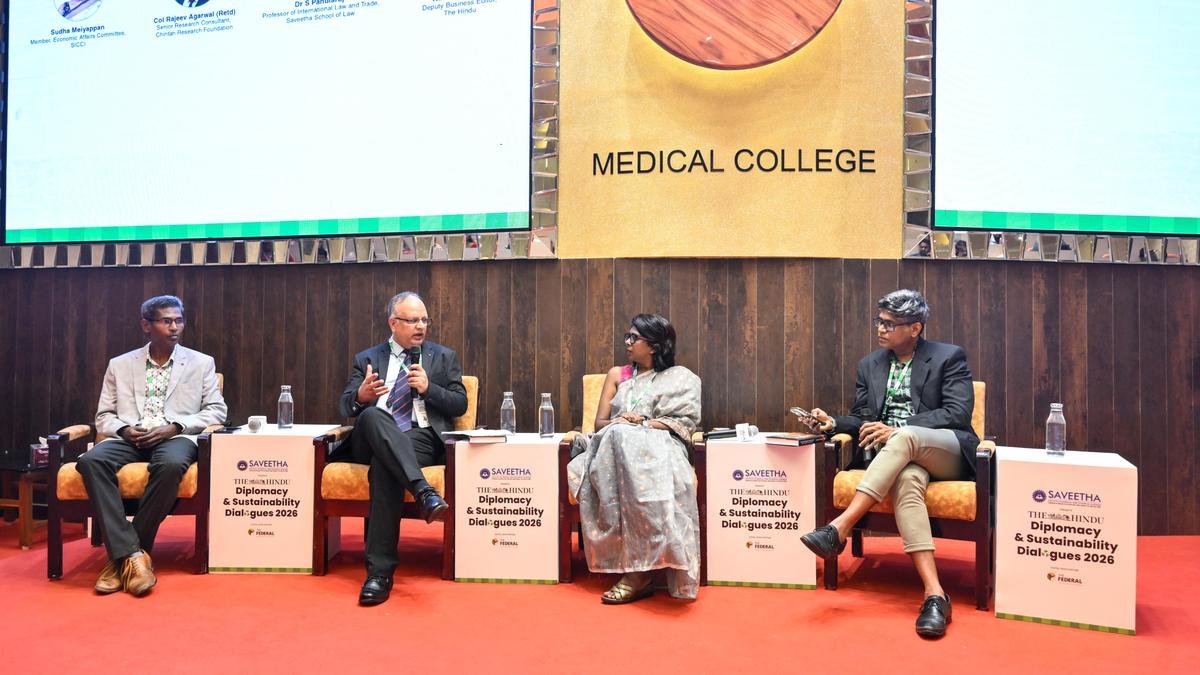
The panel discussion, “Impact of West Asia Crisis on Economic Disruptions & Sustainability: Implications for India”, focused on disruptions in trade, energy markets, and supply chains. The session featured, from left — S. Pandiaraj, professor of International Law and Trade, Saveetha School of Law; Col. Rajeev Agarwal, Senior Research Consultant, Chintan Research Foundation; and Sudha Meiyappan, member, Economic Affairs Committee, SICCI and the session was moderated by Kunal Shankar, Deputy Business Editor, The Hindu.
| Photo Credit: J. Johan Sathyadas
As the West Asia crisis impacts fertiliser supply globally, India should shift its long-term focus to gradually move away from the older model of fertiliser-dependent agricultural practices while not forgetting lessons learnt from the Sri Lankan experience, according to Sudha Meiyappan, Member, Economic Affairs Committee, Southern India Chamber Of Commerce And Industry (SICCI).
Participating in a panel discussion on the topic ‘Impact of West Asia Crisis on Economic Disruptions and Sustainability: Implications for India’ at Saveetha Institute of Medical and Technical Sciences (SIMATS) on Wednesday (May 13, 2026), she said that in the long run, India should seek to make agriculture sustainable by adopting natural farming, agro-forestry, and various other forms of sustainable movements that are taking place in the sector. She, however, put forth a caveat: India should take care to pick up lessons from the Sri Lankan experience.
The island country had made a sudden shift to organic farming, with a ban on fertiliser imports leading to a drop in production of food grains causing economic disruption and social unrest.
The panel discussion was part of the Diplomacy and Sustainability Dialogues 2026 jointly organised by the Saveetha Institute of Medical and Technological Sciences (SIMATS) and The Hindu.
Ms. Meiyappan said that in the short term, India should continue to follow the current policies while focusing on a transition to sustainable practices in the long term. “In the short term, you continue doing what you are doing today. You don’t change to organic today, but over the long term, you slowly, gradually veer away…not organic per se, but something that’s more climate-resilient and more sustainable in nature. You can’t get rid of fertilisers but [determine] how much you are using and for what crop you are using and where the crop is being grown,” she said, responding to a pointed question from the moderator Kunal Shankar, Deputy Business Editor, The Hindu.
She also warned that India was looking at curtailment of personal consumption by virtue of general price rise due to the increase in fuel prices, even without the announcement from the Prime Minister. Gold prices, for example, went beyond the threshold of being a safe haven even before the war. After the announcement, the artisans and the local shops selling gold will be impacted heavily, Ms. Meiyappan added.
Col. Rajeev Agarwal (retd), Senior Research Consultant, Chintan Research Foundation, said that the Iran war has given clear dimensions to projects like India-Middle East-Europe Economic Corridor (IMEC) while it has exposed the vulnerability of the existing trade routes and connectivity. Choke points and conflict zones, he said, would always make trade connectivity and supply lines vulnerable. An alternative is required that bypasses both these chokepoints and conflict zones. Projects like IMEC, with certain modifications given the geopolitical changes, could provide such a framework.
S. Pandiaraj, professor of International Law and Trade, Saveetha School of Law, said that India’s stand in foreign affairs should be pragmatic but also operate in a way that would not forsake the values and principles that it always stood for, whether it was the 1955 Bandung Conference or the Non-Aligned Movement (NAM). Quoting a famous movie dialogue “with great power comes great responsibility”, Dr. Pandiaraj said that India had been trying to achieve the part on becoming a great power all the time but the same could not be said about the point of responsibility. Otherwise, the country would have taken a much more stern stand on the conflicts in Ukraine, Gaza or Iran. Giving an example, he said Iranian Supreme Leader Ayatollah Ali Khamenei was killed and it took five days for India to condole his death.
“The transactional approach, the give and take approach would only take us up to a point and not beyond. We’ll lose our standing. So, India should be careful in terms of treading various passages,” Dr. Pandiaraj observed.
Published – May 14, 2026 12:34 am IST


