



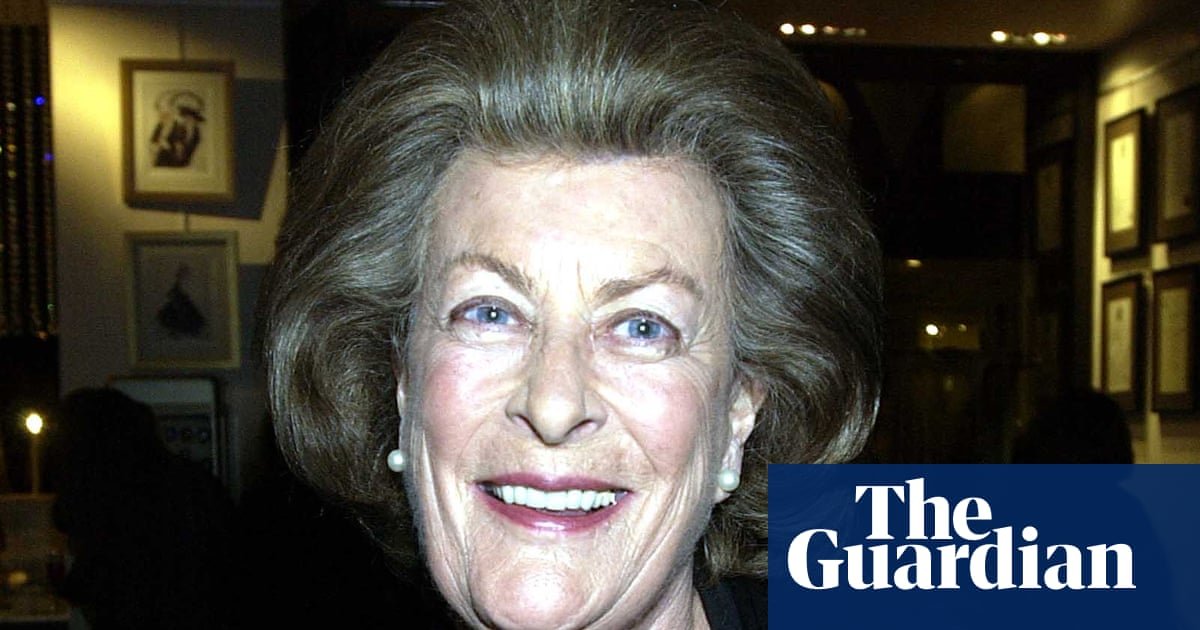
Lady Pamela Hicks, who has died aged 97, was the great-great granddaughter of Queen Victoria and her oldest surviving descendant. The link came through her father, Earl Mountbatten of Burma, which made her additionally first cousin to Prince Philip, the Duke of Edinburgh, and she was also the great-niece of the last empress of Russia, Alexandra Feodorovna.
As a child Pamela was sufficiently aristocratic to be a playmate of Princess Elizabeth, the future Queen Elizabeth II, and her sister, Princess Margaret, and she was close enough to the royal family to serve for a time as lady-in-waiting to the young queen.
Despite a life of affluence and privilege, she was both down to earth and unpompous, sharing the experience of many other elderly pensioners at the age of 89 when she was hospitalised with pneumonia and found herself lying on a hospital trolley in a corridor for 20 hours awaiting treatment.
The younger daughter of Louis Mountbatten and his wife, Edwina (nee Ashley), Pamela came into the world five weeks prematurely when her mother, on holiday in Spain, gave birth in the Ritz hotel, Barcelona, with a royal guard placed on the building. “I am so sorry it isn’t a boy,” her mother told her father. The couple briefly considered calling the child Ritzy, but settled on Pamela Carmen Louise instead; her godparents included the king of Spain, Alfonso XIII, and the Duke of Kent.
She had a peripatetic, isolated childhood, supervised by nannies and governesses, with her father having naval duties at sea and her mother taking off for prolonged absences with boyfriends. At the age of eight Pamela and her elder sister, Patricia, were left for four months in a hotel in Budapest because her mother lost the piece of paper on which she had written the address.
“I never liked my mother,” she told the Daily Telegraph in 2012. “She had no idea how to play with children. She was a woman who could never have a close conversation with you and who needed constant flattery; if she didn’t have that she became lonely and miserable.” By contrast she hero-worshipped her father.
When war broke out in 1939 she and Patricia were evacuated to New York, where they lived with their parents’ friend the fabulously wealthy Cornelia Vanderbilt, but within a year Pamela returned to Britain because she was homesick. When her father was made the last viceroy of India in 1946, responsible for engineering the subcontinent’s division and independence the following year, she accompanied her parents to Delhi.
There they lived in colonial splendour in the viceregal lodge, which had 340 rooms, a mile and a half of corridors, grounds of 190 acres – and, not least, among the army of servants, 25 whose sole duty was to cut flowers for displays. Her mother developed a close friendship with India’s first prime minister Jawaharlal Nehru (opinion is divided on whether they were lovers, though Pamela insisted the relationship was platonic), and Pamela as a teenager attended a prayer meeting with Mahatma Gandhi, who sent her a get well card when she fell off her horse. Her pet mongoose, Neola, went back to Britain with her.
She was a bridesmaid when Princess Elizabeth married Philip in 1947 and served as lady-in-waiting on the trip to Kenya, aborted when Elizabeth’s father, King George VI, died suddenly back in Britain. Pamela watched as Philip took his wife into the garden to break the news and she saw Elizabeth’s body stiffen as she realised she was becoming queen.
The following year she accompanied the royal couple on their round-the-world trip of the Commonwealth, her duties recorded as carrying the royal handbag, answering correspondence, greeting guests and collecting bouquets, a job she willingly gave up following their return.
She moved into more private life when she married the interior designer David Hicks in 1960 – a break with tradition since he was not an aristocrat and was in trade. The couple had three children, Edwina, Ashley and India, who survive her.
The family’s great tragedy came in August 1979 when, during a holiday at their castle at Sligo in the Irish Republic, Mountbatten, who had ignored security warnings, was assassinated by the IRA. The explosion on board his fishing boat also killed his daughter Patricia’s son Nicholas, her mother-in-law and a local boy, Paul Maxwell, and severely injured Patricia, her husband, John Brabourne, and the couple’s other son, Timothy.
Pamela and her children, who heard the explosion, had opted not to go on the boat. Many years later Pamela forgave the killers, saying: “We loved the Irish, we lived there for so much of our lives. You have got to go forward – follow Gandhi’s example.”
David died in 1998. Pamela remained close to the royal family, attending Queen Elizabeth’s funeral with her daughter India, though not the coronation of King Charles, as the guest list for the abbey was slimmed down: otherwise it would have been her third coronation, probably a contemporary record. She watched on television instead, uncomplainingly.
Nor did she complain about the long wait in A&E when she went down with pneumonia; “The NHS were brilliant,” she told the Daily Mail in 2018: “The staff were fantastic and I had wonderful care.”
She wrote three volumes of memoirs: India Remembered: A Personal Account of the Mountbattens During the Transfer of Power (2007), Daughter of Empire: Life as a Mountbatten (2012) and My Years With the Queen and Other Stories (2024).


