


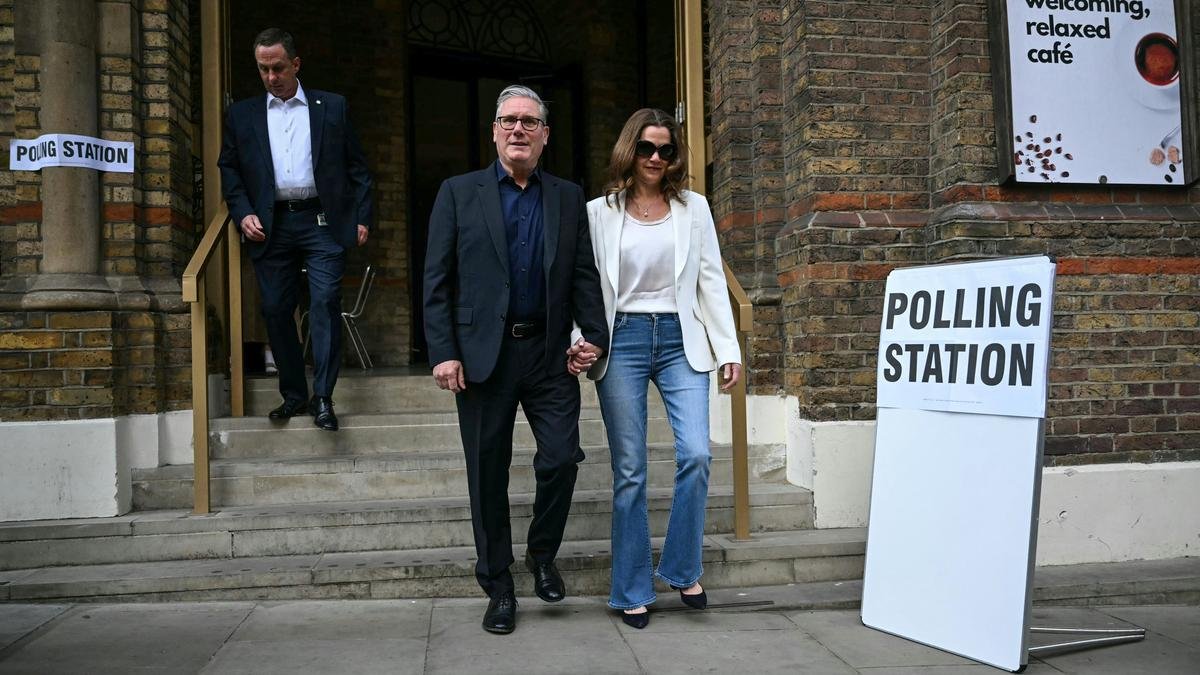
British Prime Minister Keir Starmer and his Labour party were faced with the prospect of serious political damage as voting got under way in the council elections in England alongside the Assembly elections in Scotland, and Wales on Thursday (May 7, 2026).
More than 5,000 seats in 136 councils of England were up for grabs with the Labour Party defending 2,566 seats and the Conservatives on 1,364 seats. The last elections for these seats were in 2022, when the nativist Reform U.K. had won just two seats. Last year, Reform had won 667 seats – the largest number – that were up for elections.
Mr. Starmer has struggled to keep the centrist and left flank of his party together over policies around attempts to tighten immigration and welfare spending. He has also suffered reputational damage – including in his own party – over the appointment of Peter Mandelson, the U.K.’s former envoy to Washington who had close links to the convicted paedophile and financier Jeffrey Epstein.
Labour is faced with the prospect of losing votes to both Reform on the right and the Greens on the left. Some, such as the University of Oxford’s Stephen Fisher, project the party to lose as many as 1,900 seats, or three quarters of its current tally.
“Those outcomes are so bad that the specifics don’t matter,” said Tim Bale, a political scientist of Queen Mary Univeristy of London, when asked how bad the Labour Party’s performance would need to be for it to end Mr. Starmer’s premiership.
“And in any case the decision as to whether or not to oust Starmer depends less on how bad the results are … more on whether they think anyone capable of challenging the PM can really improve the government’s ratings,” Mr. Bale told The Hindu.
Labour is fighting the Greens in inner London boroughs and the Greens and Liberal Democrats in the Northern metros – such as Leeds and Sheffield. It is fighting Reform U.K. in other northern metros like Sunderland and Barnsley.
The Conservatives, who suffered big losses in the 2024 general election, could lose 1,010 seats according to Mr. Fisher. They are defending their seats in rural counties and the outer boroughs of London.
“I did not vote this year,” said Sam Arora, a 39-year old British Indian businessman, from Wembley , a London area that is home to many South Asians.
“I find politics in this country has really sort of taken a turn,” he added. Mr. Arora, who runs a business engaged in international trade used to vote for the Conservatives but feels the party is “becoming a bit too far right”.
In Scotland, Labour projected to come third
In both Scotland and Wales, Labour was projected to come in third – trailing behind Reform.
In Scotland, all 129 places in the Scottish Assembly at Holyrood were contested, with voters animated by issues around the cost of living, health and social care and immigration, as per a Savanta poll for the BBC. The online poll surveyed 2,136 people above the age of 16 in Scotland, between 29 January and February 6).
The Scottish National Party (SNP), which won the election in 2021, with 64 seats – i.e., just one seat short of a majority – ran a campaign around Scottish independence, promising a referendum on secession from the U.K., as early as 2028. A 2022 Supreme Court ruling had given the U.K. Parliament the sole power to call such a referendum, the last of which was in 2014.
First Minister John Swinney had said in recent weeks that the SNP getting a majority in Holyrood would be a solid argument for Westminster to give Holyrood the power to call a referendum.
However, a YouGov poll released on Wednesday (May 6, 2026), projected the SNP to win 62 seats, with Reform coming in second with 19 seats and Scottish Labour following closely behind in third place with 17 seats. The Scottish Greens were projected to get 16 seats, twice as many as they won in 2021.
Reforming the National Health Service (NHS), Britain’s healthcare system, has been at the top of the list for Scottish Labour’s leader, said Anas Sarwar, a former dentist. Mr. Sarwar had urged voters to “save the NHS” which was “not safe” with the SNP and its leader.
Support for Welsh Labour on the decline
In Wales, the Senedd (Assembly) is also being expanded from a strength of 60 members to 96, with every seat being contested. The same three issues – cost of living, healthcare and immigration ranked on top of Welsh voters concerns in another Savanta poll of 2086 Welsh adults.
Labour has run the devolved (partly autonomous) government in Wales ever since the Senedd was formed in 1999. Polls published at the end of April and in early May have generally projected centre-left nationalist party Plaid Cymru coming in first, closely followed by Reform and Labour coming in third.
Plaid leader Rhun ap Iowerwerth, launching his manifesto in April had termed a vote for Reform Party as “a proxy vote for the politics of Trump”, referring to the U.S. President. The party appears to have tamped down its approach to an independence referendum, saying instead in its manifesto that it would prepare a report on whether Wales should be independent from the U.K.
Support for Welsh Labour had been declining before Labour formed the U.K. government in 2024, according to Jac Larner, a professor of political behaviour at Cardiff University. But Mr. Starmer has not helped, he said.
“In essence Labour are paying a double cost of governing here — paying the price for an unpopular Welsh Government and an unpopular U.K. Government,” Mr. Larner said.
Published – May 07, 2026 12:50 pm IST
