



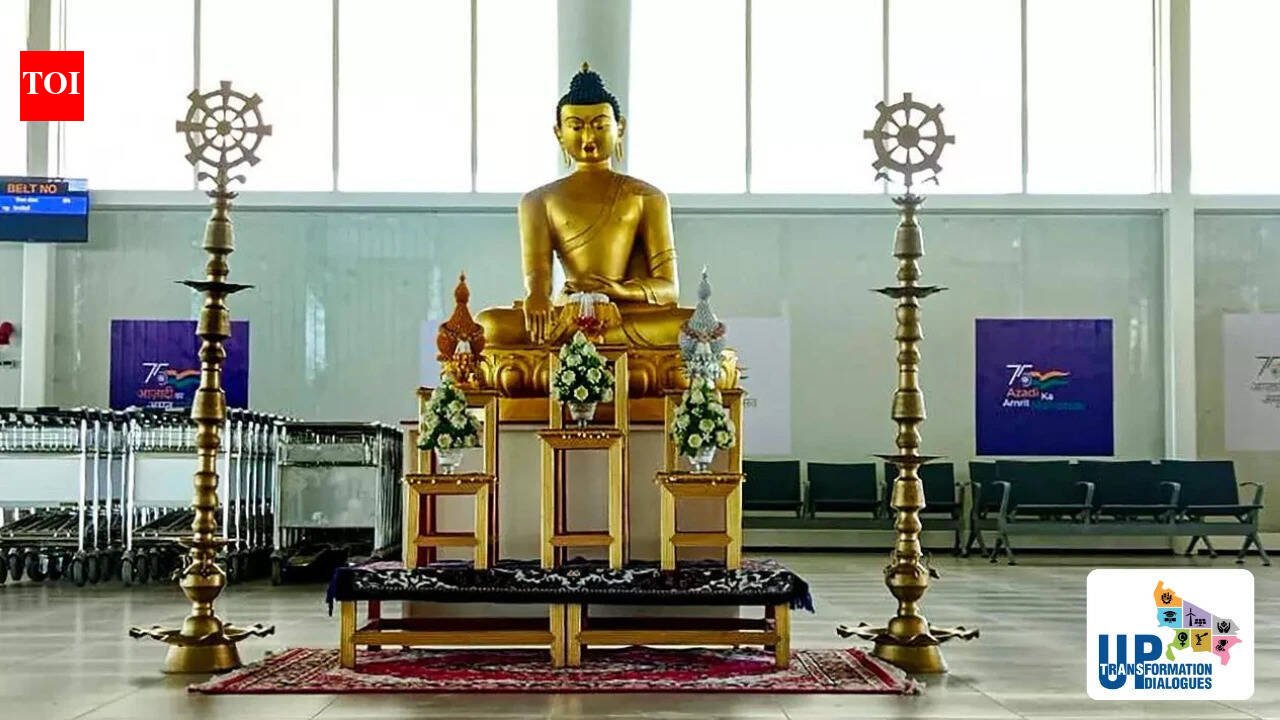
Kushinagar, located in the easternmost part of Uttar Pradesh, covers an area of 2,873.5 square kilometres. Situated along the Bihar border, it lies roughly 50-53 kilometres east of Gorakhpur on National Highway 28. It is a predominantly rural, agrarian district headquarters with fertile alluvial soil.Over the past nine years under chief minister Yogi Adityanath’s leadership, Kushinagar has transformed from a relatively underdeveloped Buddhist pilgrimage site plagued by poor connectivity, health challenges like encephalitis outbreaks, and limited infrastructure into a vibrant global tourism hub.The inauguration of Kushinagar International Airport in October 2021 by Prime Minister Narendra Modi marked a pivotal milestone, making it Uttar Pradesh’s third international airport and significantly boosting access for Buddhist pilgrims from countries like Sri Lanka, Thailand, and beyond.Conceived to serve the sacred Mahaparinirvana site and the broader Buddhist Circuit, the airport features a 3.2 km runway capable of handling wide-body aircraft, a modern terminal inspired by traditional “Ulta Chaata” design, advanced facilities including Instrument Landing System (ILS), and capacity for multiple Boeing 737-type aircraft.The inaugural international flight carried Sri Lankan dignitaries and Buddhist monks, followed by domestic services from Delhi, Mumbai, and Kolkata under the UDAN scheme. This infrastructure has significantly reduced travel barriers for pilgrims from Southeast Asia and beyond, boosting visitor numbers to Kushinagar and nearby sites while symbolising the “double-engine” government’s push for regional development.This development, part of a broader Buddhist Circuit initiative, has enhanced air links to key sites and positioned Kushinagar as a gateway for spiritual tourism, drawing increased footfall and fostering local economic growth.The Uttar Pradesh Buddhist Circuit is a comprehensive pilgrimage and tourism network that traces key events in the life of Gautama Buddha across six major sites: Sarnath, Kushinagar, Shravasti, Kapilvastu, Kaushambi, and Sankisa. Under chief minister Yogi Adityanath’s government, this circuit has received focused investment— including a planned ₹4,200 crore package—to enhance infrastructure, connectivity, and visitor facilities while preserving ancient heritage.These efforts link the sites through improved roads, airports, and themed developments, positioning Uttar Pradesh as a global spiritual destination alongside international spots like Lumbini (Nepal) and Bodh Gaya (Bihar). In 2025 alone (January–September), the circuit attracted over 61 lakh visitors, with projections exceeding 64 lakh for the year, including nearly 2.72 lakh international tourists.Infrastructure and urban development have seen remarkable progress, with connectivity projects, road expansions, and beautification efforts modernising the area while preserving its sacred heritage. Recent initiatives include over Rs 525 crore worth of projects launched in 2026 across assembly segments, covering tourism facilities, bridges like the Rs 800-crore Narayani River crossing, and enhancements around Ramabhar Stupa, Buddha Ghat, and the Hiranyavati River banks.Tourist facilitation centres, gate complexes, and vihar developments worth crores have improved visitor experiences, alongside better roads and public amenities that have reduced migration and poverty. These efforts integrate heritage conservation with modern infrastructure, turning Kushinagar into an emerging growth centre in eastern Uttar Pradesh.Healthcare infrastructure in Kushinagar has witnessed a remarkable transformation under Yogi Adityanath’s governance, shifting the district from being notorious for recurrent encephalitis outbreaks and inadequate medical facilities to a hub with modern, accessible care. The establishment of the Autonomous State Medical College (ASMC) Kushinagar, along with its attached 300+ bed teaching hospital (expanded to 500 beds), has introduced advanced departments in emergency medicine, surgery, orthopaedics, obstetrics, paediatrics, and more, complete with state-of-the-art operating theatres, laboratories, and simulation facilities. This government medical college not only trains MBBS students but also delivers quality tertiary care to locals and pilgrims, significantly curbing vector-borne diseases through better sanitation and health initiatives.Socio-economic and sectoral advancements have further elevated living standards, focusing on health, education, agriculture, and welfare. Encephalitis has been controlled through upgraded healthcare, including a new government medical college, while welfare schemes have provided housing, rations, and electricity.The Musahar community in Kushinagar, once among the most marginalised and vulnerable groups facing poverty, starvation, and social exclusion, has witnessed targeted upliftment under chief minister Yogi Adityanath’s inclusive development agenda. Through dedicated welfare drives, thousands of Musahar families have received permanent pucca houses under PMAY, land leases and housing rights, free ration under NFSA, Ayushman Bharat health cards for cashless treatment, Ujjwala LPG connections, electricity access, and toilets, effectively bringing them into the mainstream.Recent Rs 525 crore development packages in the district have further prioritised their empowerment with skill training, self-help group linkages, and livelihood opportunities in agriculture and allied sectors, while schemes like pensions and education support have improved health, nutrition, and children’s futures.The establishment of Mahatma Buddha Agriculture and Technology University, ODOP focus on banana products, modernised sugar mills, and self-help groups empowering women have boosted livelihoods and education. International events like the Buddhist Conclave have amplified its global profile, blending spiritual significance with tangible progress.Under the One District One Product (ODOP) initiative championed by chief minister Yogi Adityanath, Kushinagar has leveraged its abundant banana cultivation to promote banana fibre products and value-added banana-based items as its signature offering, turning agricultural waste into a sustainable livelihood source. Farmers and artisans process banana stems into eco-friendly fibre for crafting biodegradable bags, ropes, mats, doormats, and other utility products, while also producing banana chips, jam, and processed foods. Government support through training programs, modern processing units, market linkages, and branding has empowered women self-help groups and rural entrepreneurs, boosting incomes and reducing plastic usage.With a district GSDP of approximately Rs 11,857 crore, its economy is anchored in banana, sugarcane, paddy, and vegetable cultivation—bolstered by ODOP initiatives on banana fibre and value-added products—alongside four modernised sugar mills and the Mahatma Buddha Agriculture and Technology University that enhance productivity and farmer incomes.


