


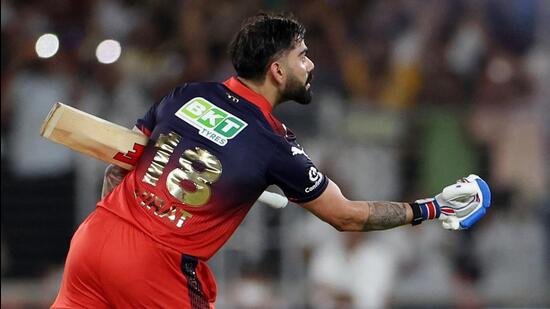
Ahmedabad: Last year, they won it for him. This year, they won it with him. They couldn’t have done it without him.
It would be apt if Royal Challengers Bengaluru (RCB) – they have back-to-back title wins after waiting 17 years for the first – dedicated their victory speech to Virat Kohli.
Of course, he is box office. Kohli mania fills stadiums, sells merchandise, draws sponsors, gets girls squealing, kids whooping, men hollering. Kohli’s 42-ball 75* in the run chase for the title on Sunday against IPL’s strongest attack again proved his centrality to RCB’s success.
He may be RCB’s primal force, but in-game accolades appeal to Kohli the most. This
especially in T20s. Kohli’s 675 runs at a SR of 165.84 showed that at 37 he has kept up with the times.
RCB are no longer a team of batting prima donnas. Over three years under head coach Andy Flower the team structure has been repaired. Yet, they haven’t found a better crisis manager than Kohli. RCB acknowledge that.
The team could have gone about chasing 156 in the final conventionally. Kohli told fellow opener Venkatesh Iyer to kill the game in the Powerplay. The sluggish pitch wasn’t going to get easier to bat when the field spread. It did not. And that was Kohli’s game sense.
Later, when RCB lost a flurry of wickets mid innings, the dressing room stayed calm. That was only because Kohli was still batting. Devdutt Padikkal told the broadcasters after the win: “When each wicket fell, I was talking to Venky (Iyer). He was asking me, ‘Are you getting nervous?’ I was like, as long as he (Kohli) is there, there’s no need to be nervous because he knows what he is doing and he does it every time.”
Kohli showed what he was made of. He even whipped Kagiso Rabada over deep midwicket with wristy artistry – of the kind a young Kohli had used against Lasith Malinga. The RCB opener attacked Gujarat Titans’ best bowler to weaken their resolve in Ahmedabad.
In the first half of this decade, T20 had become a chore for Kohli. He would be the off-field poster boy, but increasingly a misfit with the bat on it, as Power-hitting exploded.
How he has transformed his mindset – after years of building muscle memory to preserve the wicket to attacking from the word go – has been a personal triumph.
“It was just the demands of today’s modern game where you need to get those 20-30 extra runs,” Kohli said recently. “I had to kind of change my mindset, not my game so much, more often take on the bowlers, probably the best in the opposition. That was always my target.”
In last year’s win, Kohli was second lead to Phil Salt’s opening assault. This season, Salt couldn’t find his hitting range and then got injured. Venkatesh Iyer filled in, but more than once Kohli had to hit the high notes. By now, Kohli had become an intent machine.
Think of Sachin Tendulkar in the 1990s. A batting force like no other, he didn’t have the resources to push India to big wins. It’s not emphasised enough, but through the 2010s, before T20 speeded up, Kohli for RCB was equally brilliant for the times –
masterminding classy, calculated offensives. Like Tendulkar for India, once Kohli found a well-knit playing unit at RCB, the fruits of labour have become sweet.
“It’s been amazing. We had to wait for so long and then you know…just to have a group of guys where you feel like when you are stepping on to the ground, you don’t need to be the one to step up every time. There is a guy behind you, around you, who can win games for you. We have Man-of-the-Match awards spread throughout the group as well,” said Kohli.
“I feel so happy playing in a group where we have balance and strength, and we are an all-round strong team.”
