


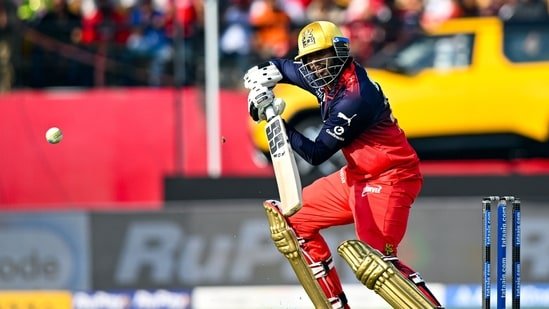
RCB did not get Venkatesh Iyer when his market was at its hottest. They chased him when Kolkata Knight Riders bought him back for ₹23.75 crore before IPL 2025, after a bidding war in which RCB stayed involved deep into the premium range.
One year later, the same player arrived in Bengaluru for ₹7 crore after a steep auction correction. Against PBKS, Venkatesh finally gave RCB the kind of ledger-backed night that explains why Andy Flower’s side had kept chasing him.
RCB’s long Venkatesh Iyer bet finally gets its ₹3.80 crore defence
Venkatesh’s 73 not out off 40 balls in Match 61 was not only a strong batting performance. It became the first clean financial defence of RCB’s long pursuit. Our monetary ledger valued his innings at ₹3.80 crore on a rating-adjusted basis. His match cost stood at ₹1.75 crore. That left RCB with a profit of ₹2.05 crore from one game.
RCB had once pushed KKR deep into a premium auction battle for Venkatesh. They lost him at ₹23.75 crore. After one poor season at KKR, his valuation crashed. RCB returned, bought him for ₹7 crore, and then watched him deliver more than half that auction price in our modelled value in one night.
The move carried history. Venkatesh Iyer had been part of KKR’s title-winning 2024 setup, but his 2025 season did not justify the massive price tag. He scored 142 runs in 11 matches at an average of 20.29 and a strike rate of 139.21. KKR moved on from a player they had once broken the bank for. RCB took the other side of that market.
Flower had already made RCB’s thinking clear. After RCB finally signed Venkatesh, he said it was “two years running” that they had battled KKR for him, adding that both franchises rated him highly. He also pointed to Venkatesh’s competitive spirit, cricketing intelligence and leadership qualities.
Match 61 gave that belief a number. Venkatesh finished as the No. 1 player in the match by rating-adjusted worth and also No. 1 by profit/loss. His impact score for money was 95.00. The ledger placed the performance in the historic/freak band. His entire value came through batting: 96.51 raw batting impact, 95 batting score, 40 balls faced.
That makes the innings cleaner from an analysis point of view. He did one job and crushed it. He entered after RCB had a platform and converted it into 222/4. His 73* carried eight fours and four sixes at a strike rate of 182.50. The innings had a proper growth curve, too. He did not slog from ball one, nor did he waste the base. He moved from control into acceleration, then into damage.
The phase split explains why the model rewarded him so heavily. He scored 8 off 8 in his first middle-over block. He then ripped through the next middle phase with 40 off 19. At the death, he added 25 off 13. That means 65 of his 73 runs came off his last 32 balls. RCB did not merely get a finishing cameo. They got a middle-to-death conversion innings that turned a good total into a winning total.
This is where the KKR-RCB contrast becomes sharp without needing to call it regret. KKR had already seen Venkatesh’s ceiling. They had also paid the full premium for it. When the returns collapsed in 2025, they exited the position. RCB bought the same asset after the correction. They did not buy the ₹23.75 crore version. They bought the ₹7 crore version, with the same high-end upside and a far lower recovery burden.
At ₹23.75 crore, every quiet game becomes expensive. At ₹7 crore, one high-grade innings can change the season ledger. Against PBKS, Venkatesh’s ₹3.80 crore worth against a ₹1.75 crore match cost gave him a recovery rate of 217.14% for the match. In simple terms, he returned more than double his match allocation.
For RCB, this was not yet a full-season redemption. It was proof of concept. Their long pursuit was built on the belief that Venkatesh’s best version could solve a rare Indian batting problem: left-handed power, top-order flexibility, middle-over hitting and dressing-room leadership in one package. The first two appearances had not delivered enough. The third appearance finally did.
The ledger also changes how his ₹7 crore price should be read. It no longer looks like a passive buy waiting for form. It looks like a corrected market entry into a player RCB had valued even when the auction room pushed him above ₹20 crore. The franchise waited a year, got the discount, and then got the spike game.
KKR may still defend the release on the grounds of squad balance and prior output. RCB can now defend the purchase through a hard return. Venkatesh’s 73* did not erase every question around consistency, but it gave Bengaluru the exact argument they needed: when this player hits, the return is not incremental. It is explosive.
Method note
The monetary reading is based on a match-wise valuation model that compares player cost allocation with rating-adjusted performance worth. It uses batting, bowling, fielding and context inputs, along with manual performance grading, to estimate match-level return. The figures are analytical estimates, not official IPL salary accounting or franchise financial records.
