


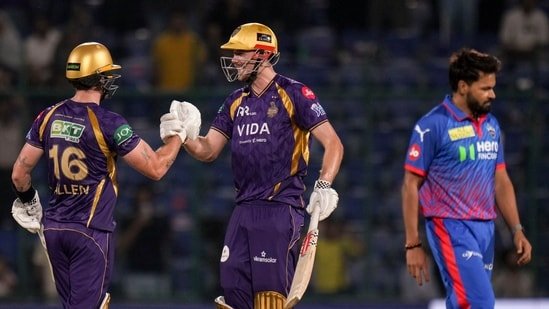
Kolkata Knight Riders kept their IPL 2026 playoff hopes alive with an eight-wicket win over the Delhi Capitals, but the larger story was not only Finn Allen’s assault. It was the pattern behind the win.
KKR chased 143 in 14.2 overs at the Arun Jaitley Stadium, with Allen making an unbeaten 100 off 47 balls. The result gave KKR their fourth win of the season and kept them in the playoff race after a difficult first half.
Ian Bishop flags KKR’s powerplay anomaly
Ian Bishop noticed the deeper trend in KKR’s wins in IPL 2026. “I don’t know how far KKR can push for a playoff spot; but happy to see a team buck the trend and not win the Power play, yet still win 4 of their games anyway. Helps to be chasing middling totals and/or your bowling group doing a great job. Very Gujarat Titans like,” Bishop wrote on X (formerly Twitter).
The point was not about one match. It was about how KKR have won this season.
Against DC, they did not win the powerplay. Delhi were 55/1 after the first six overs. KKR were 43/2 in reply. DC had the better first six overs, but KKR won with 34 balls left.
KKR have won four matches without winning the powerplay
KKR’s four wins have come without a single powerplay win. Against Rajasthan Royals, RR were 63/0 after six overs, KKR were 51/3 in reply. Against Lucknow Super Giants, LSG were 37/1, while KKR were 31/3. Against Sunrisers Hyderabad, both sides were 71/1 after the powerplay. Against DC, KKR again trailed in the phase.
So the split is clear: KKR have lost the powerplay in three of their four wins and tied it once. They have not won the powerplay in any of those victories.
In IPL 2026, the powerplay has been a strong indicator of match control. Teams that win the first six overs usually carry that advantage deep into the game. KKR are winning through a different route.
The explanation lies in what happens after the powerplay. Against RR, Rajasthan went from 63/0 to 155/9. KKR took 9 wickets for 92 runs after the first six overs.
Against SRH, Hyderabad were 71/1 after the powerplay and were bowled out for 165. KKR took 9 wickets for 94 runs after the first six. Against DC, the squeeze was even sharper. Delhi were 55/1 after six overs and finished at 142/8. They scored only 87 runs and lost seven wickets in the final 14 overs.
That is the pattern for the three-time IPL champions in this edition. KKR are losing the powerplay and then pulling the match back through the middle overs and the back end.
Finn Allen gave KKR’s model a harder edge
Before the DC match, KKR’s wins were mostly built around containment. They kept targets in the 155-166 range and found a way through. Allen changed the formula’s look.
His unbeaten hundred turned a modest chase into a heavy win. KKR did not just recover from losing the powerplay; they managed to get a huge net run rate boost.
KKR’s model needs batting violence to travel further, and that seems to be arriving just at the right time. Bowling can keep them alive, but a batter in Allen’s form can change the ceiling of the side.
Bishop’s Gujarat Titans comparison works in one clear sense. KKR are winning through bowling control, chaseable totals, and fast recoveries after ordinary starts. But the comparison has limits.
GT’s wins have been built on a repeatable structure. KKR’s current run is still more fragile. Losing powerplays repeatedly is not a sustainable comfort zone. Against stronger batting units. A 55/1 start can become 75/0/ Against stronger bowling attacks, 45/2 can become 50/4.
So, while Bishop’s tweet captures the story well, it also exposes the risk.
KKR have found a route that goes against the usual IPL pattern. Their bowling has been good enough to erase early deficits. Their latest win showed what happens when that control is followed by a match-breaking innings. For now, Bishop’s theory holds and looks like an interesting pattern. KKR have four wins without winning a powerplay. That is rare, risky and central to their late-season push.
