



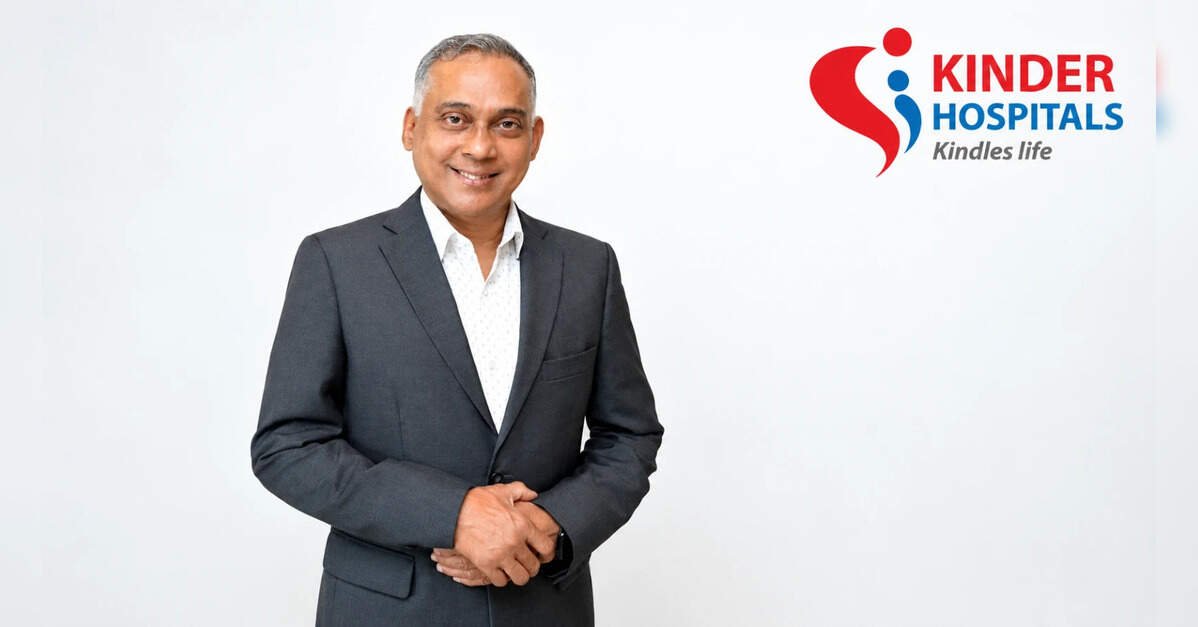
Rooted in Singapore and established in Kerala since 2011, Kinder Hospitals is pursuing a state-wide expansion strategy built around specialised maternal, fetal, neonatal and paediatric care, with accessibility and clinical quality at the centre of its healthcare proposition.
Kerala has one of India’s more mature healthcare ecosystems, with high health awareness and relatively broad access to primary and secondary care. The next layer of demand, however, is increasingly around specialised care: high-risk pregnancies, fetal medicine, neonatal intensive care, paediatric critical care and advanced women’s healthcare.
Kinder Hospitals is looking to build its next phase of growth around these areas.
With its origins in Kinder Clinic Pte. Ltd., Singapore, Kinder entered Kerala with its first centre in Cherthala in 2011. It has since expanded to Kochi, Kollam and Aranmula and is planning a wider network across the state, including proposed centres in Kottayam, Thrissur, Wayanad, Kozhikode and Palakkad.
“Our roots are in Singapore, and that heritage has shaped our approach to healthcare systems, clinical processes, quality and international standards. At the same time, our healthcare journey in Kerala has been shaped by the needs of the communities we serve. Our objective is to bring these perspectives together to deliver specialised care that is clinically strong, accessible and relevant to Kerala,” says Dr. Vethody Kumaran Pradeep Kumar, Chairman, Kinder Hospitals.
For Kinder, the objective is not simply to create more healthcare infrastructure.
“Every new facility has to answer a fundamental question: does it improve access to the right care at the right time? Infrastructure by itself is not the measure of success. Clinical capability, timely intervention, patient experience and affordability are equally important,” Dr. Pradeep Kumar says.
AFFORDABILITY AND THE MAA JEEVANA INITIATIVE
Affordability forms an important part of Kinder’s healthcare philosophy, particularly in women’s healthcare, where the cost of surgery or specialist treatment can become a barrier to timely care.
“No woman should be deprived of quality healthcare because she cannot afford it,” says Dr. Pradeep Kumar. “We believe access to good healthcare should not depend solely on a person’s financial circumstances.”
That philosophy also finds a direct expression through Kinder Maa Jeevana, a CSR initiative that provides free gynaecological surgeries and other general surgical procedures to underprivileged women.
“Maa Jeevana is our effort to address a very practical gap. There are women who require surgery but may postpone or forgo treatment because they cannot afford it. Through this initiative, we want to make essential surgical care accessible to those women,” Dr. Pradeep Kumar says.
While Maa Jeevana represents a direct CSR intervention, Kinder’s larger strategy is focused on building sustainable specialised healthcare infrastructure that can serve a wider population.
BUILDING A CONNECTED REGIONAL NETWORK
Kinder’s expansion strategy is based on taking specialised mother-and-child healthcare closer to communities while linking regional centres to deeper clinical capabilities.
Kochi serves as the flagship centre for advanced maternal, fetal and paediatric care, with specialised surgical and critical-care capabilities.
Cherthala remains the foundation of Kinder’s Kerala presence, while Kollam is intended to strengthen access to specialised maternal, neonatal and paediatric services in South Kerala. Aranmula is being developed as a mother-and-child healthcare centre serving Central Travancore.
Further expansion is planned across Kottayam, Thrissur, Wayanad, Thirur and Palakkad.
“Our expansion is fundamentally about access,” says Renjith Krishnan, Managing Director & CEO, Kinder Hospitals India. “Families should not have to travel to a major metropolitan centre simply because specialised expertise is concentrated there.”
The network model is also intended to strengthen referrals between locations.
“We are not looking at these as isolated hospitals. Each centre has a role within a larger clinical network. A patient can receive care closer to home, while cases requiring higher levels of expertise can be referred through an established pathway,” Krishnan says.
For the company, this approach is particularly relevant to maternal and neonatal care, where the time between diagnosis, referral and intervention can be clinically significant.
CLINICAL DEPTH OVER GEOGRAPHICAL SCALE
The expansion is being accompanied by investment in specialised clinical capabilities.
Kinder’s maternal healthcare portfolio includes high-risk pregnancy management, maternal-fetal medicine, prenatal screening, advanced anomaly scanning, fetal assessment, labour and delivery facilities and emergency obstetric care.
Its neonatal capabilities include intensive care for premature and extremely low birth-weight infants, advanced respiratory support and mechanical ventilation, with nitric oxide therapy and therapeutic hypothermia where clinically indicated.
The paediatric portfolio includes emergency and critical care, paediatric subspecialties, early identification of congenital and developmental conditions, growth and developmental monitoring and preventive child-health programmes.
Women’s healthcare services extend to gynaecology, minimally invasive laparoscopic and hysteroscopic procedures, reproductive medicine and fertility care, and preventive screening.
“Opening a facility is only the beginning,” Krishnan says. “The real investment is in the clinical ecosystem behind it: specialists, technology, protocols, emergency capabilities and referral networks. We want every new centre to add clinical value rather than simply increase our geographic footprint.”
The company is also looking to strengthen capabilities within existing centres as it expands.
“Our approach is to create regional centres that can manage routine care effectively while having the systems to identify and escalate complex cases quickly,” he says.
SINGAPORE ROOTS, KERALA FOCUS
While Kinder’s origins lie in Singapore, the company sees its Kerala operations as part of the state’s wider healthcare ecosystem rather than as a parallel system.
“Our Singapore heritage has given us an international perspective on healthcare delivery, quality systems and clinical standards. Kerala, meanwhile, has a strong public-health foundation and a highly health-conscious population. We see an opportunity to bring these strengths together while developing healthcare that responds to the needs of families here,” says Dr. Pradeep Kumar.
The company believes private healthcare can complement Kerala’s existing infrastructure through specialised services, advanced diagnostics, neonatal and paediatric critical care, technology and stronger referral networks.
“We are not trying to replace what already exists. Kerala has built a strong healthcare foundation. Our role is to contribute specialised capabilities and improve access where there is an opportunity to do so,” Dr. Pradeep Kumar says.
MEASURING GROWTH THROUGH ACCESS
For Kinder, the larger challenge is to ensure that expansion translates into meaningful healthcare access.
“Healthcare growth cannot be measured only by the number of hospitals or beds,” Krishnan says. “We have to look at how many families gain access to specialised care, how quickly they receive it and whether the network is delivering the clinical value we set out to create.”
That principle will become increasingly important as Kinder moves into new locations across Kerala.
“We want scale, but we want responsible scale,” Krishnan adds. “Every location has to strengthen the network, improve clinical capabilities and maintain the standards that Kinder stands for.”
The company’s longer-term ambition is to evolve from a network of hospitals into an integrated mother-and-child healthcare institution with a strong presence across Kerala and, eventually, a wider national footprint.
For Dr. Pradeep Kumar, the underlying proposition remains straightforward.
“Our ambition is to build an institution that families can trust for quality, specialised and compassionate healthcare. That trust has to come from clinical standards, accessibility and the way we care for every patient.”
From its Singapore origins to its first Kerala centre in Cherthala and its expanding presence across the state, Kinder Hospitals is now entering a new phase in which the focus is shifting from individual facilities to a connected healthcare network.
The ambition is to combine specialised clinical care, international standards and regional accessibility into a model that can serve Kerala’s mothers, women and children today and potentially provide the foundation for a larger national healthcare platform tomorrow.
Disclaimer: The above content is non-editorial, and TIL hereby disclaims any and all warranties, expressed or implied, relating to it, and does not guarantee, vouch for or necessarily endorse any of the content.
