



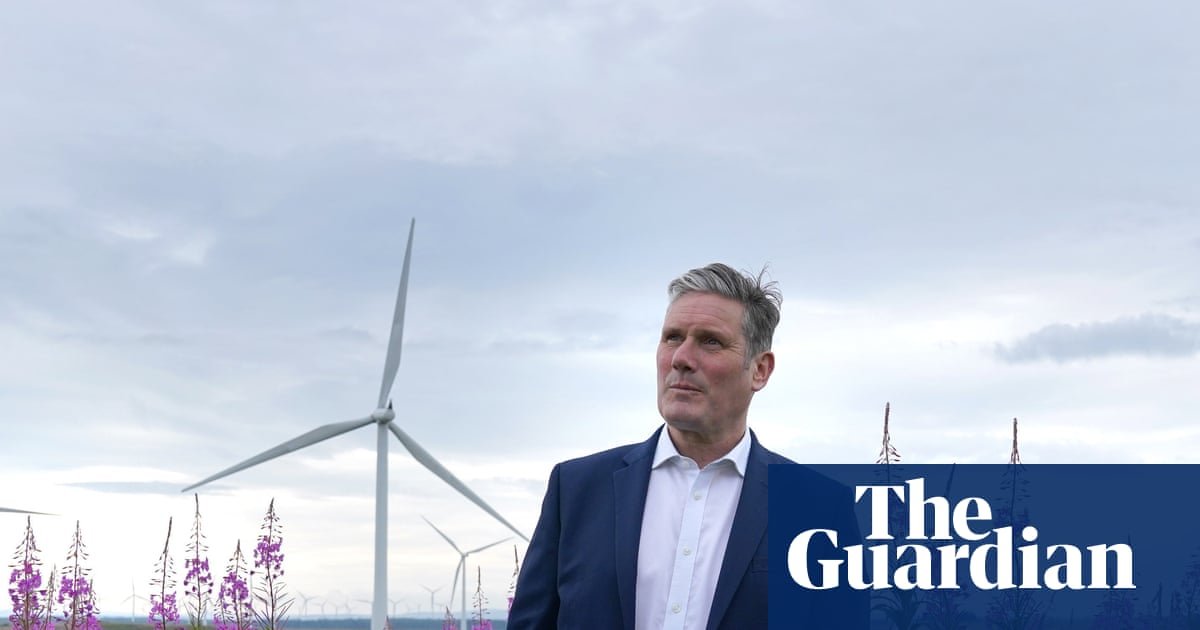
Less than a year ago, Keir Starmer stood in front of an audience of senior officials and business leaders from 60 countries in London to declare climate action was “in the DNA of my government”.
Vowing to go “all out” for net zero and to “accelerate” while others were slowing down, the Lancaster House speech was his strongest intervention yet on the issue. “We’re paying the price for our overexposure to the rollercoaster of international fossil fuel markets,” he said. “Homegrown clean energy is the only way to take back control of our energy system.”
For many who know Starmer, that speech reflected his genuine and rationally thought-out view. Climate action is not only necessary but economically beneficial, and can help the UK avoid future cost of living crises – arguments he has made in private as well as in public.
But throughout his premiership, Downing Street has also been home to senior advisers sceptical about green issues. They have sought to stifle Starmer’s pro-climate interventions, watered down environmental policy and tried to steer Labour towards Reform and the Conservatives’ anti-net-zero stances.
That faction has now seen the results of its actions. The safe Labour seat of Gorton and Denton has swung decisively to the Green party. Labour’s internecine fighting left it vulnerable and its messaging confused: Reform targeted the Labour seat, but the Greens – with a message of hope, faith in public services and strong environmental action – romped to victory.
Starmer is now facing renewed questions over his leadership. With the Greens taking their first byelection seat, he faces stark choices. Will he reassert his pro-climate instincts? Is there enough time to ditch the anti-green advice that has brought him to this point?
Ami McCarthy, head of politics at Greenpeace UK, said Labour must try to reset, and urgently. They said: “The message from Gorton and Denton to Westminster is loud and clear: people are hungry for change. This is a victory for people power over billionaires and big polluters, for the politics of hope over the politics of hate, for decency over denial and division.
“More than twice as many votes went to parties determined to tackle the climate crisis than to Reform, showing the limited public appeal of Nigel Farage’s climate-denying, renewable-hating, Trump-loving platform. And there’s a clear lesson here for Labour too: if they want to regain ground from the Greens, they need to offer the bold solutions on cost of living, climate and nature that people are clearly looking for.”
Asad Rehman, the chief executive of Friends of the Earth, said Labour must understand that its policies on the cost of living should be presented in a pro-net-zero light, as that is how voters see them. He said: “In the run-up to the byelection, people [said] making their homes warmer to bring down their bills, better public transport, improving green spaces and strengthening local communities are among their top priorities.
“We need politicians who push for affordable and achievable green policies such as ramping up renewables and making polluters pay for action to tackle the climate crisis they’ve caused.”
So how did Labour get it so wrong? The recent history of Starmer’s green agenda reveals how the prime minister has ended up outflanked by the charismatic Green leader Zack Polanski. For figures within Downing Street, the Lancaster House speech last April should really not have happened – messages about “net zero” being in Labour’s DNA were contrary to the direction they believed the party should take, which was to tack increasingly towards Reform. Tellingly, it was scarcely pushed on the news “grid” of important announcements that governs the press office and went largely unreported in British media.
Not quite six months later, in September, that same No 10 operation took a much more active interest in another climate event: the Cop30 UN climate summit in Brazil. Starmer, journalists were firmly told, would not be attending. The climate could get on without him; he was busy.
Those briefings proved wrong. Starmer did go to Cop30, just as he had attended Cop29, his first as prime minister, and Cop28 as leader of the opposition.
The briefings were no accident, however. They followed months of increasingly intense leaks and briefings against the energy secretary Ed Miliband, and against climate and environmental commitments more broadly.
Ever since Starmer looked likely to take office, a faction within his government worked against his green agenda. The most influential figure in that group, the Guardian understands, was Morgan McSweeney, the recently departed chief of staff.
McSweeney was one of the architects of the Labour Together movement that emerged in 2015. Countering Labour’s hard left, whose champion Jeremy Corbyn won the party leadership after Miliband’s general election defeat, Labour Together came from the Blue Labour tradition, and the environment was never a priority for the group.
“It was seen as something for the Lib Dems – not a social justice issue, not a hard campaigning issue, not core Labour to their mind,” one observer said. “Labour was urban; the countryside was for the Tories,” a former campaigner added.
McSweeney also cultivated links with Peter Mandelson – understood to have contributed to his resignation – and with Tony Blair, Labour’s most electorally successful prime minister. Mandelson’s advisory firm Global Counsel has numbered BP and Shell among its clients. Blair, whose thinktank has been funded by and has advised petrostates, last year attacked aspects of net zero policy, declaring “any strategy based on either ‘phasing out’ fossil fuels in the short term or limiting consumption is a strategy doomed to fail”.
McSweeney was instrumental in the downgrading of Labour’s key pre-election commitment, made in 2021, to spend £28bn a year investing in the UK’s green economy. That was reduced, less than six months before the general election, to a pledge to spend roughly half as much.
Yet Starmer took his own views from a wider range of sources than McSweeney and Labour Together, including Miliband, economists and business leaders, who argued that the UK would benefit from pursuing policies that boosted the green transition. Rachel Reeves followed suit in declaring in 2021 that she would be “the first green chancellor”.
Despite this, Starmer’s record on the climate has been broadly positive, according to campaigners. McCarthy said: “He deserves huge credit for making the bold clean power 2030 target one of the government’s key missions. We have seen record-breaking auctions for renewable energy, delivering new solar power at less than half the price of new gas. Along with new incentives for heat pumps and insulation, this plan can deliver lower energy bills and green jobs while reducing our dependence on gas markets dominated by dictators like Putin.”
On nature conservation, praise is harder to find. Attacks on “bats and newts” as hindrances to development, and the loosening of key protections, have raised questions over his judgment in a country where voters pride themselves on a love of animals.
Shaun Spiers, of the Green Alliance thinktank, said: “The prime minister was wrong to pit growth against nature, and the chancellor wrong to keep doing so. It is tragic that Starmer’s government is taking so much of its planning policy from opaquely funded rightwing campaign groups and thinktanks.”
With McSweeney gone, it is for Starmer to decide whether to follow his instincts or the urgings of other interests. Though some sections of the media have been keen to highlight any flicker in public support for net zero, backing remains remarkably resilient. Research by King’s College London in February found roughly two-thirds of the British public want the government to reach net zero by 2050 or before.
Labour is losing more voters to the Green party and Liberal Democrats than to Nigel Farage, according to recent polling from YouGov, a trend reinforced by the Manchester byelection. The memory of the energy price spike that followed the war in Ukraine and sent the cost of living soaring remains fresh, and the promise of clean, green, homegrown energy in place of volatile imported gas retains appeal.
Robbie MacPherson, a Kennedy scholar at Harvard University and former head of secretariat for parliament’s all-party climate group, said the whole party – Starmer and any potential rivals – should take heed, return to Starmer’s instincts and embrace Labour’s “DNA” in pursuing net zero and tackling the cost of living.
He said: “Delivering and building on the ambition in Labour’s 2024 manifesto should be the priority of every elected Labour politician – it’s the best way to keep power and beat Reform.”


