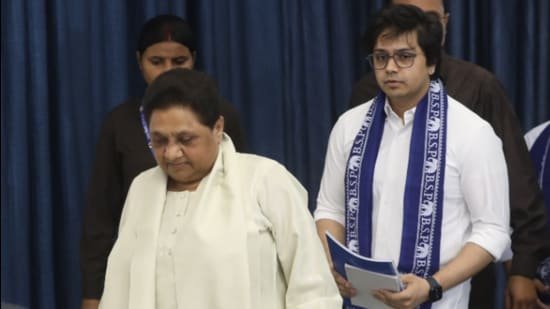
In 1996, the Bahujan Samaj Party (BSP) was on the rise when a beleaguered Congress sought an alliance for the Uttar Pradesh assembly elections. The BSP obliged. By then, the BSP had shared power with the Samajwadi Party (SP) for a year and 181 days and the Bharatiya Janata Party (BJP) for 137 days. The BSP was in demand for clout among the Bahujan Samaj, or the marginalised sections of Dalits, Scheduled Tribes (STs), Other Backward Classes (OBCs), and religious minorities, and its leadership was not averse to forging alliances with parties across ideological divides.
Bahujan Samaj Party chief Mayawati. (X)
The Congress-BSP alliance was described as a surrender to a 12-year-old party. But it held out hope for the declining Congress, whose vote share in Uttar Pradesh plummeted to 8% in the April 1996 Lok Sabha elections. Congress leaders from across the country campaigned for the BSP-led alliance. The Congress passed a resolution promising a secular and stable government under Mayawati with a development-oriented administration.
In return, BSP founder Kanshi Ram sought support for the Congress, as the two parties held joint rallies that drew huge crowds. The pre-poll electoral alliance collapsed within two months. It failed to get a majority in the state assembly. The BSP dumped the Congress and joined hands with the same “communal” BJP it had vowed to oust, forming the government.
Mayawati called the Congress the first Manuvadi party, or the adherent of a structured and hierarchical social order. She said the then Prime Minister PV Narasimha Rao sought the alliance to check the Congress’s further downfall.
In her book on her struggles and the Bahujan Movement, Mayawati wrote that a powerful Congress with a vote share of 48% in the early 1980s ridiculed the BSP and its leadership as it polled barely 2.4% in its first election in 1985. “Soon, the Congress leadership realised its growing popularity with the Bahujan Samaj as it rose to over 20% in the 1996 Lok Sabha elections while they fell from 48 to 8% [in Uttar Pradesh].”
The BSP progressed and formed a majority government in 2007, while the Congress remained on the decline. Ahead of the 2027 assembly polls, the Congress has sent out feelers to the BSP for a possible tie-up, rocking its alliance with the SP. In a reversal of fate, the BSP has now declined. The Congress showed some signs of recovery in the 2024 Lok Sabha polls in alliance with the SP.
The Congress-SP alliance won 43 of the 80 Lok Sabha seats in Uttar Pradesh and polled 43.52% of the votes. The Congress won six of the 17 seats it contested and polled 9.46% of the votes. The BSP, which contested on its own, secured 9.39% of the votes but failed to win any seats.
Some Congress leaders favour a tie-up with the BSP even though Congress leader Rahul Gandhi and SP chief Akhilesh Yadav share a close relationship. A group of Congress leaders visited Mayawati’s residence last month but were snubbed. Is it possible that this happened without the knowledge of the Congress leadership? Or is it a pressure tactic to get more seats?
Some Congress leaders compare the situation with Tamil Nadu, where a senior leader opposed a pre-poll alliance with the Tamilaga Vettri Kazhagam (TVK) and stuck with the Dravida Munnetra Kazhagam (DMK). The Congress allied with TVK when it swept to power last month.
Is something cooking in Uttar Pradesh, and why? The SP polled 33.59% of the votes compared to the BSP’s 9.39% in the 2024 Lok Sabha polls. The SP won 111 seats in the 2022 assembly polls and 37 Lok Sabha seats in 2024. The BSP has one assembly member and no representation in the Lok Sabha. Then why the BSP? Mayawati’s votes are transferable. She is flexible in forming alliances, as her guiding force has been power, not ideology. Mayawati struck deals with the BJP thrice.
A more plausible reason for Congress’s keenness to ally with the BSP could be a possible alliance also in Punjab and Uttarakhand as well. The BSP allied with Shiromani Akali Dal in Punjab and polled 1.77% votes in 2022. In Uttarakhand, it secured 4.77% votes in a direct fight between the Congress and the BJP the same year.
In her book, Mayawati wrote that they can think again on adjustments with the BJP only if it renounces its Manuvadi traits and removes small-time leaders, who create a rift, without naming anyone. The BJP has changed since. And now it is not Mayawati, but the BJP, which will dictate the terms.
About the Congress, she wrote that the party should realise and pledge against repeating the mistakes of meting out step-motherly treatment to the Bahujan Samaj. What could the Congress gain from an alliance with the BSP? Some party workers believe they can rebuild the vote bank of Muslims, Brahmins, and Dalits.
The other option for Mayawati is an understanding with the All India Majlis-e-Ittehadul Muslimeen to try to bring together Dalits and Muslims. But who gains in a multi-cornered contest — the BJP.