


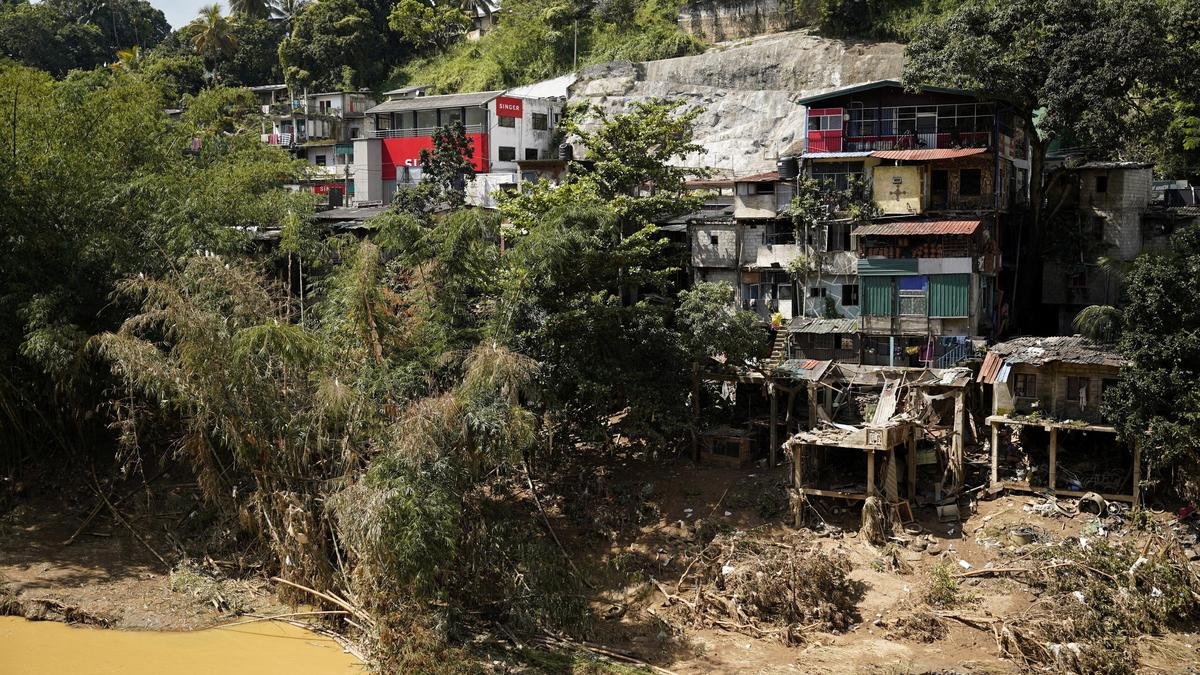
Houses damaged by the overflowing Mahaweli River following Cyclone Ditwah, in Kandy, Sri Lanka on December 4, 2025.
| Photo Credit: Reuters
Shaky social media visuals of the Rasuwa floods in Nepal have rattled the world. With over 1,250 lives lost so far — over 4,000 people are still missing — the extent of devastation is slowly becoming evident. Seeing colleagues in Nepal reporting from different locations and bringing to us fragments of information and various news angles was a stark reminder that the full story of a climate shock rarely fits into one dramatic headline.
We read about locals, tourists on holiday, and pilgrims. We see reports of governments’ outreach to help citizens, and assistance offered in rescue operations and contributions towards the herculean rehabilitation effort that awaits the country. We see social media posts from those seeking information about their missing loved ones.
While we share the risks of the growing climate crisis, each climate shock shows us that the world we live in is unequal and unfair. Soon after the flash floods, news outlets highlighted Nepal’s negligible contribution to climate change – accounting for 0.1% of total global greenhouse gas emissions. A point to ponder before we are drawn to unsubstantiated claims or conspiracy theories.
Reports of at least 900 workers believed to be trapped at 12 hydropower projects affected by flash floods in the districts of Rasuwa and Nuwakot brought back memories of Cyclone Ditwah that hit Sri Lanka late last year. Many of us reported from different affected areas. Each story, every life, was undoubtedly important, but the pattern that slowly emerged was hard to ignore. While the risks may have been common, vulnerabilities are different.
Among the most affected in this disaster were Sri Lanka’s Malaiyaha Tamil community, especially people working in the tea and rubber estates across the central and southern hill country. Historically marginalised, they not only contend with exploitation but are also the most vulnerable to climate shock, as Ditwah made evident.
The United Nations sought to mobilise $35 million in aid towards humanitarian assistance. The island is still rebuilding after the unprecedented floods and landslides. Some affected families stayed in temporary shelters for months, struggling to commute to the tea estates where they are employed for a daily wage. The concerns over compensation and transition to safe, permanent homes are far from gone. Ten months later, some communities tell us the cyclone is yet to pass.
Climate shock events of the magnitude witnessed in Nepal recently, or in Sri Lanka last year, draw global attention. But there are signs that show up from time to time. The stories may not be dramatic, but they are still telling.
In late 2018, districts across Sri Lanka’s Northern Province were severely hit by flash floods. Tens of thousands of people were affected; crops were damaged, and villages inundated. Neck-deep in work, the then government agent (a post similar to that of a District Collector in India) of Kilinochchi, who spared time to explain the situation to me, said: “In fact, we were giving drought relief to our people even days before the flood suddenly hit us.” As Sri Lanka prepares for the possible effects of El Niño this year, I am reminded of the GA’s matter-of-fact comment on how people and authorities were forced to combat one climate shock after another.
We have witnessed major climate shocks in quick succession in the region. The floods in Pakistan in 2022, floods in different parts of India over the last few years, the cyclone in Sri Lanka in 2025, and now, Nepal’s staggering floods. A Pakistani friend recently shared a 2009 piece from Himal Southasian on her social media. Authored by former diplomat Shyam Saran, it contended that South Asia is an ecologically interconnected system and called for a collaborative response to the climate crisis. Journalists in the region, however, have had more stories about natural disasters than collective strategies to tell.
Published – September 04, 2026 01:24 am IST
